Free printable practice
Estimating Rounding Practice Activities
Class 5 maths worksheets for estimating answers in word problems by rounding numbers sensibly before calculating.
Free printable worksheet PDFs
Preview every available page, then download the free worksheet PDF for home, homeschool, tutoring, or classroom practice.
Preview the exact activity before downloading it.
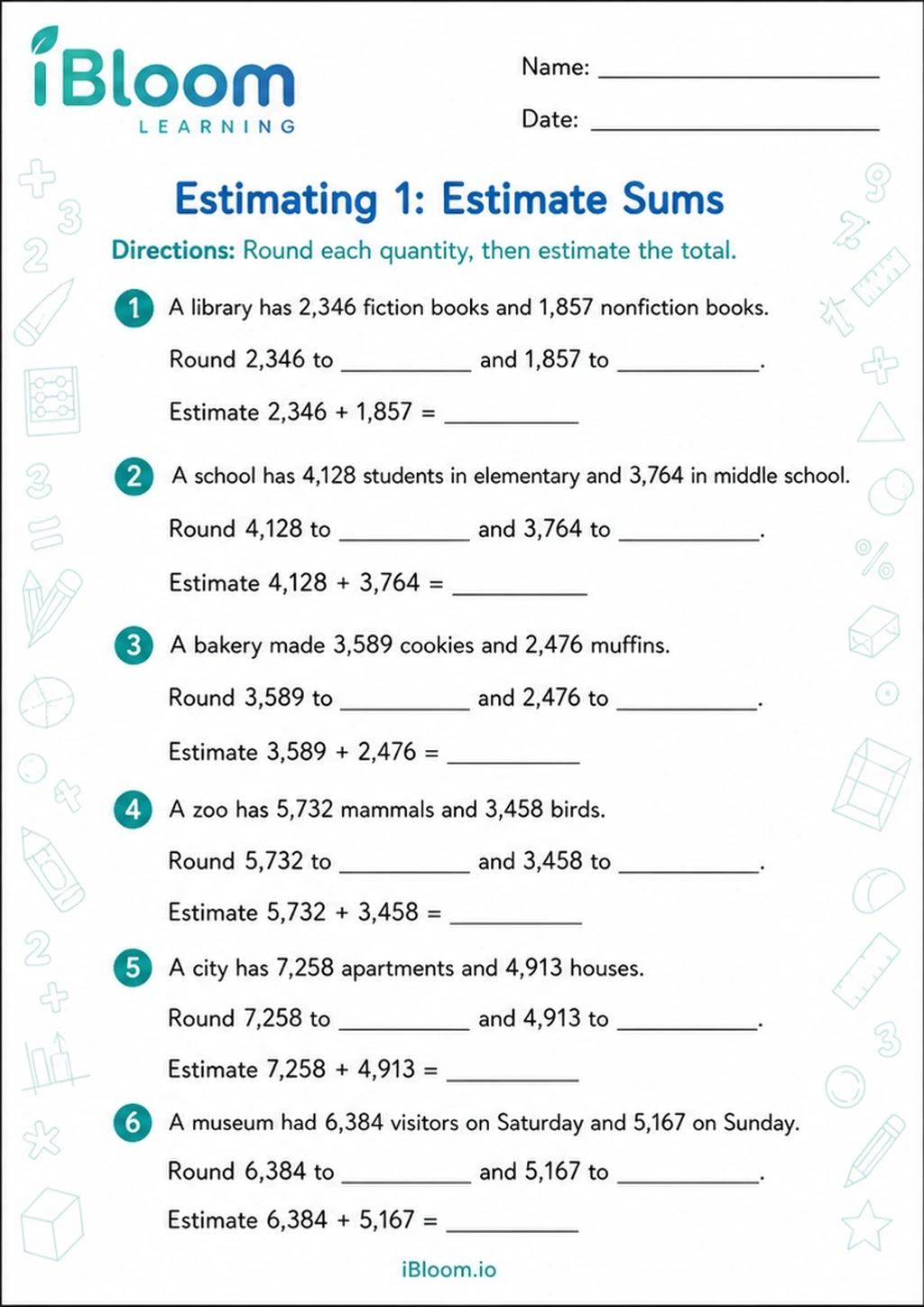 Estimating 1: Estimate SumsClass 5 printable practice for Estimating and Rounding Word Problems.Class 5Free PDF preview
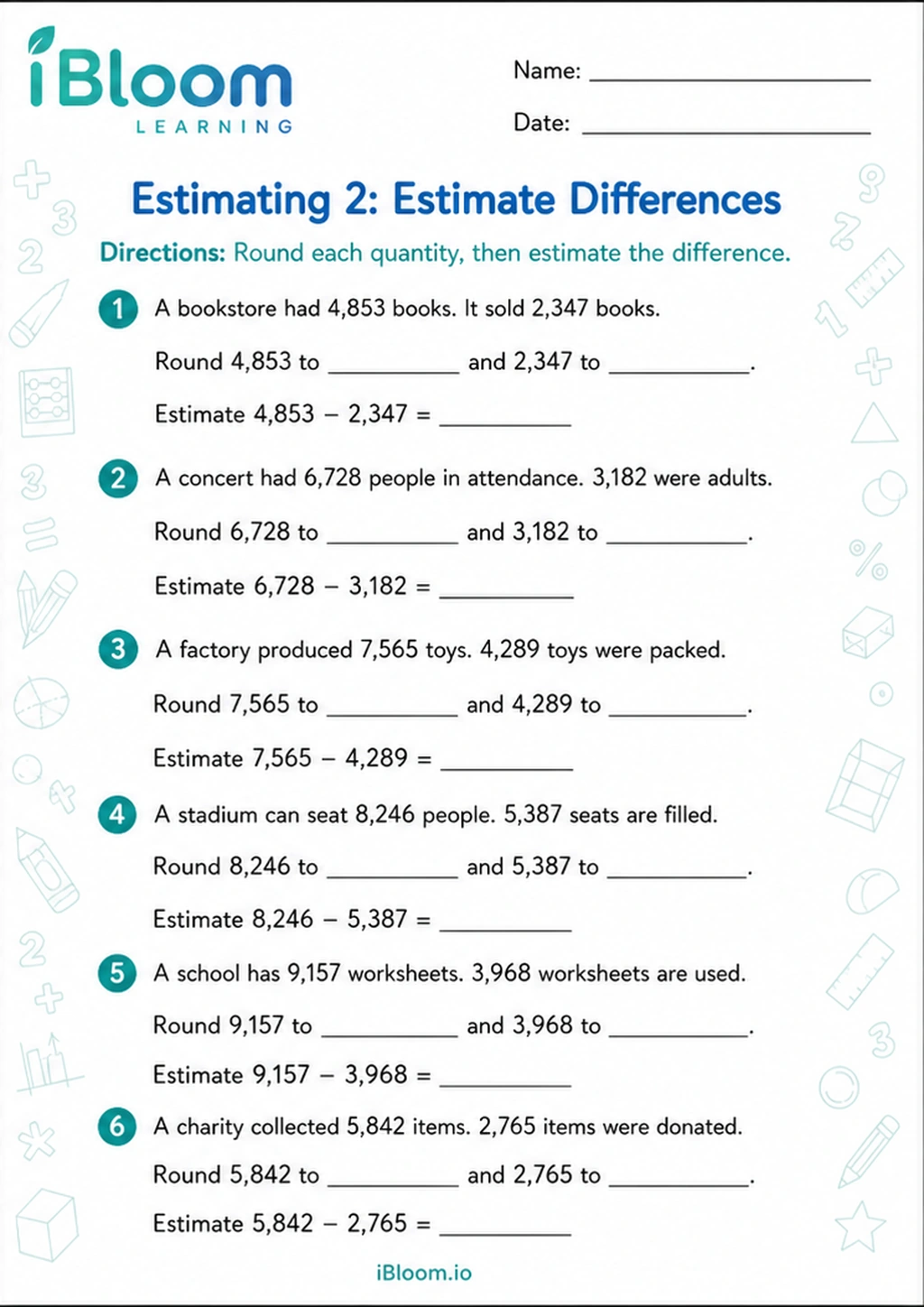 Estimating 2: Estimate DifferencesClass 5 printable practice for Estimating and Rounding Word Problems.Class 5Free PDF preview
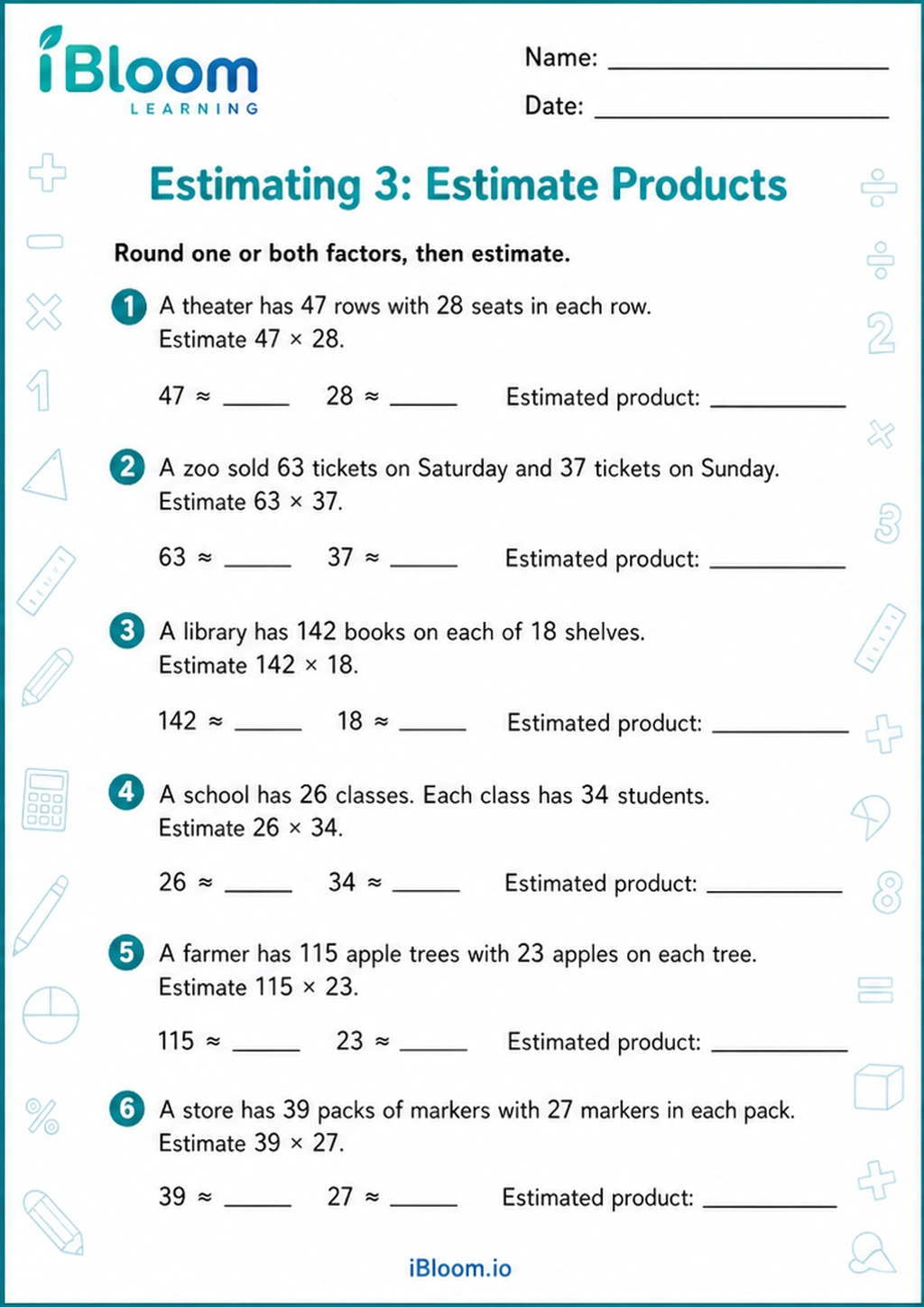 Estimating 3: Estimate ProductsClass 5 printable practice for Estimating and Rounding Word Problems.Class 5Free PDF preview
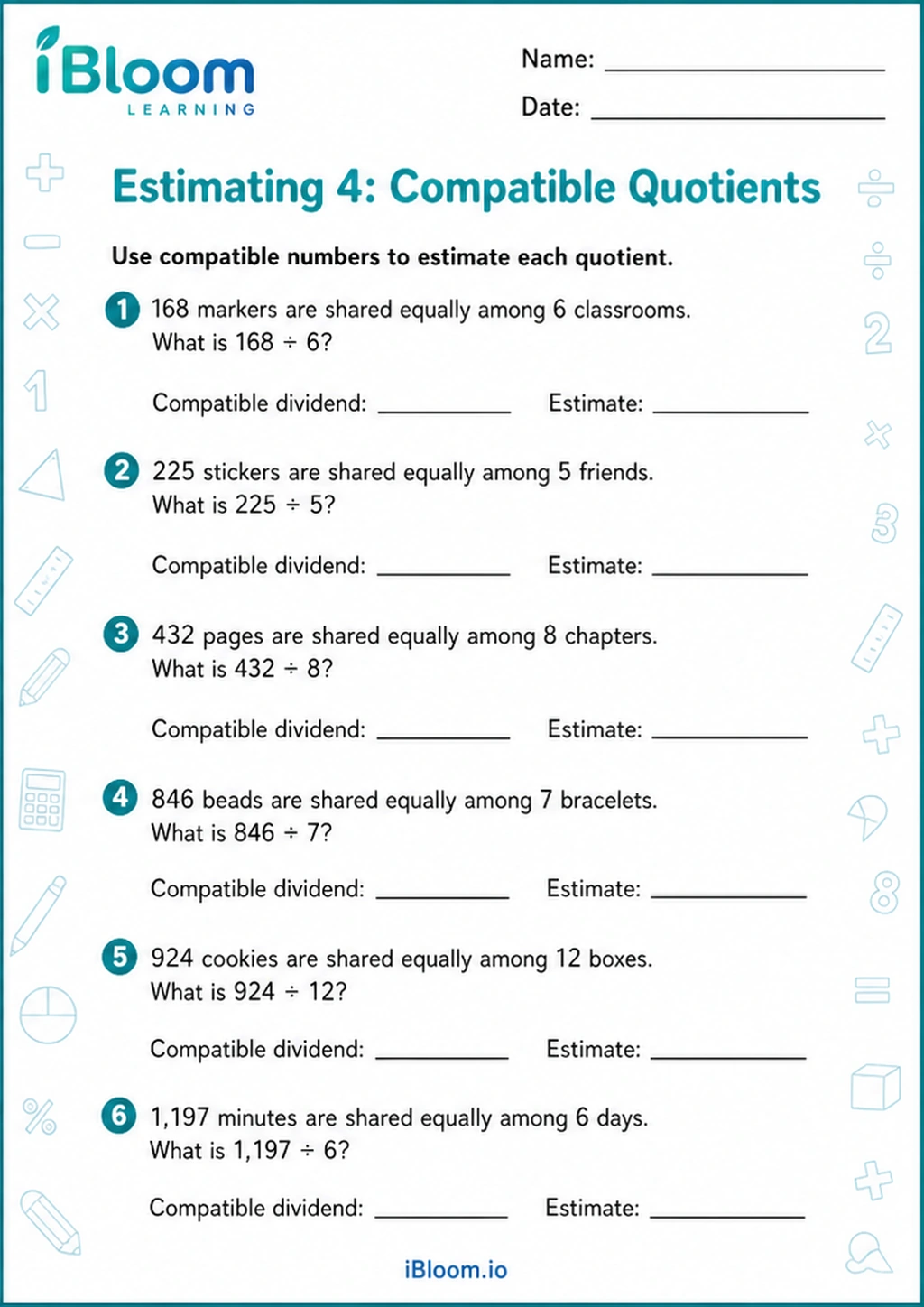 Estimating 4: Compatible QuotientsClass 5 printable practice for Estimating and Rounding Word Problems.Class 5Free PDF preview
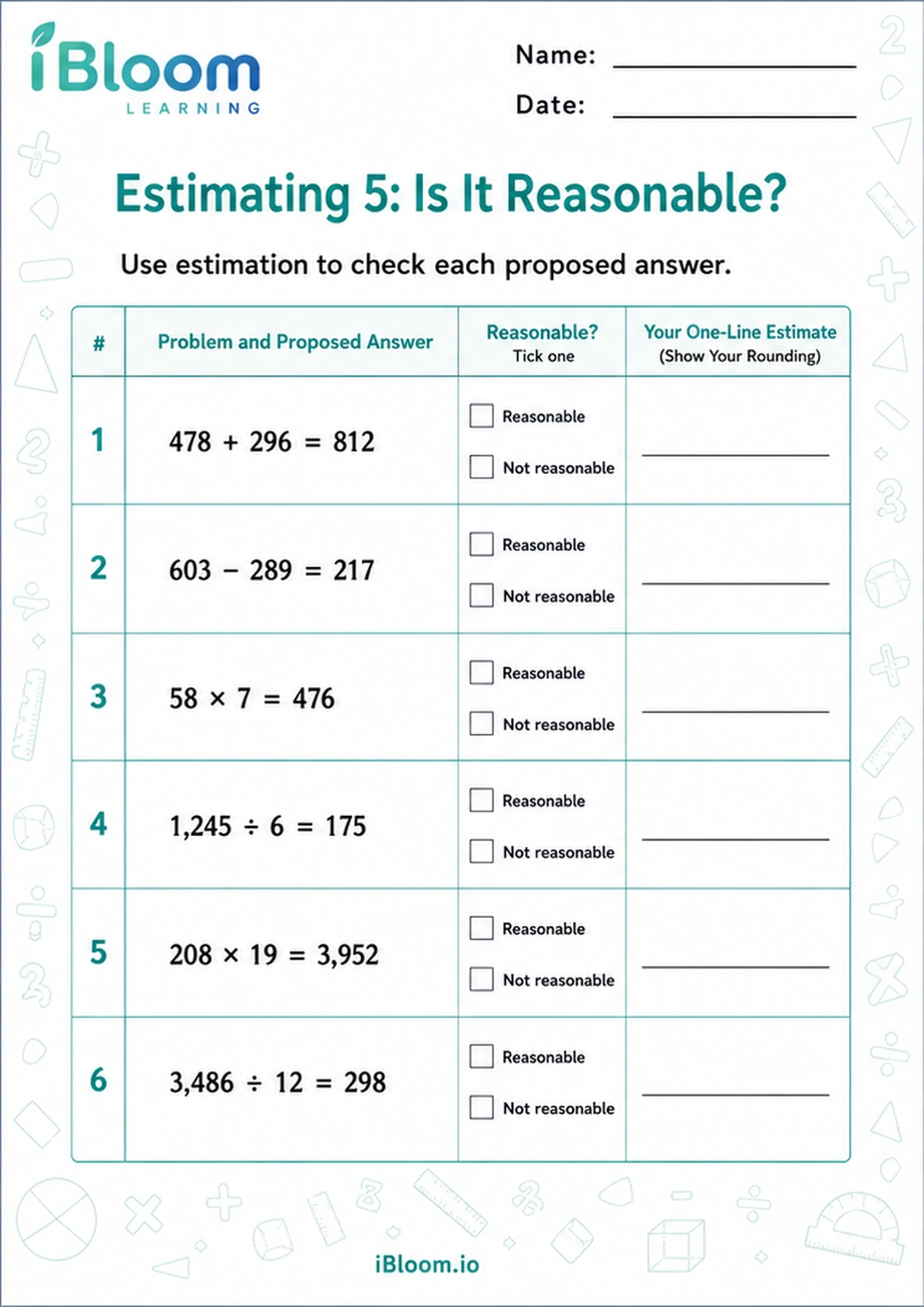 Estimating 5: Is It Reasonable?Class 5 printable practice for Estimating and Rounding Word Problems.Class 5Free PDF preview
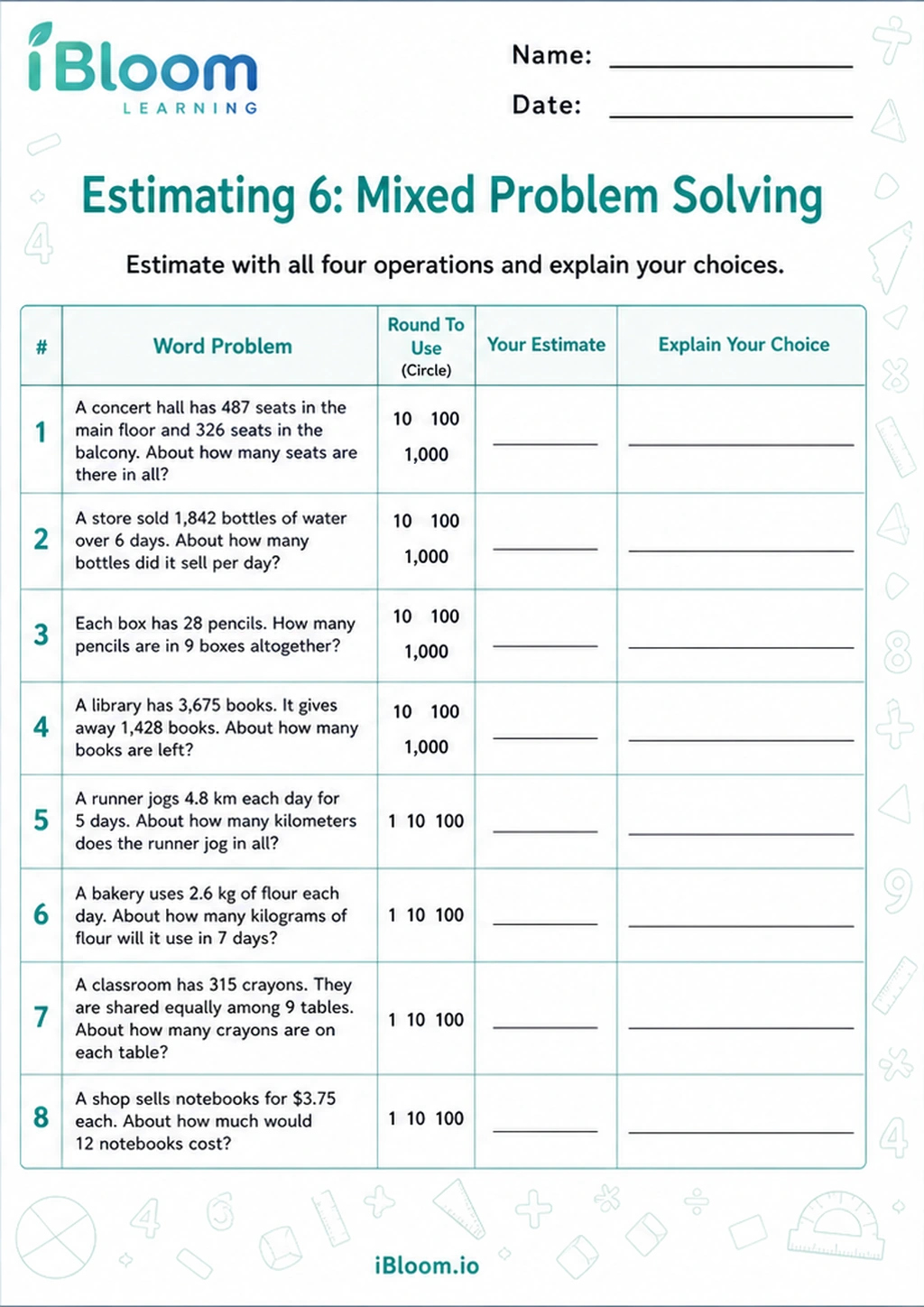 Estimating 6: Mixed Problem SolvingClass 5 printable practice for Estimating and Rounding Word Problems.Class 5Free PDF preview
Practice that builds confidence
Understanding estimation in word problems
These Class 5 maths worksheets help children use rounding as a thinking tool in word problems. They practise deciding when an exact answer is not needed, choosing a suitable place value, and checking whether a calculated answer is reasonable.
The printable activities include estimation questions based on everyday situations such as totals, differences, quantities, prices, and measures. Children read the problem, round the given numbers, solve mentally or with short working, and compare the estimate with the context.
Estimation is not random guessing. In these worksheets, children learn to simplify a word problem by rounding numbers to a helpful place value, such as the nearest ten, hundred, or thousand, then using the rounded numbers to find an approximate answer. For example, ₹486 and ₹319 can be rounded to ₹500 and ₹300 to estimate a total of about ₹800.

Building the skill step by step
The practice moves from recognising which numbers need rounding to using the rounded values in addition, subtraction, multiplication, or division situations. Children also meet questions where they must decide whether rounding up or down makes sense in context. This is especially useful in word problems where the answer may be described as “about”, “approximately”, “close to”, or “nearly”.
Parent routine for home practice
At home, ask your child to underline the important numbers, circle the question being asked, and say the rounding choice aloud before solving. Try a short routine with bills, distances, or packet quantities: “Round first, estimate, then explain.” If the exact answer is later calculated, ask, “Is it close to your estimate?” This builds number sense rather than only written accuracy.

Classroom uses for teachers
Teachers can use these printables for class practice after teaching place value and rounding, as a maths centre activity, or as a quick check before multi-step word problems. Pair work is effective: one child chooses the rounding place, while the other checks whether the estimate fits the story. The sheets also support discussion on why two sensible estimates can sometimes differ.

Common errors to watch for
Some children round every number to the same place even when it makes the problem less useful. Others ignore the operation and estimate a total when the problem asks for a difference. Watch for place-value slips, such as rounding 4,786 to 4,700 instead of 4,800 to the nearest hundred. Encourage children to write the rounded numbers clearly before solving.
Free printable PDF download
Use this Class 5 estimating and rounding word problems worksheet page to preview the activity, print it, or download it as a PDF for quick practice. It works well for homework, homeschool lessons, tutoring, morning work, revision, and classroom centers.
Answers and answer key support
After the child completes the worksheet independently, parents and teachers can use the answer support or answer key information to check the work, review mistakes, and choose the next practice step.
Why iBloom worksheets help
The iBloom activities keep the focus on reasoning through real word problems, not just isolated rounding drills. Each question encourages children to read carefully, choose an efficient estimate, use maths vocabulary correctly, and judge whether an answer is reasonable. A child-friendly strategy is: read the story, spot the numbers, round smartly, solve, and check if the answer makes sense.
Helpful answers
Frequently asked questions
What do Class 5 children practise in these estimating and rounding worksheets?
They practise reading word problems, identifying the important numbers, rounding them to a useful place value, and using the rounded numbers to estimate an answer.
Should children calculate the exact answer after estimating?
Sometimes it is helpful. First estimating builds number sense, and then comparing with the exact answer helps children see whether their solution is reasonable.
Which place values are used for rounding in this practice?
The worksheets mainly support rounding whole numbers to practical place values such as tens, hundreds, and thousands, depending on the numbers and the word problem.
How can I help if my child rounds correctly but answers the wrong question?
Ask your child to underline what the problem is asking before rounding. They should decide the operation from the story first, then round the numbers and estimate.
Are these worksheets suitable for mental maths practice?
Yes. Because rounded numbers are easier to work with, many questions can be solved mentally or with brief written working, making them useful for mental maths and reasoning.
Is this Class 5 estimating and rounding word problems worksheet free?
Yes. You can preview it for free and use the printable worksheet for home or classroom practice.
Can I download this Class 5 estimating and rounding word problems worksheet as a PDF?
Yes. Use the worksheet download option to save a printable PDF, or print the worksheet directly from the page.
Does this Class 5 estimating and rounding word problems worksheet include answers or an answer key?
When the activity has fixed answers, iBloom includes answer support so parents and teachers can check the completed worksheet.