



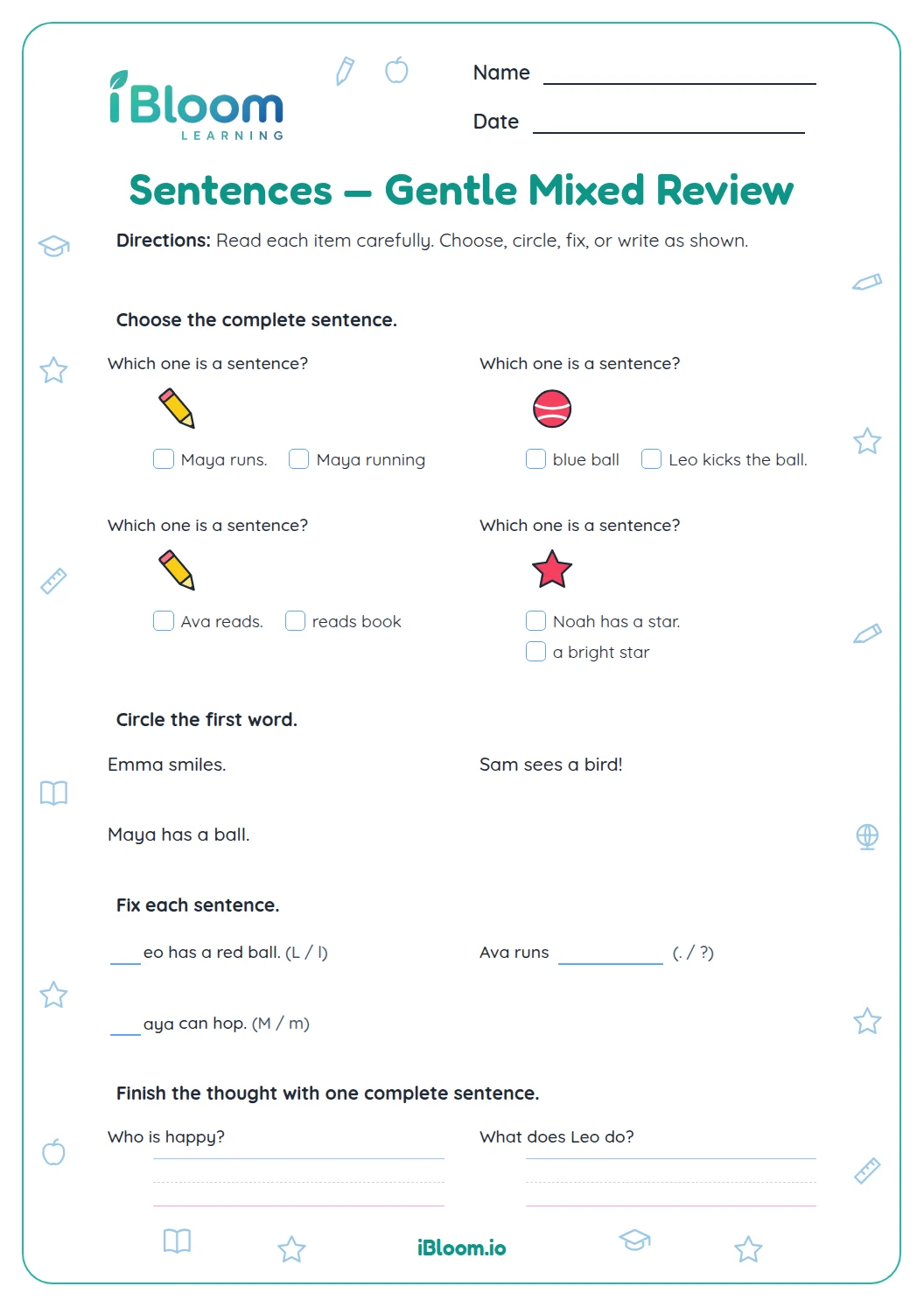
About this worksheet
This free printable worksheet introduces preschool and kindergarten children to proper nouns through people’s names. The 16 questions begin with six choices between lowercase and correctly capitalized names, supported by small face pictures and letter labels. Part B asks children to circle four names in familiar sentences, and Part C asks them to correct four names with lowercase starts. Part D invites them to write their own first name and a friend’s first name. An adult can read aloud and help with letter formation. The sheet practices names of people under Common Core L.1.2a, with a separate answer key.
Aligned to L.1.2a
What makes a person’s name a proper noun?
A person’s name identifies a particular person. Friend is a general word, while Ana names one friend. People’s names begin with capital letters even when they appear in the middle of a sentence.
Use the child’s own name as an oral example before starting. Point to its first letter, say its name and compare its capital and lowercase forms.
How do the choices teach capital letters?
Each Part A question gives the same name twice, with only the first letter changing. Labels such as “small a” and “capital A” make the letter forms explicit. Small face pictures support the people context. Read the sentence aloud, then have the child mark the correctly capitalized name.
- 1My friend is named ___.
- 2Choices: ana (small a) and Ana (capital A)
- 3Ana is a person’s name.
- 4Choose Ana because its first letter is capital A.
What should children do after choosing capitals?
In Part B, children circle Ben, Mia, Sam and Ana inside short sentences about lunch, play, the bus and reading at home. Each name appears within a sentence, so children must distinguish the person’s name from a capital at the beginning.
Part C presents mia, ben, sam and ana with lowercase first letters. Children write Mia, Ben, Sam and Ana in the blanks, keeping the remaining letters lowercase and using each sentence as a spelling guide.
Part D brings the practice into the child’s own life. Children write their first name and a friend’s first name. The key gives examples; check each child’s actual names for a capital first letter and accurate spelling.
Practice names with an adult
- 1Say the child’s name and point out its capital first letter.
- 2Read each Part A sentence aloud and compare the two versions of the name.
- 3For Part B, ask who the sentence names before circling the word.
- 4For Part C, help the child identify the first letter that needs changing.
- 5Help the child write their own first name and a friend’s first name in Part D.
- 6Compare the completed names with the answer key and say each name aloud.
Capital-letter slips to notice
The mistake
Choosing ana because all its letters are lowercase.
The fix
A person’s name needs a capital first letter: Ana.
The mistake
Circling I instead of Ben in “I sit with Ben at lunch”.
The fix
Ask which word names the person at lunch. I is capitalized, but Ben is the person’s name to circle.
The mistake
Writing MIA when correcting mia.
The fix
Capitalize the first letter and keep the others lowercase: Mia.
Common Core alignment
Begin people’s names with capital letters.
On this sheet: Children select, identify and correctly write names of people in familiar contexts.
Show the official wordingHide the official wording
Capitalize dates and names of people.
What to practice next
Make more practice
Further reading
Questions parents and teachers ask
Is this suitable for preschool children?
It works as an adult-supported activity for preschool children who are beginning to recognize letters in names. Read the sentences aloud and compare the two name choices together. For the writing section, model a capital letter on separate paper if the child needs help forming it.
Which proper nouns does the sheet use?
The fixed questions use Ana, Ben, Mia, Sam, Leo and Ava in familiar situations such as playing, reading and sharing. The last two questions ask children to write their own first name and a friend’s first name, connecting the capital-letter rule to people they know.
Why is I not the answer in the first circling sentence?
The instruction asks for a person’s name, so Ben is the answer in “I sit with Ben at lunch.” I is a capitalized pronoun, but it does not give the person’s name. Ask the child who is named in the sentence before they circle anything.
Should children capitalize every letter in a name?
For these practice names, children write the first letter as a capital and keep the remaining letters lowercase. Part C changes mia, ben, sam and ana to Mia, Ben, Sam and Ana. For personal names, follow the spelling and capitalization that the person actually uses.
What help does the answer key provide?
The separate key marks the six correct choices, circles the four names and supplies the four corrected spellings. It also gives sample names for Part D. Those last answers vary, so check the child’s chosen names for correct spelling and a capital first letter.