








About this worksheet
This printable helps preschool and kindergarten children recognize green in familiar objects and express the color through drawing. Picture choices keep the first activities concrete; drawing prompts invite children to add their own examples.
Aligned to L.K.5c
How do children recognize green?
Children connect color words with things they see in everyday life. A tree, frog, cucumber, evergreen, broccoli, palm tree, seedling, and cactus are pictured as familiar green examples on this page.
The word “usually” leaves room for real objects to vary. A picture or toy can be made in many colors, so learners use familiar examples rather than treating color as a rule for every object.
What does the worksheet ask children to do?
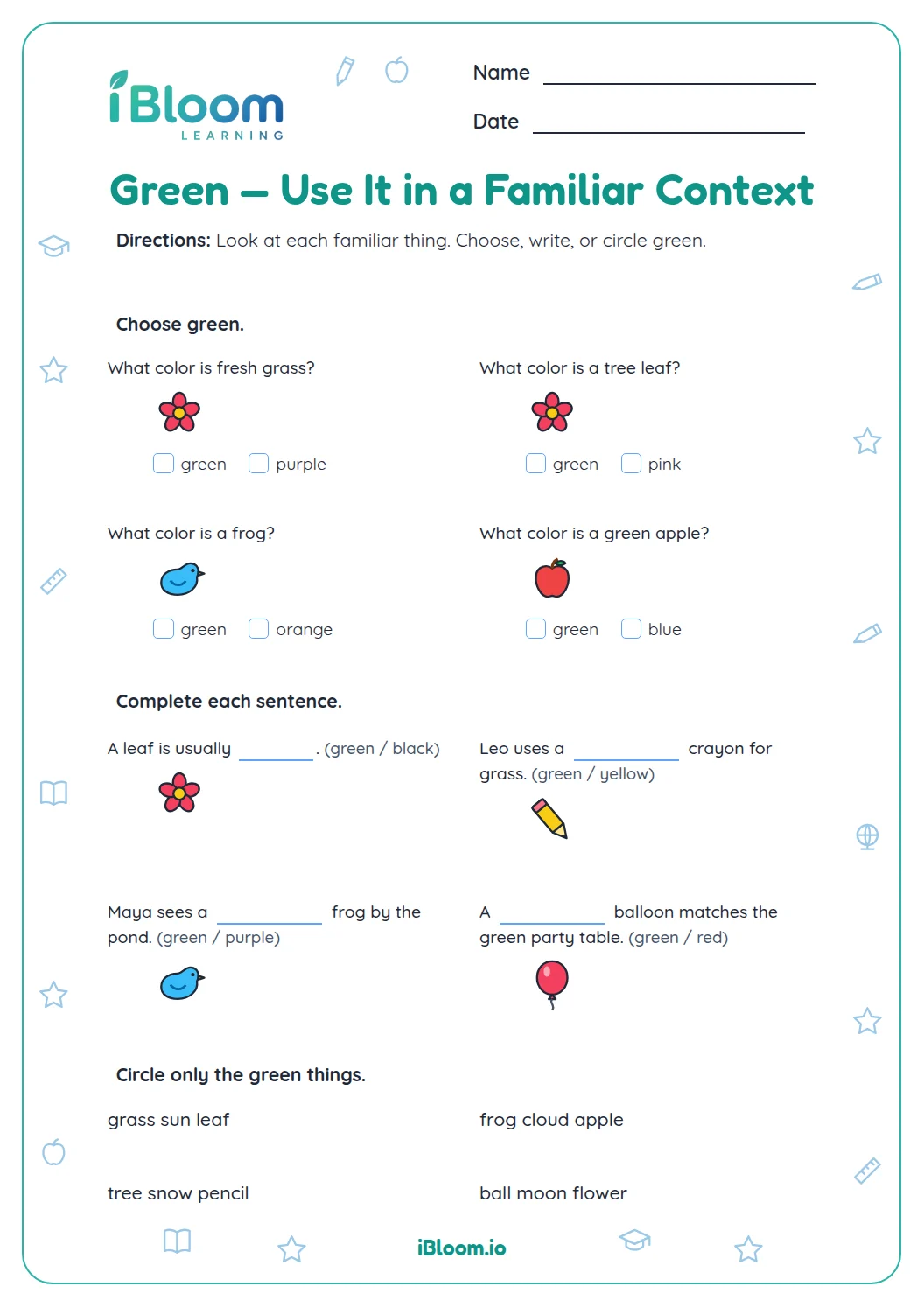
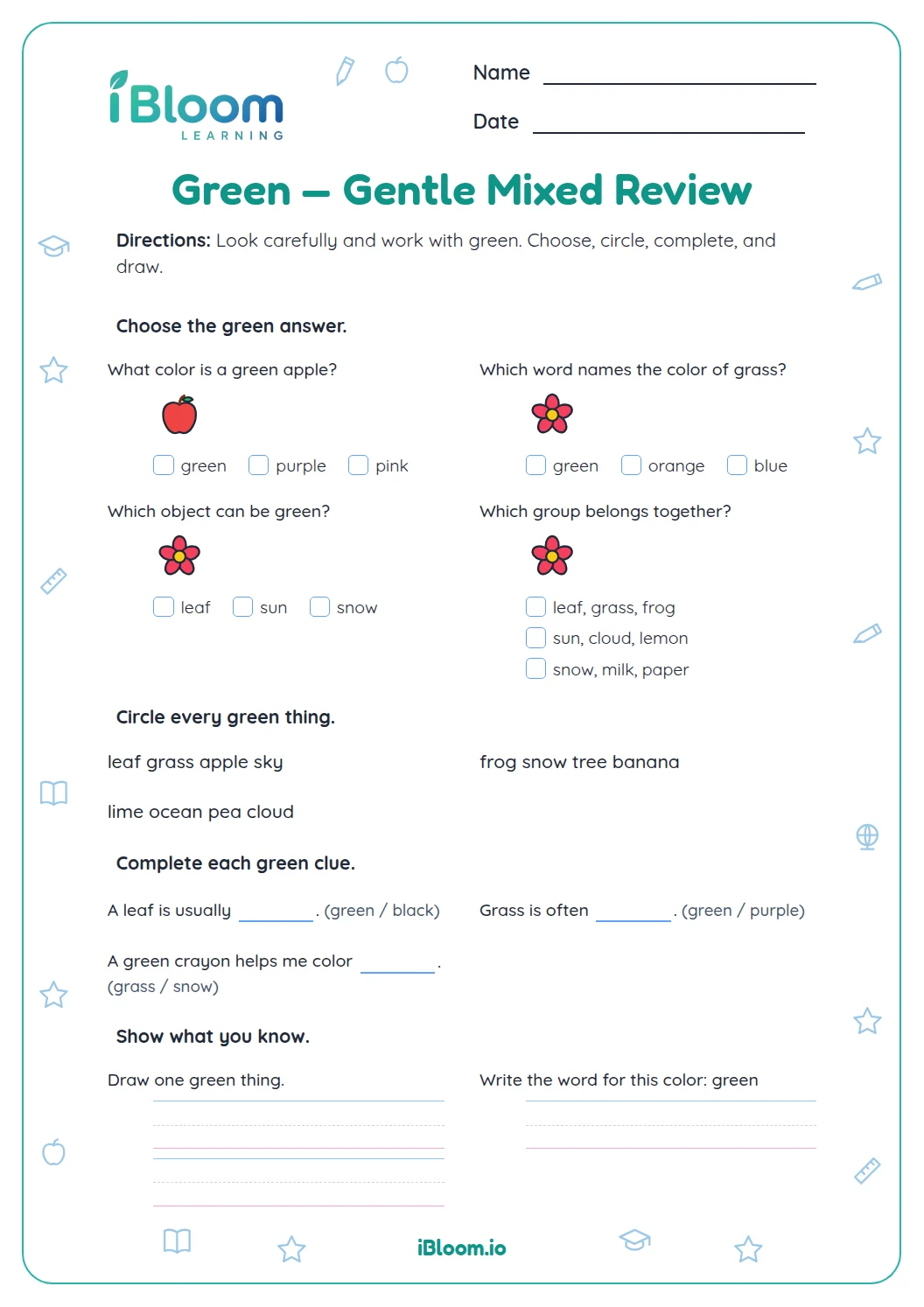
Questions 1–10 are picture-supported sentences. Choose a color word to complete each sentence; most familiar objects on the page are green. Questions 11–14 invite drawings of a green tree, frog, garden plant, or toy.
The answer key identifies the completed word and gives an example for each open drawing prompt. A child’s drawing can look different from the sample and still answer the prompt.
- 1Look at the frog picture.
- 2Complete: “A frog is usually ___.”
- 3Choose “green.”
How can an adult support the activity?
Name each pictured object aloud if a child is not reading yet, then let the child point to a choice. For the drawing prompts, invite the child to name the object and describe where its green color appears.
Accept a recognizable drawing that follows the prompt. The goal is to connect the word green with a familiar object or an idea the child can represent.
How to use this worksheet
- 1Name the pictures in a question if the child would like help.
- 2Ask which item is usually green and let the child point.
- 3For each drawing prompt, read the object aloud and draw it in green.
- 4Invite the child to name the drawing or describe its color.
- 5Use the answer key for picture choices; accept a clear drawing that fits its prompt.
Common mistakes and quick fixes
The mistake
Choosing a picture because it can be green, even when it is not a familiar green example.
The fix
Ask which choice is usually shown or found as green.
The mistake
Expecting every real object to have only one color.
The fix
Use “usually” and explain that objects can come in different colors.
The mistake
Treating the sample drawing as the only correct answer.
The fix
Accept any recognizable green tree, frog, garden plant, or toy that matches the prompt.
Early learning alignment
Children connect the color word green with familiar pictured objects and their own drawings.
Connect the color word green with familiar objects and drawings.
On this sheet: Children choose familiar green objects and represent green ideas in drawings.
Show the official wordingHide the official wording
Identify real-life connections between words and their use (e.g., note places at school that are colorful).
What to practice next
Make more practice
Questions parents and teachers ask
What does this green worksheet include?
It has 10 picture-supported sentence completions and four drawing prompts for preschool and kindergarten learners. Children complete familiar color sentences, most with green, then draw a green tree, frog, garden plant, and toy. A separate answer key gives the word and sample drawings.
Can I read the picture choices to my child?
Yes. Name each pictured object aloud and ask the child to complete its sentence with a color word. The child can point to a choice instead of reading independently. Most answers are green, while familiar color clues also help children compare.
Are the drawing prompts graded against one exact picture?
No. The key gives examples, but a child may draw another clear version of the requested object. A tree can have a different shape or number of branches and still fit the prompt if it is recognizable and shown as green.
Why does the worksheet say “usually green”?
Some objects can be made in many colors, and real plants can vary in shade. “Usually green” points children toward familiar examples without saying that every tree, toy, or other object must be green in every setting or picture they encounter.
How can I help if my child is unsure what to draw?
Read the prompt aloud and ask the child to picture the object first. For a garden plant, they might draw a stem and leaves; for a toy, they can choose a familiar toy. Invite them to name the picture and its color when they finish.