




About this worksheet
This free printable letter V worksheet gives preschool and kindergarten children ten short activities with adult support. Children trace uppercase V and lowercase v, choose the first letter of pictured words, and supply a missing v in simple sentences about music, play and books. Violin, volleyball and volcano pictures help children connect the letter to something they can name. The practice supports Common Core RF.K.1.d and RF.K.3.a through letter recognition and the consonant sound /v/. A separate answer key shows the letter for each activity.
Aligned to RF.K.1.d and RF.K.3.a
Which words will my child use?
The picture words are violin, volcano and volleyball. Before the child writes, name each picture together. Talk about a violin at music time, a volleyball at the park, and a volcano in a book. Familiar situations give the new letter a purpose.
An adult can read the full sentences. The child’s job is to listen for /v/, recognize its letter and write one missing letter.
How do we connect V with its sound?
Say the letter name, vee, then say its sound, /v/. To form V, start at the top, slant down to a point, and slant back up. Lowercase v has the same basic shape at a smaller size.
- 1I play the ___iolin.
- 2Name the violin picture and say /v/ at the start.
- 3Write v in the blank: violin.
- 4Read the finished sentence aloud.
How do the three parts build practice?
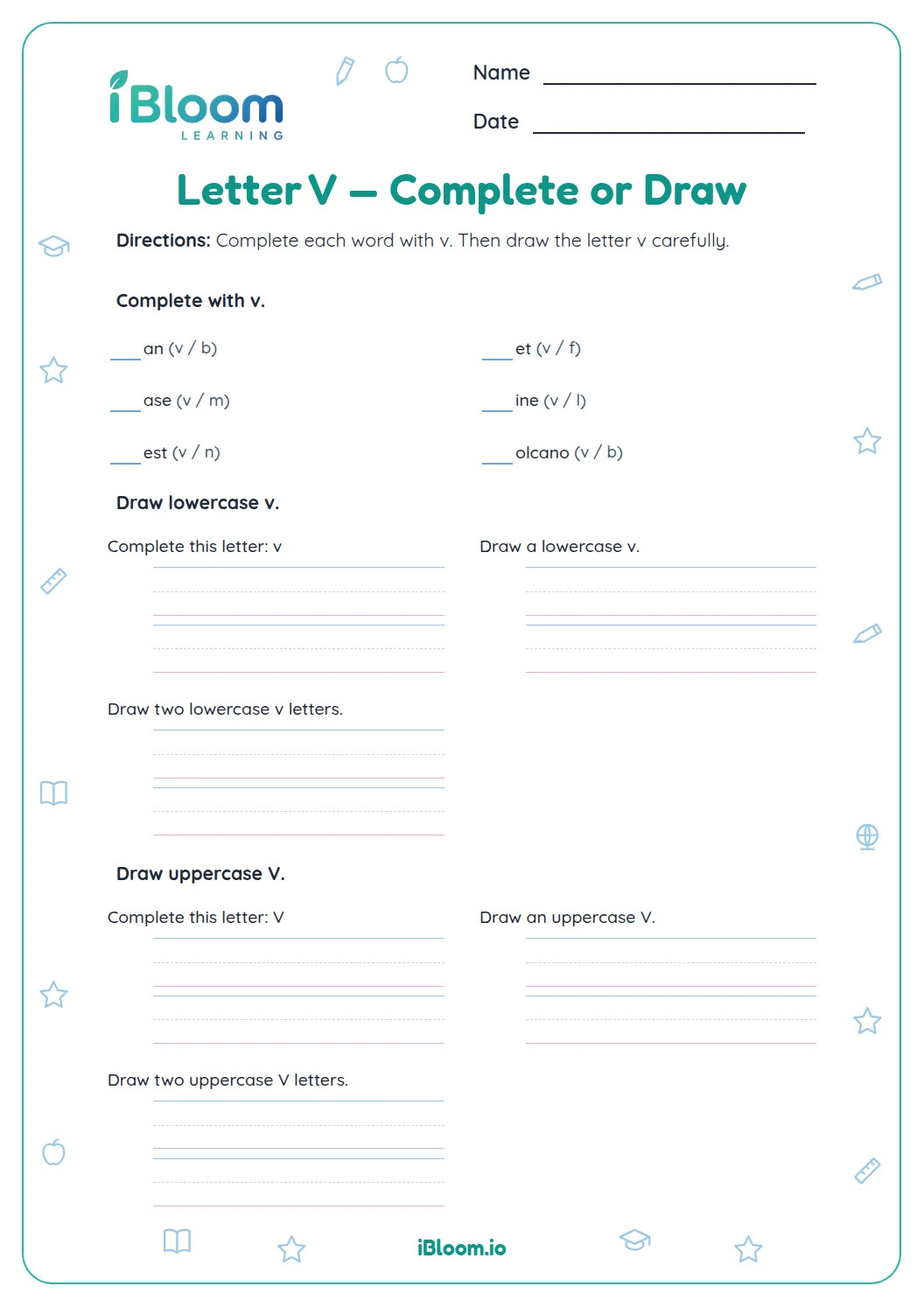
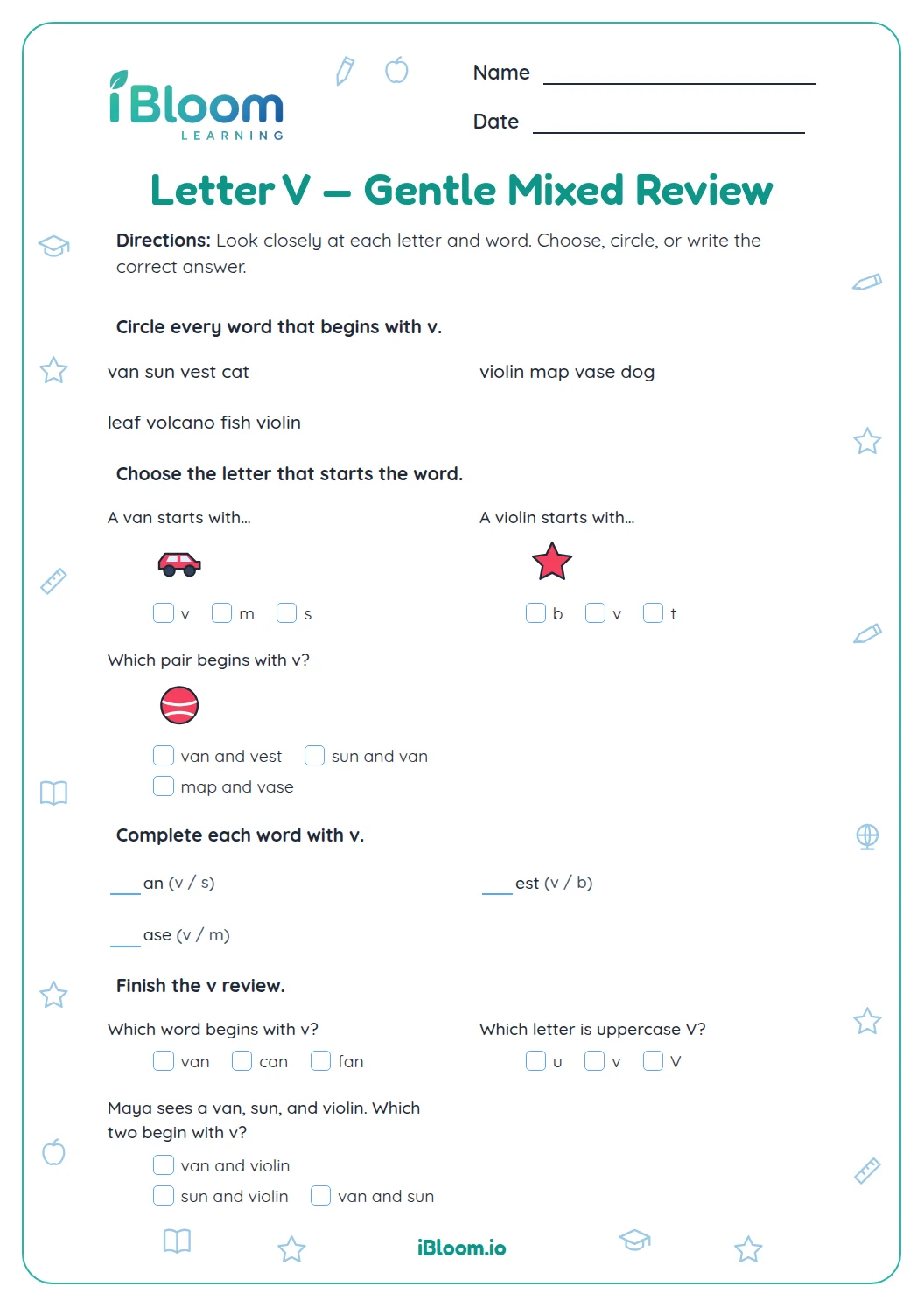
Part A has two tracing rows. Part B has four picture-supported questions with uppercase or lowercase letter choices. Part C has four sentences with a missing first letter. The picture and the spoken sentence support the child as the choices disappear.
Ask the child to say the first sound before selecting or writing a letter. This makes the repeated v answers useful sound practice instead of a copying exercise.
How to use this worksheet
- 1Name the three pictures together before starting.
- 2Trace V and v while saying the letter name.
- 3Read Part B aloud and have the child say each picture word.
- 4Hold the /v/ sound, then choose the matching printed letter.
- 5Read each Part C sentence and let the child add the missing v.
- 6Use the key to check letter choice, then say one finished sentence together.
Mistakes to notice and how to help
The mistake
Choosing W because it also has slanted lines.
The fix
Follow the shape with a finger: V has one bottom point; W has two.
The mistake
Saying the letter name vee as the first sound of violin.
The fix
Model a short /v/ sound without adding the long ee sound, then say violin.
The mistake
Writing an uppercase V in the middle of violin.
The fix
Point to the other small letters in the word and use a lowercase v to match.
Common Core alignment
Recognize uppercase V and lowercase v in letter choices and word beginnings.
On this sheet: Children identify both forms of V and connect them to the printed words.
Show the official wordingHide the official wording
Recognize and name all upper- and lowercase letters of the alphabet.
Say /v/ and connect it to the beginning of violin, volcano and volleyball.
On this sheet: Children say picture names aloud and supply their initial letter.
Show the official wordingHide the official wording
Demonstrate basic knowledge of one-to-one letter-sound correspondences by producing the primary sound or many of the most frequent sounds for each consonant.
What to practice next
Make more practice
Further reading
Questions parents and teachers ask
Does my child need to read the sentences independently?
No, an adult can read every sentence and name every picture. Ask the child to repeat the picture word and listen to its first sound. The printed sentences give the words a setting, while the child concentrates on recognizing V and v and writing the missing letter.
What pictures are included on the letter V sheet?
The sheet uses violin, volcano and volleyball pictures. Name each one before asking for its first letter, especially if the child has another name for it, such as ball. Then connect the word to music time, outdoor play or a book you might read together.
Why do the blanks in Part C all need v?
Each blank completes a word beginning with v, so the child can use one new letter successfully in several sentences. Have the child say the whole word before writing. Repeating the sound in violin, volleyball and volcano connects the written letter with several spoken words.
How should I help with the two tracing rows?
Demonstrate one V with two slanted strokes that meet at a point. Let the child trace slowly and say the letter name. Repeat with the smaller v, keeping the same basic movement. Accept developing pencil control while checking that the bottom is pointed rather than rounded.
What does the answer key show?
The answer key identifies V or v for each tracing row, letter choice and word blank. Use it to check the letter rather than demand perfect handwriting. After checking, ask the child to point to one picture, name it and say its first sound without help.