






About this worksheet
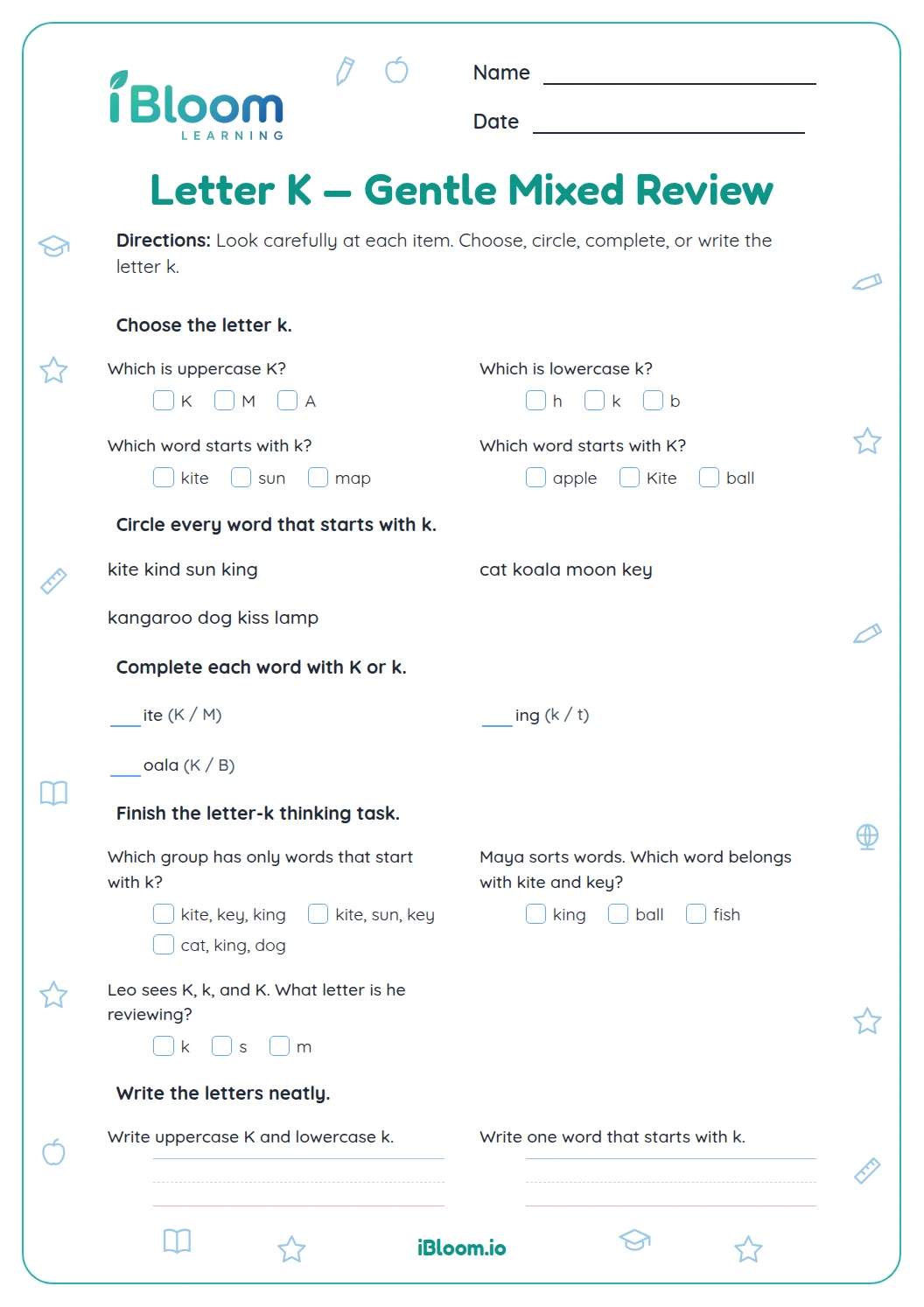
This free letter K worksheet gives preschool and kindergarten children 14 short activities. Part A traces uppercase K and lowercase k. Part B uses four picture clues; Part C asks children to print K or k in familiar words and names; Part D asks them to identify K words in sentences. The printing practice supports Common Core L.K.1a. An adult can read prompts aloud, and a separate answer key gives the choices and letters.
Aligned to L.K.1a
How do children form K and k?
Both forms have a tall straight stroke and two slanting strokes on the right. Uppercase K uses the full letter height. For lowercase k, the slanting strokes meet lower on the tall stroke. Part A gives one tracing row for each form.
Part A gives one row for each form. Encourage a comfortable pencil hold and slow strokes that follow the model.
How do the pictures give K a familiar job?
Part B asks children to choose something that opens a door, flies on a string, carries a joey, or locks a box. Part D asks them to choose a sentence containing a word that begins with K or k.
When should children write K instead of k?
Part C asks for uppercase K in the names Kim and Ken. It asks for lowercase k in the everyday words key and kite. Each prompt tells children which form to print, so they can focus on forming the letter accurately.
- 1A key opens the door.
- 2Print lowercase k: ___ey
- 3Write k in the blank to make key.
Which words begin with K or k?
Part D presents four pairs of short sentences. Children choose the one containing a familiar K or k word. Read each choice aloud and listen for its first sound.
- 1A kite is high. / A bird can fly.
- 2Choose “A kite is high.”
- 3Kite begins with k.
How to use this worksheet
- 1Trace uppercase K and lowercase k slowly.
- 2Read each picture clue aloud and choose the matching picture.
- 3Print the missing letter in each familiar name or word.
- 4In Part D, read each pair and choose the sentence with a K or k word.
Mistakes to discuss
The mistake
Making lowercase k as tall and wide as uppercase K in every part.
The fix
Keep the tall stroke, but start the slanting part around the middle of it.
The mistake
Writing lowercase k at the beginning of Kim or Ken.
The fix
Point to the uppercase direction and explain that a person’s name begins with a capital letter.
The mistake
Choosing the door instead of the key for something that opens a door.
The fix
Name both objects, then act out turning a key in a lock.
Common Core alignment
Trace and print uppercase K and lowercase k in familiar names and words.
On this sheet: Children trace both letter forms and print K or k to complete names and picture-supported words.
Show the official wordingHide the official wording
Print many upper- and lowercase letters.
What to practice next
Make more practice
Further reading
Questions parents and teachers ask
Does this worksheet practice both K and k?
The picture choices include a key, kite, and kangaroo. The last part asks children to choose sentences containing K words. The other prompts use key and kite in familiar phrases. An adult can say each word aloud so children can focus on hearing its first sound and noticing its first letter.
Should my preschooler read the prompts independently?
An adult can read every prompt aloud. This lets a preschooler focus on letter formation and familiar picture meanings. Name the objects in the choices before asking the question, then let the child choose. In Part C, read the word and point to the space for K or k.
Which pictures appear in the letter K choices?
The choices include a key, a spoon, a hat, a kite, a kangaroo, and a cat. Children choose a key for opening a door and locking a box, a kite for flying on a string, and a kangaroo for carrying a joey in a pouch.
Why are Kim and Ken included?
Kim and Ken give uppercase K a familiar use at the beginning of a person’s name. Read the names aloud before children fill the blanks. Then compare those capital letters with lowercase k in key and kite, keeping attention on the different letter sizes and shapes.
What does the answer key show for tracing?
The key repeats the target letter for each tracing row and supplies the answers to the picture choices and missing letters. For tracing, also look at the child’s pencil strokes. The tall stroke and two slanting strokes should make a recognizable K or k that follows the printed model.