



About this worksheet
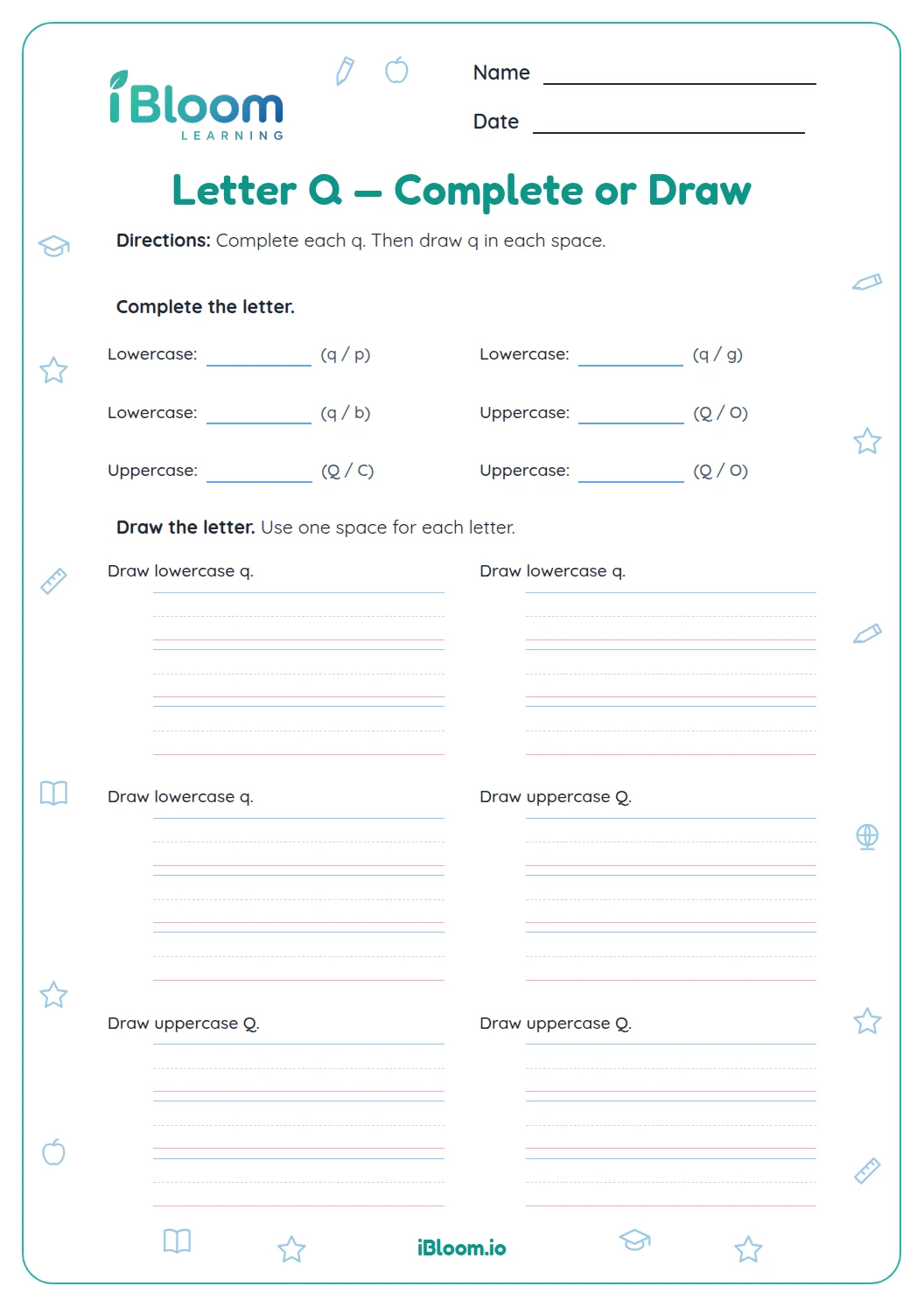
This free printable letter Q worksheet connects printing with familiar words for preschool and kindergarten children. One tracing activity models uppercase Q and lowercase q, with space to copy each form. Six letter blanks use names, a duck’s quack, a quarter, quiet reading and a quilt. Seven short clues ask children to print familiar q words, including quiz, queen and question. The 14 activities practice letter formation in Common Core L.K.1.a. An adult can read the clues aloud, and a separate answer key shows the letters and words.
Aligned to L.K.1.a
How do we form uppercase Q and lowercase q?
For uppercase Q, make a round shape and add a short tail. For lowercase q, make a small round shape and extend the right-hand stroke below it. Follow the printed model and your classroom’s handwriting style.
Part A provides one tracing activity with both Q and q. Each model repeats along the line, with a row underneath for copying each form. Children can refer to these models when completing the familiar words in Part B.
Why does Quinn need a different Q from quack?
A person’s name begins with a capital letter. The blanks for Quinn and Quincy therefore need Q. The other blanks complete words printed in lowercase: quack, quarter, quiet and quilt.
- 1A duck says quack. ___uack
- 2The model word quack begins with lowercase q.
- 3Write q in the blank.
How should an adult use the picture clues?
Name the duck, the quarter and the book together. The duck helps children connect q to quack; the coin identifies the quarter; the book accompanies the quiet-reading clue. Read the full clue, since a picture can suggest more than one word.
Part C takes the practice from single letters to whole words. Read each clue aloud, then let the child print the matching word. Some earlier Part B blanks include a duck, quarter and book picture. Check both the meaning and the shape of the letters.
How to use this worksheet
- 1Trace uppercase Q and lowercase q in Part A, then copy each form.
- 2Complete the six Q or q blanks in Part B; use uppercase Q for Quinn and Quincy.
- 3Read each Part C clue aloud and print the matching word.
- 4Check the letter forms and all seven word spellings with the separate answer key.
Mistakes to discuss
The mistake
Writing O instead of Q.
The fix
Compare the round letters and add the short tail that makes uppercase Q.
The mistake
Reversing lowercase q into p.
The fix
Point to the model: the long stroke goes down on the right of the small round shape.
The mistake
Using lowercase q at the start of Quinn.
The fix
Explain that Quinn is a name, then find uppercase Q in the tracing rows.
Common Core alignment
Trace and print uppercase Q and lowercase q in names and familiar words.
On this sheet: Children trace Q and q, supply them in familiar words, and print seven complete words from clues.
Show the official wordingHide the official wording
Print many upper- and lowercase letters.
What to practice next
Make more practice
Further reading
Questions parents and teachers ask
Can a child who cannot read the clues use this sheet?
Yes, an adult can read each clue and name the pictures. The child traces or prints Q and q, fills six missing letters, and prints seven whole words from the clues. Read each clue aloud before the child decides, then check the answer key together.
What pattern can children notice in these words?
These nine examples show Q or q followed by u, a useful pattern to notice while printing. Point to Quinn, quack, quarter, quiet, Quincy, quilt, quiz, queen and question. Read each complete word aloud, then ask the child to supply only the missing Q or q in Part B.
What does the book picture mean?
The book goes with the sentence about being quiet while reading. The duck and quarter pictures also match their letter-completion prompts. Read each sentence aloud before asking the child to print its answer; the pictures give context while the wording narrows the choice.
How should I check the final word answers?
Check that the child matched each clue to the right word: quack, quarter, quiet, quilt, quiz, queen and question. Then look at the letter shapes, especially the downward stroke on the right of lowercase q. Children can use the printed models in Part A while practicing careful printing.
Should we finish every activity in one sitting?
You can split the practice after the tracing activity. Return later to the six letter blanks and seven word clues if your child needs a break. Keep the completed tracing row visible as a model, and read unfamiliar clues aloud before asking the child to print each answer.