


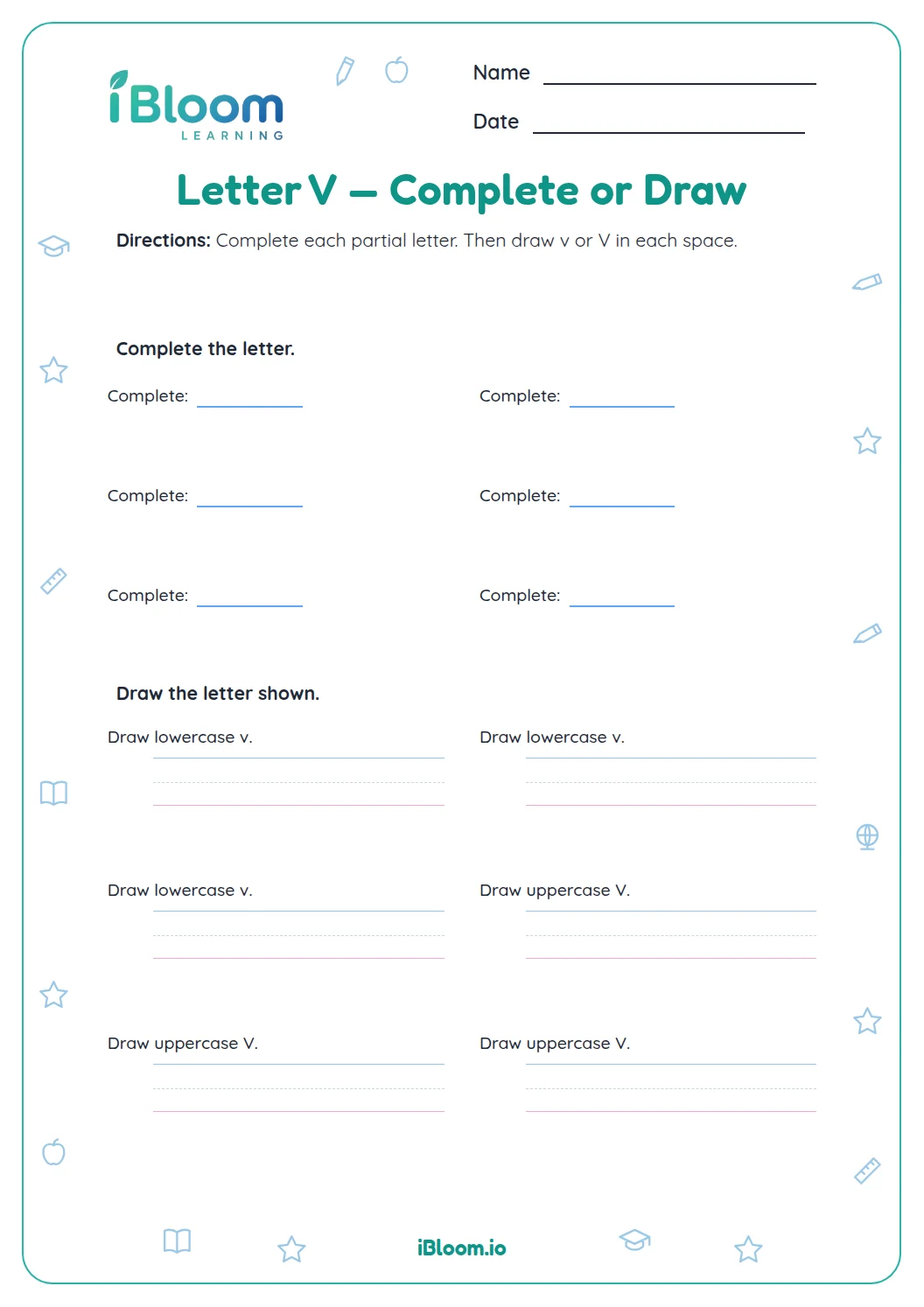
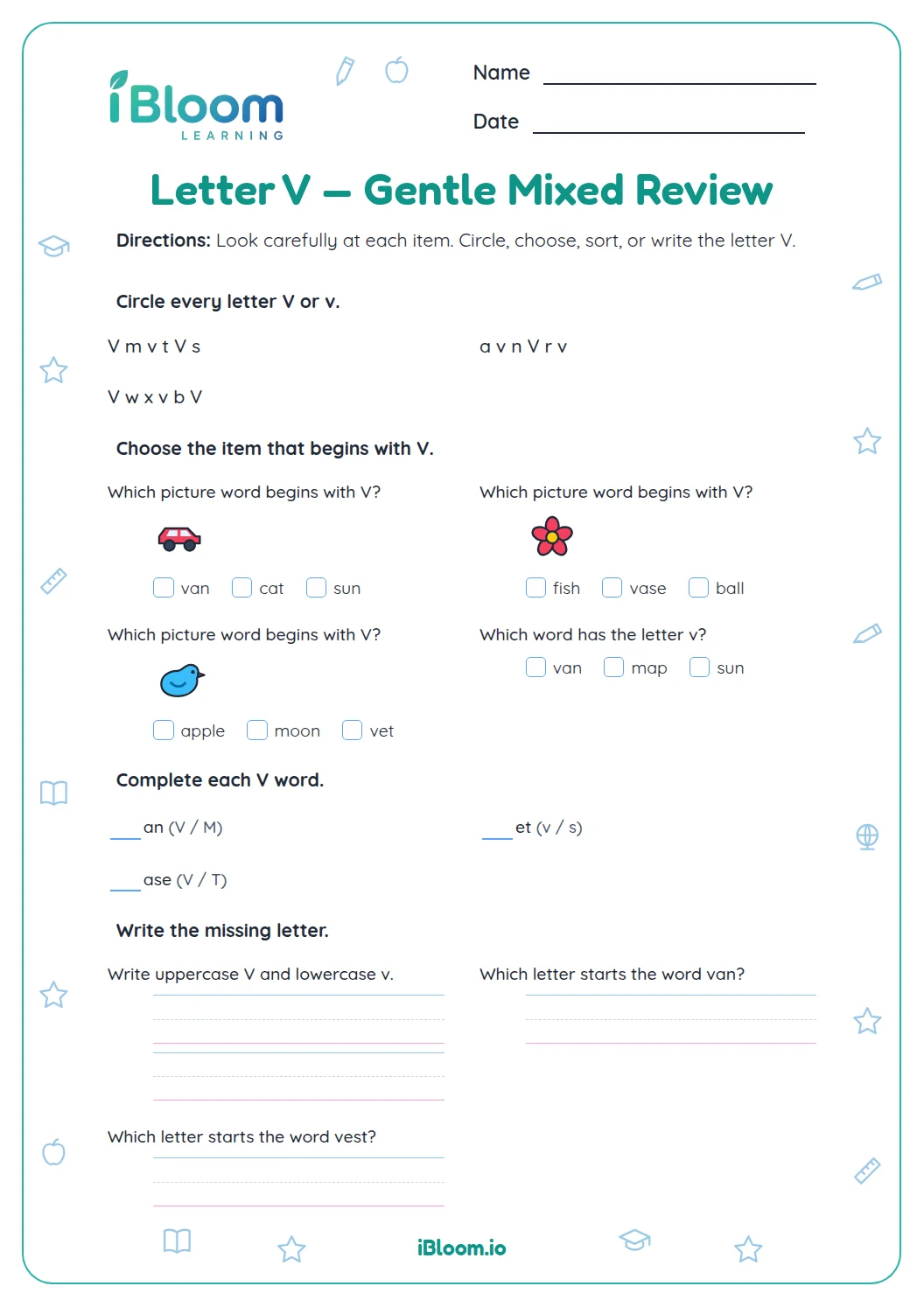



About this worksheet
This free printable letter V worksheet is for preschool and kindergarten children who are learning the letter and its sound. Children trace the capital V, the small v, and the words violin and vest. They circle the words that start with v in two short sentences, such as "Vera drove the van home." Then they use pictures to find what starts with v, such as a violin, a volcano and a volleyball, and what has a v inside, such as a glove or an avocado. The activities build letter recognition and printing, Common Core RF.K.1.d and L.K.1.a, and a first look at the /v/ sound. A two-page answer key shows every answer.
Aligned to RF.K.1.d and L.K.1.a
What is on this worksheet?
The two pages have four parts. Part A is tracing: the capital and small letters together (Vv), then the words violin and vest. Part B has two short sentences, and children circle the words that start with v: Vera and van in the first, vet and vest in the second. Part C shows three pictures in each of three questions and asks which one starts with v: violin, volcano and volleyball. Part D asks which picture has a v inside its name, even when v is not the first letter: glove and avocado.
A grown-up says the name of each picture and reads the sentences aloud with the child. The goal is to connect the shape of v with its sound, not to test reading.
- Part A: trace Vv, violin and vest
- Part B: circle the v words in 2 sentences (4 words to find)
- Part C: 3 picture questions on words that start with v (violin, volcano, volleyball)
- Part D: 2 picture questions on words with a v inside (glove, avocado)
What should children notice about the letter V?
V is a point with two straight lines: the capital V goes down to the point and back up, and the small v is the same shape in a smaller size. Say the sound /v/ together: top teeth rest on the bottom lip, and your voice hums. It is easy to mix up with /f/, which uses the same mouth position without the hum. A hand on the throat lets a child feel the difference: /v/ buzzes, /f/ does not.
Look for letters that are similar. The small v is like a u with a point, and w looks like two v's joined together. Tracing the v and saying the sound at the same time helps children remember the difference.
Why look for v in the middle of words too?
Alphabet books show a letter at the start of words, but v also appears in the middle of many familiar words, such as glove and avocado. Part D asks children to find the v even when it is not first. A child has to say the whole name slowly and listen for the /v/ sound inside it.
At this age, you can say each name aloud and let the child point to where they heard /v/. If your child is not sure, write the word on a scrap of paper and look at it together.
- 1Which one starts with v?
- 2Say the names: sun, violin, map.
- 3Say the first sound of each: /s/, /v/, /m/.
- 4Which one starts with /v/? violin
- 5Mark the bubble next to the violin.
How to use this worksheet at home or in class
- 1Say the sound /v/ together and feel your lip and teeth, then say words like violin and vet slowly.
- 2Trace the capital V and the small v on the first line while saying the sound with each stroke, then trace violin and vest.
- 3Read the two sentences in Part B aloud and let your child find and circle each word that starts with v.
- 4For Part C, say the three picture names aloud and ask which one starts with v. Say the first sound of each name slowly if your child is stuck.
- 5For Part D, say each name slowly and ask your child to point to where the /v/ sound is.
- 6Check with the answer key and celebrate each one found, then trace v words again on another day.
Common mistakes and quick fixes
The mistake
Saying /f/ instead of /v/ for words like violin and vest.
The fix
Show the mouth shape in a mirror. The lip and teeth are the same for both sounds, but v hums. Feel the throat on /v/ and not on /f/.
The mistake
Rounding the bottom of a small v so it looks like a u.
The fix
Say "down to a point, then up" while tracing. Make the point at the bottom touch the line.
The mistake
Listening only to the first sound in Part D, so glove and avocado seem to have no v.
The fix
Say the name slowly with a pause between the sounds: g-l-u-v. Ask where the hum of /v/ comes, and point to it.
Common Core alignment
Most US states use Common Core or a close version, so this sheet fits Kindergarten letter work in most classrooms.
Recognize and name both the capital V and the small v, and find them in words.
On this sheet: Main standard. Children recognize both V and v and find the letter in words.
Show the official wordingHide the official wording
Recognize and name all upper- and lowercase letters of the alphabet.
Print the capital V and small v, here by tracing them and the words violin and vest.
On this sheet: Part A traces Vv, violin and vest, so children practice the letterforms.
Show the official wordingHide the official wording
Print many upper- and lowercase letters.
What to practice next
Make more practice
Further reading
Questions parents and teachers ask
What is on a letter V worksheet for kindergarten?
This one has four parts: tracing Vv, violin and vest; circling the words that start with v in two short sentences; and five picture questions about what starts with v or has a v inside, like a violin, a volcano and a glove. It has 10 activities over two pages, with a separate answer key.
What sound does the letter V make?
V makes the sound /v/, as in violin. To say it, rest your top teeth on your bottom lip and hum. It is easy to confuse with /f/, which uses the same mouth shape without the hum, so feel your throat while saying both.
What if my child does not know what a picture is?
Say the name aloud and have your child say it back, then say the first sound slowly. The volcano and the avocado may be new words, and the volleyball looks like any ball, so say its full name. Naming the pictures is part of the practice, and a quick look at a real one helps.
Are the words too hard for a preschooler?
The sentences may be, so read them aloud and let your child point and circle. The pictures in Parts C and D need no reading. For preschool, do Part A and the picture questions only, and come back to the circle-the-word sentences when your child is ready.
What are the answers to Part B?
The words to circle are Vera and van in "Vera drove the van home," and vet and vest in "The vet has a vest on." Each starts with v. Drove has a v too, but in the middle, so it is not circled here; it makes a good talking point for Part D.
How long does this worksheet take for kindergarten?
About 10 minutes. If attention runs out, split it into two sessions: trace and circle on one day, and finish the picture questions the next. Keep the pace relaxed, and let your child say the /v/ sound whenever they find the letter.