



About this worksheet
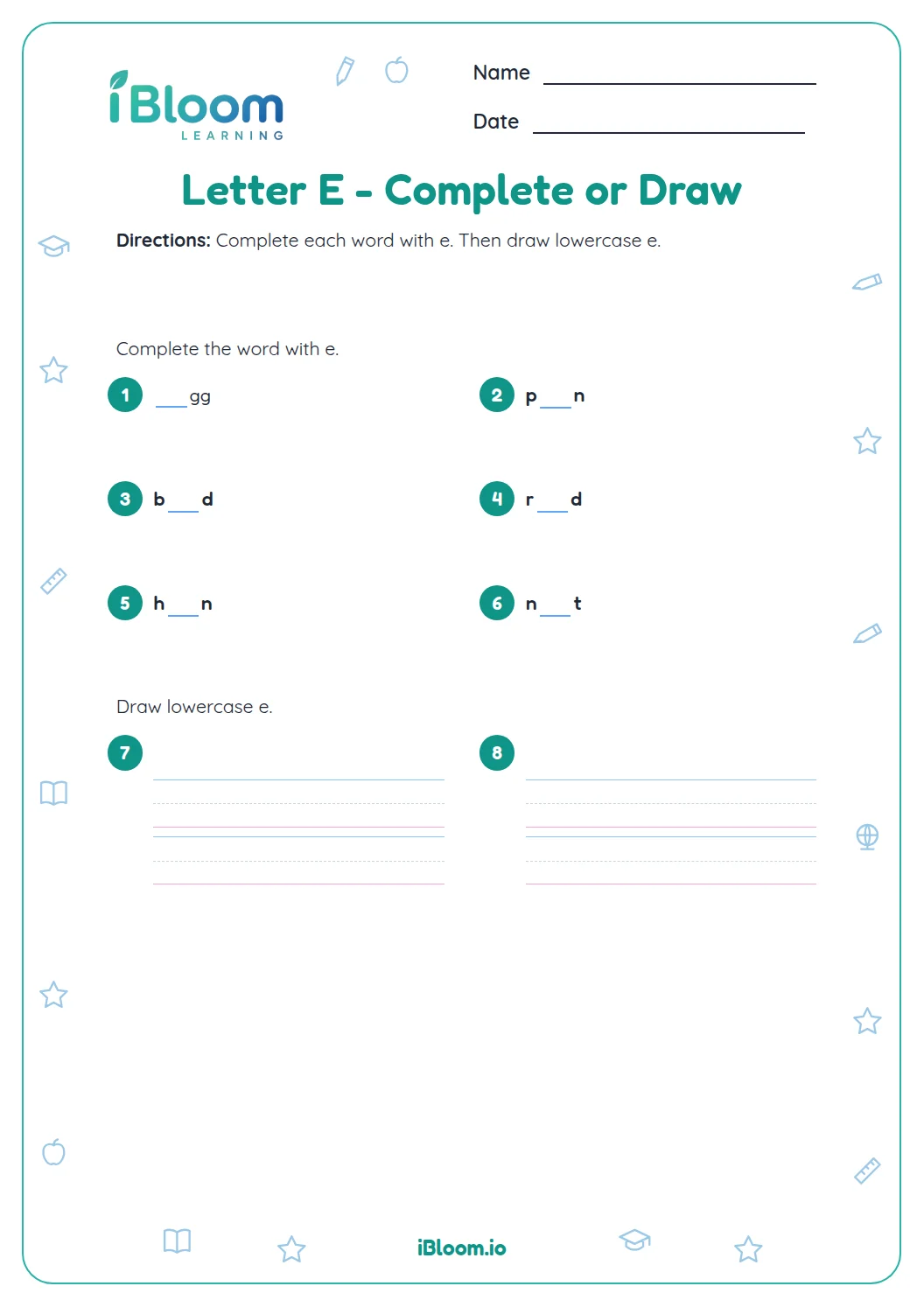
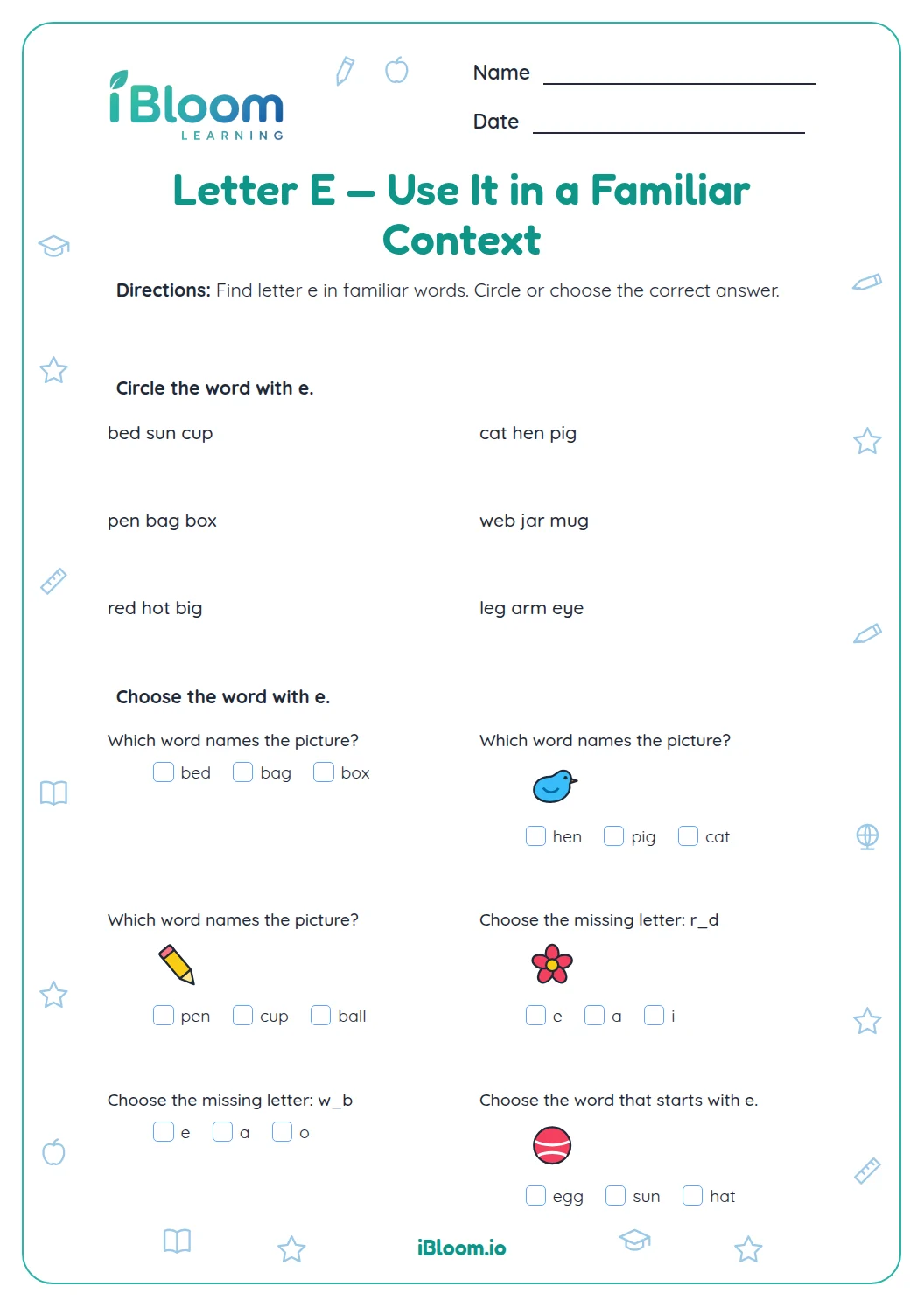
This free Letter E worksheet gives preschool and kindergarten children three ways to revisit one letter. Part A has two tracing rows, one for E and one for e. Part B uses four picture clues to practice identifying a first letter. Part C has four short word-search rows: children circle the word beginning with e in each row. An adult can name the pictures and read the words aloud while the child checks their letters. These ten activities practice letter recognition in Common Core RF.K.1d. A separate answer key identifies each choice and search word.
Aligned to RF.K.1d
How do the two forms of E connect?
Say the letter name while pointing to each form. Uppercase E has one tall line and three short lines; lowercase e has a curved body with a short line across its middle. Part A lets children follow both shapes before looking for the letter in words.
How do I use the picture clues?
Name the egg, elephant, ear, and envelope with the child. Ask for the first letter of each name, then let the child mark the matching choice. The choices change position, so each picture needs a fresh look.
The names supply familiar examples of E words. Read the names naturally; the activity asks for the letter, and the words begin with different vowel sounds.
How does the word-row search work?
The search presents four rows of complete words. Children look across each row and circle the word that begins with lowercase e: egg, ear, elephant, or envelope. An adult can read each row while the child checks the first letter visually.
- 1cat egg sun dog
- 2Check the first letter of each word.
- 3egg begins with e. Circle egg.
How to use this worksheet
- 1Point to E and e and say their shared letter name.
- 2Trace both rows in Part A, then copy each letter on the empty line.
- 3Name each picture in Part B before marking a letter choice.
- 4Read each Part C word row together and circle its E word.
- 5Use the key to check choices, then ask the child to point to e in each circled word.
Mistakes to check together
The mistake
Choosing F for uppercase E.
The fix
Compare their horizontal strokes: E has a bottom stroke too.
The mistake
Looking for uppercase E in the word rows.
The fix
Point back to the lowercase e tracing row and find that same form at the start of egg.
The mistake
Circling a word because it has e somewhere inside.
The fix
Point to the first letter; the direction asks for a word that begins with e.
Common Core alignment
Recognize uppercase E and lowercase e in tracing, picture choices, and word beginnings.
On this sheet: Children identify E and e and locate e at the beginning of four words.
Show the official wordingHide the official wording
Recognize and name all upper- and lowercase letters of the alphabet.
What to practice next
Make more practice
Further reading
Questions parents and teachers ask
Does my child need to read all the search words?
No, an adult can read the words aloud while the child looks for the initial letter e. Start with egg, then point to its first letter. In each search row, have the child compare the beginnings of the words and circle the matching whole word.
Which pictures are on the worksheet?
The four picture clues are an egg, an elephant, an ear, and an envelope. Name each one together before choosing a letter. All four names begin with E, and the correct letter appears in different choice positions so the child must look at every set.
What should children circle in Part C?
Children should circle egg, ear, elephant, and envelope, one word in each of the four rows. The task is to find a word beginning with e. Encourage a left-to-right scan and stop at the first letter of each word before circling the whole word.
Can I split this review into shorter sessions?
Yes, you can finish the tracing and picture choices first, then return to the search rows later. Begin the second session by pointing to uppercase E and lowercase e again. Keep the letter name consistent and let the child name a familiar E word before searching.
How should I use the answer key?
Use the answer key to check the four letter choices and four circled search words. For tracing, check whether the child followed the letter shapes rather than grading a perfectly smooth line. Ask the child to name E and e aloud when you review the work.