


About this worksheet
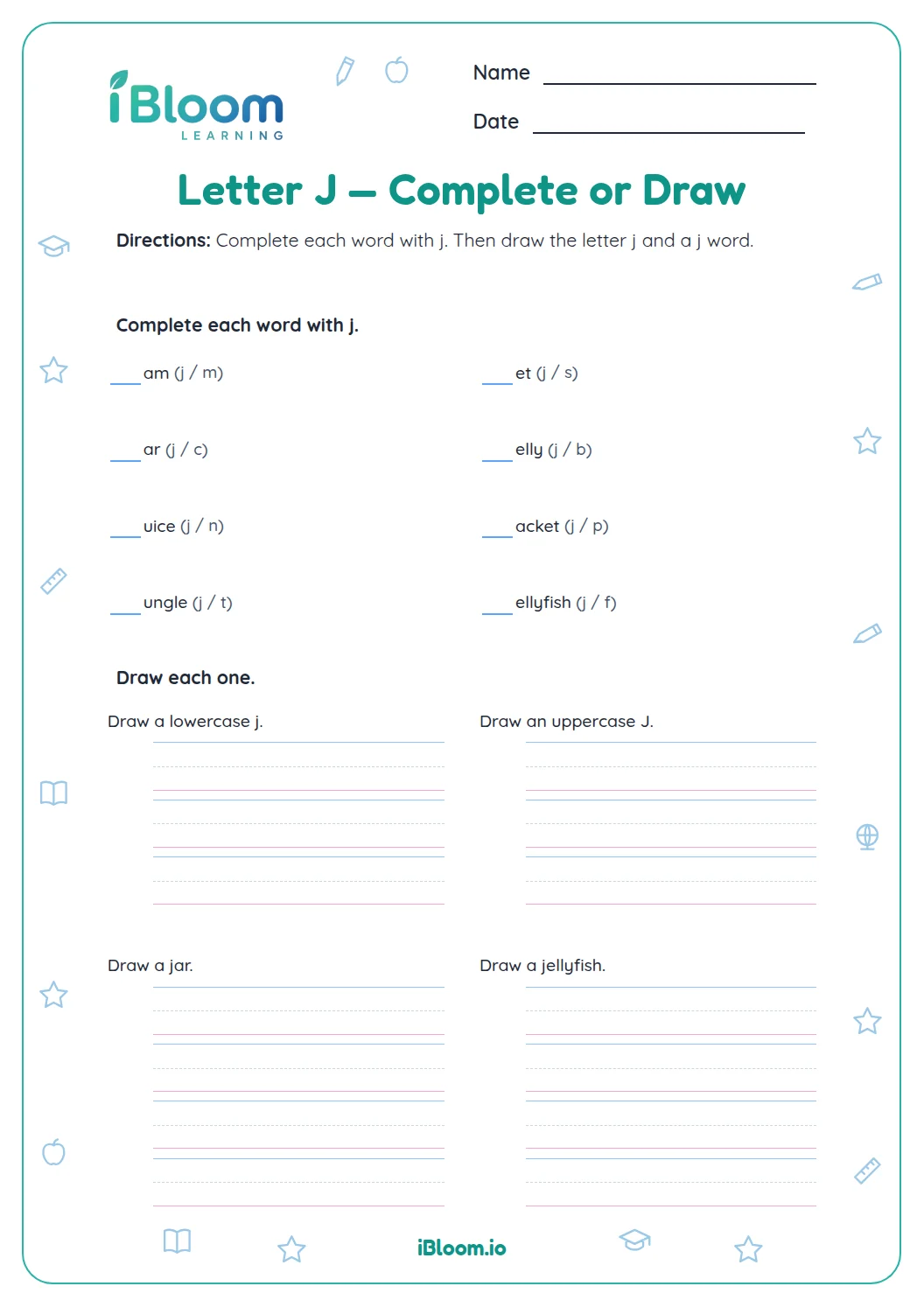
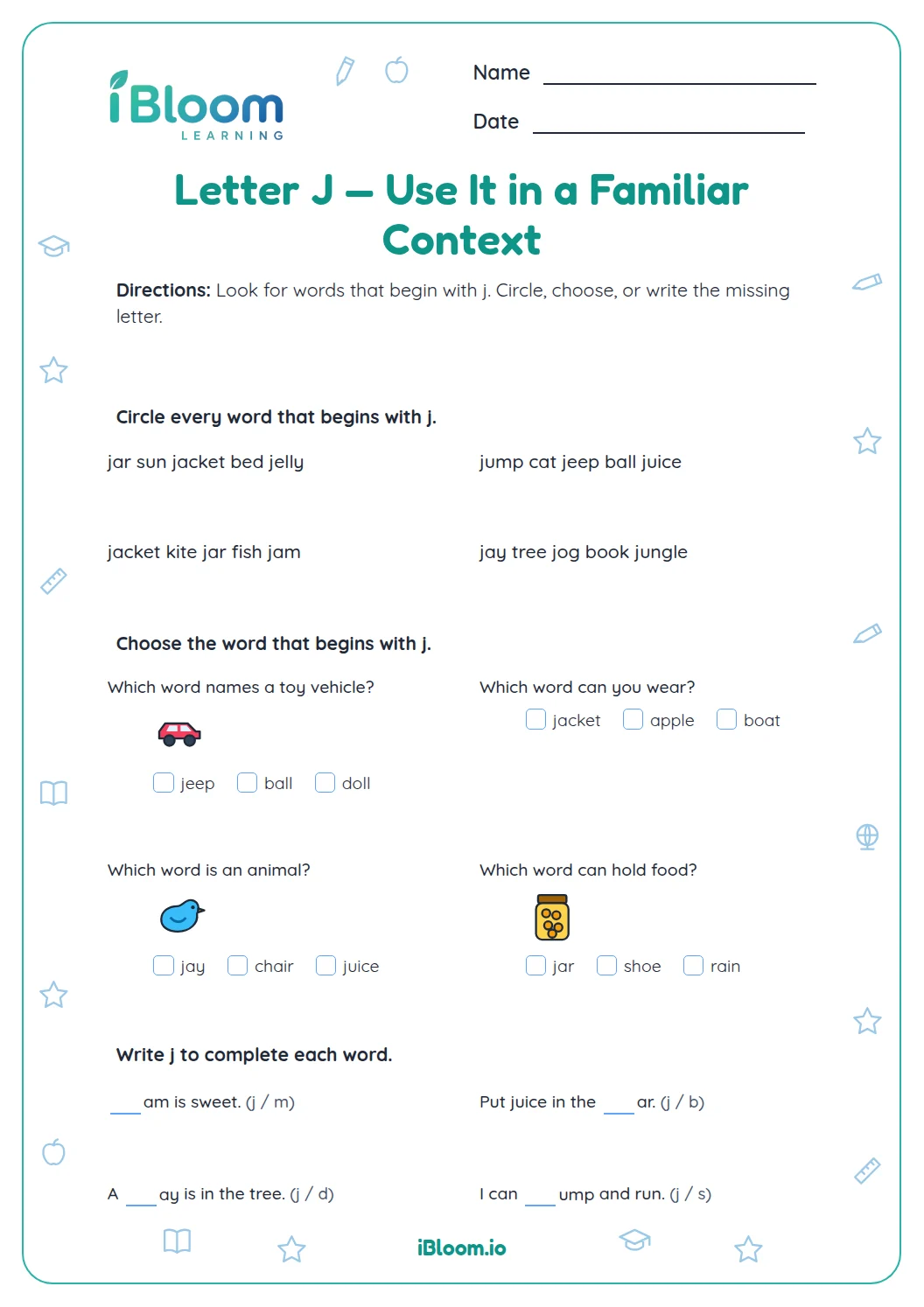
This gentle two-page letter J review is for preschool and kindergarten learners. It uses pictures to practice the initial /j/ sound with familiar words such as juice, jeans, and jack-o-lantern, then adds simple letter finding and tracing. Children say each picture name, listen for its first sound, and connect that sound to uppercase J and lowercase j. The printable has 14 activities and a separate answer key.
Aligned to RF.K.3a
What sound does J make in these words?
J begins words such as juice, jeans, and jack-o-lantern. Say each name slowly and notice the first sound before looking for the matching letter.
How can children tell J and j apart?
Uppercase J is the capital form; lowercase j is the small form. Both are the same letter and represent the same first sound in the words on this page.
- 1Say the picture name: juice.
- 2Listen to its first sound: /j/.
- 3Choose the picture name that begins with that sound.
How should children practice tracing?
Start at the top of each model and follow its path slowly. Children can say the letter name and sound as they trace.
How to use this worksheet
- 1Say the picture name out loud.
- 2Listen for the first sound in the word.
- 3Choose the picture that starts with /j/.
- 4Find uppercase J and lowercase j among other letters.
- 5Trace each form slowly while saying its name.
Common mistakes and quick fixes
The mistake
Choosing a picture because its name contains j later.
The fix
Listen only to the first sound; jet begins with /j/.
The mistake
Mixing up uppercase and lowercase forms.
The fix
Say “big J, little j”; both are the same letter.
The mistake
Starting a trace at the bottom.
The fix
Begin at the top of the model and follow the line carefully.
Common Core alignment
This sheet connects the practice to a specific Common Core skill.
Connect the consonant J/j with its primary sound.
On this sheet: Picture names and letter choices practice hearing /j/ at the start of words.
Show the official wordingHide the official wording
Demonstrate basic knowledge of one-to-one letter-sound correspondences by producing the primary sound or many of the most frequent sounds for each consonant.
What to practice next
Make more practice
Further reading
Questions parents and teachers ask
What sound does J make?
J often begins with the /j/ sound heard at the start of juice, jeans, and jack-o-lantern. Children say the picture name and listen to its first sound in the picture questions. The separate answer key lists the response, and a quick reread helps children connect each answer to its clue.
Does lowercase j make the same sound as uppercase J?
Yes. Uppercase J and lowercase j are two forms of the same letter. Both make the /j/ sound at the start of the familiar words on this sheet. The separate answer key lists the response, and a quick reread helps children connect each answer to its clue.
Can an adult help with the picture names?
Yes. An adult can name each picture slowly and invite the child to repeat the word. Then ask what sound comes first before the child picks a picture. The separate answer key lists the response, and a quick reread helps children connect each answer to its clue.
What kinds of activities are included?
The printable has 14 activities: one tracing line, picture sound choices, and letter-finding and matching questions. It spans two worksheet pages and includes a separate answer key. Children can take the sections one at a time and say the letter sounds aloud.
How long should a child spend on this review?
About 15 minutes is a reasonable starting point for these 14 short activities. A child can take breaks between the picture, letter-finding, and tracing sections. The separate answer key lists the response, and a quick reread helps children connect each answer to its clue.