


About this worksheet
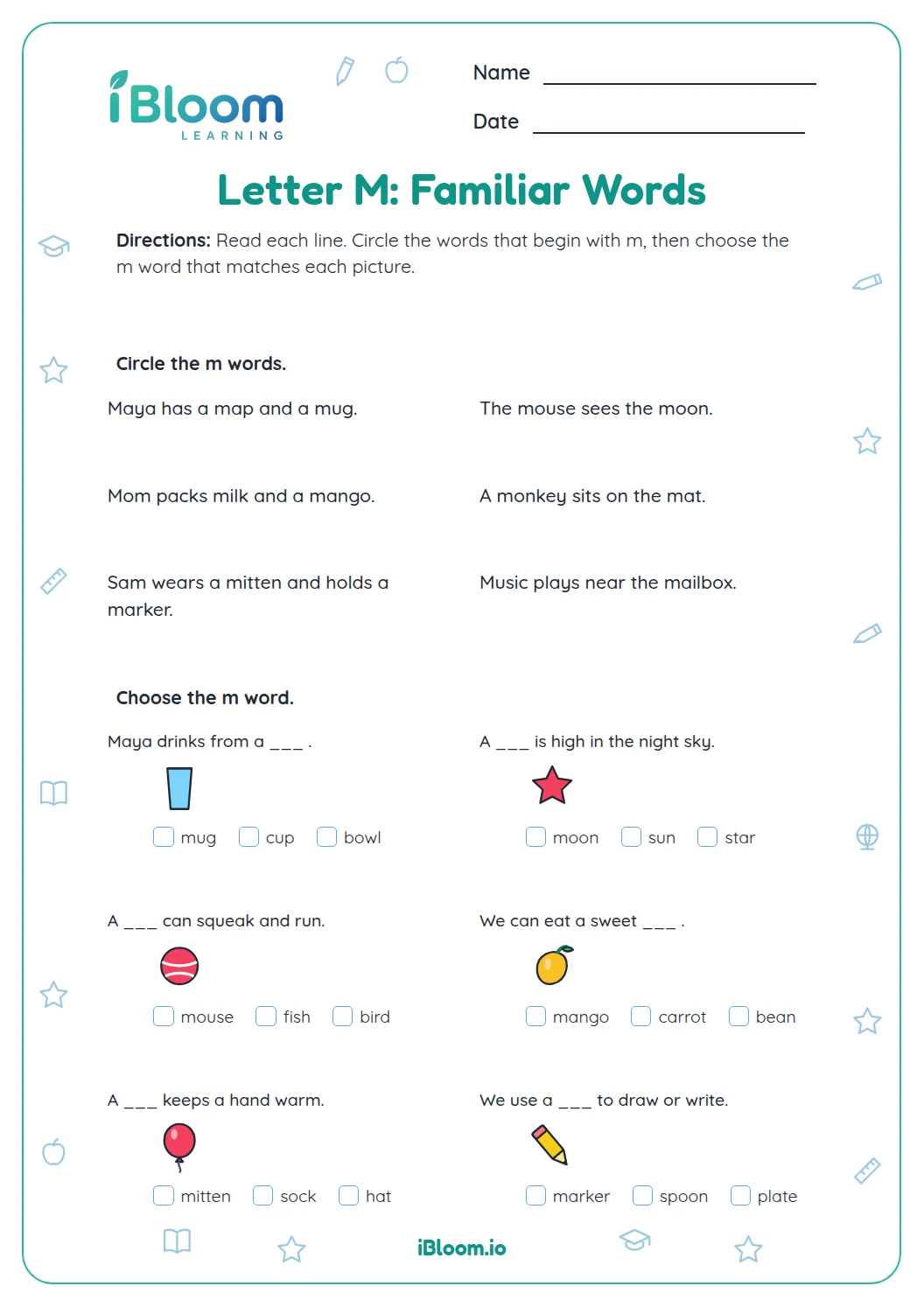
This Pre-K and Kindergarten page practices the letter M and its /m/ sound through letter choices, picture clues, word completion, and drawing. Children name familiar pictures, complete short M words, and connect the beginning sound to the letter. The sound practice aligns with CCSS RF.K.3.a.
Aligned to RF.K.3.a
What sound does M make?
M makes the /m/ sound at the beginning of moon, mouse, and milk. Children can say each picture name and listen for the first sound. Uppercase M and lowercase m are two forms of the same letter.
- 1Say moon slowly.
- 2Hear /m/ at the beginning.
- 3Choose M or m.
What will children practice?
The worksheet begins with letter recognition and picture choices, then moves to completing M words and drawing a moon.
- Part A: choose uppercase M, lowercase m, and M picture words
- Part B: say picture names and identify M sounds
- Part C: complete M words and draw a moon
How can an adult support the activity?
Name each picture together before choosing. If a child uses a different word for a picture, say the intended word and listen for its first sound.
- 1Say mouse.
- 2The first sound is /m/.
How to use this worksheet
- 1Point to each letter choice and name it.
- 2Say each picture name before choosing.
- 3Listen to the first sound, not just a sound later in the word.
- 4Complete the M words using their picture clues.
- 5Draw a moon and say its first sound.
Common mistakes and quick fixes
The mistake
Choosing a word with M in the middle
The fix
Say the word slowly and listen to its very first sound.
The mistake
Mixing up uppercase M and lowercase m
The fix
Name both forms and notice their different shapes.
The mistake
Guessing a picture name
The fix
Say the intended picture word together before listening for /m/.
Curriculum alignment
This printable gives focused practice with the stated skill.
Connect M to its common consonant sound.
On this sheet: The worksheet asks learners to apply this skill in each part.
Show the official wordingHide the official wording
Demonstrate basic knowledge of one-to-one letter-sound correspondences by producing the primary sound or many of the most frequent sounds for each consonant.
What to practice next
Make more practice
Further reading
Questions parents and teachers ask
What sound does M make?
M makes the /m/ sound, as in moon, mouse, and milk. Say a word slowly and listen to the sound at its beginning. The letter practice on this sheet pairs M and m with familiar picture words. Naming the picture aloud helps a child focus on the first sound.
Why should children name the pictures aloud?
Saying a picture name helps children connect a spoken word to its first sound. When they say moon or mouse, they can hear /m/ before looking for the printed M. This builds the connection between speech sounds and letters, an important early step in reading familiar words.
Should children practice uppercase M or lowercase m?
Both forms appear in early reading. Uppercase M and lowercase m look different, but they represent the same letter and the same /m/ sound. This worksheet asks children to identify both forms and find words that begin with the sound. Repeated practice helps make the shapes familiar.
What if a child names a picture differently?
Use the name the child knows, then say the word together and listen for its first sound. Some pictures can have more than one common name, so focus on the word printed or spoken during the activity and whether it begins with /m/. You can model the picture name if needed.
What can children do if they name a picture differently?
Say the intended picture word together before choosing an answer. A picture can have more than one common name, so agree on the word for the activity and listen for its first sound. For example, map begins with /m/, while cap begins with /k/.