





About this worksheet
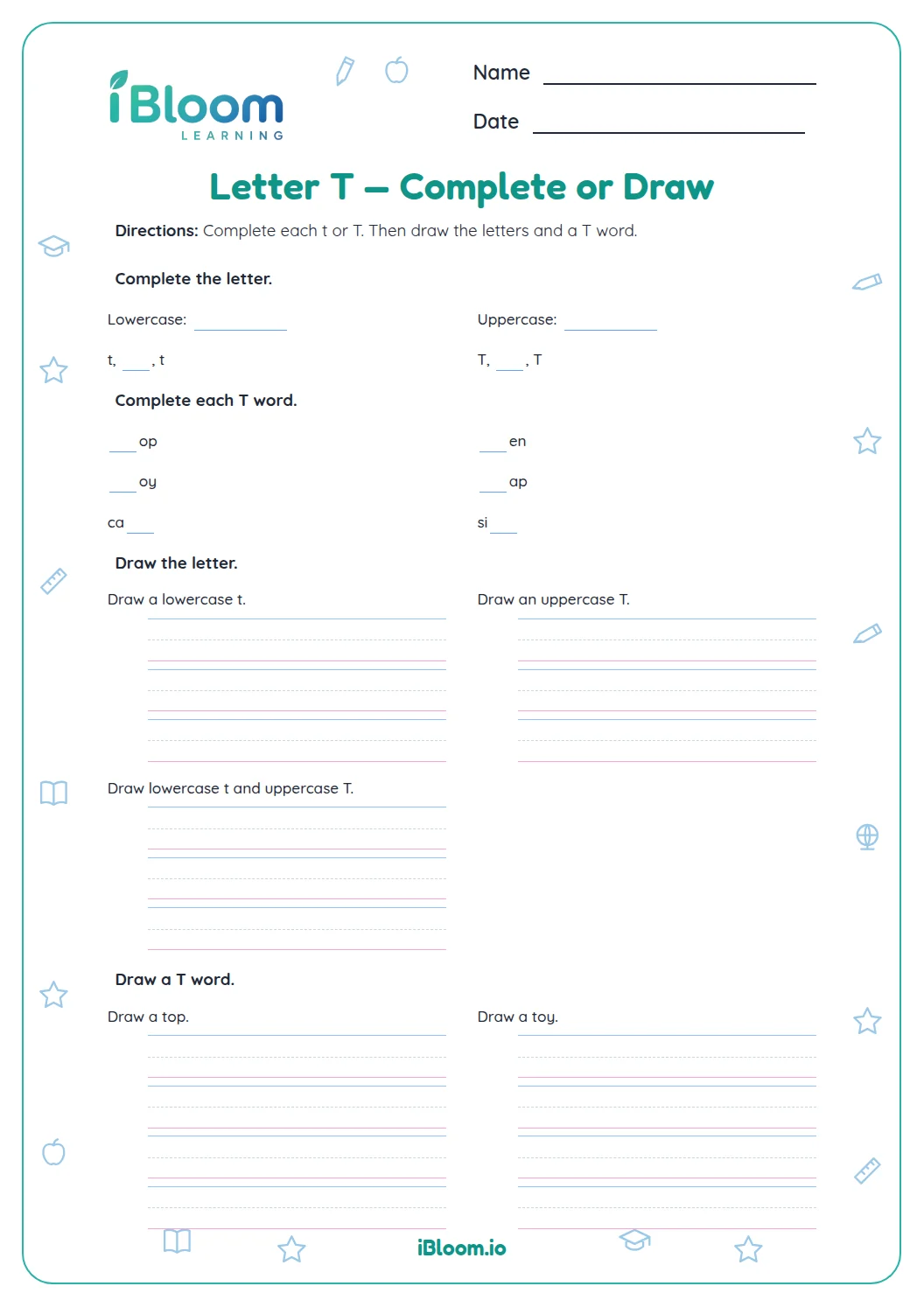
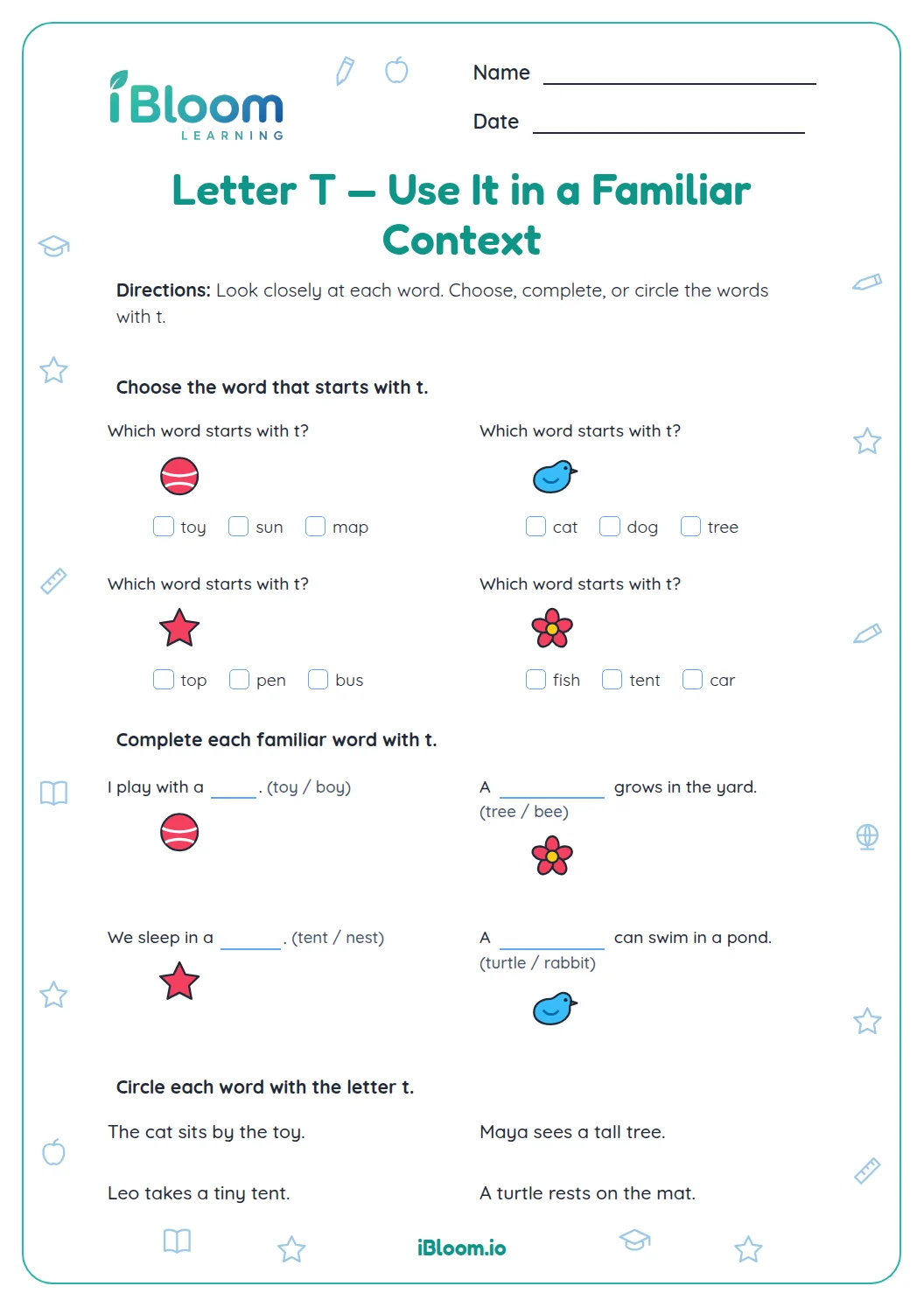
This gentle Letter T review mixes picture and letter choices with circling words that begin with T, completing picture-backed T words, and tracing lowercase t. Children can say picture names aloud, listen for /t/, and then identify or write the letter that starts each word. The two-page worksheet includes a separate answer key.
Aligned to RF.K.3.a
How can a child find uppercase T and lowercase t?
The first four items mix picture clues with uppercase and lowercase letter choices. Say each picture name or letter aloud, then look or listen for T. Turtle and tree begin with /t/.
- 1Name each picture: turtle, apple, ball.
- 2Turtle begins with /t/.
Which words begin with the /t/ sound?
Four short rows ask children to circle every word that begins with /t/. Saying each word slowly can help a child hear the first sound. Some rows have more than one correct word.
How do picture clues help finish a word?
Five picture-backed blanks ask for missing letters in T words, such as tree or taco. The final item gives children a chance to trace and write lowercase t.
Try the page together
- 1Name each picture before choosing its matching word or letter.
- 2Point to uppercase T and lowercase t and say the letter name.
- 3Read each word row aloud and circle every word that starts with /t/.
- 4Use the picture clues to write the missing letters in each T word.
- 5Trace lowercase t, then try writing it on the line.
Helpful reminders
The mistake
Choosing a word because it has t somewhere inside.
The fix
Listen only to the very first sound in the word.
The mistake
Mixing uppercase T with lowercase t.
The fix
Show both forms side by side and say that each is the letter T.
The mistake
Circling only one word in a row.
The fix
Read every word and circle all the ones that begin with /t/.
Common Core alignment
This early literacy sheet supports kindergarten letter-sound knowledge.
Produce the primary sound for consonants, including T.
On this sheet: Picture naming and beginning-sound questions connect T to its consonant sound.
Show the official wordingHide the official wording
Demonstrate basic knowledge of one-to-one letter-sound correspondences by producing the primary sound or many of the most frequent sounds for each consonant.
What to practice next
Make more practice
Further reading
Questions parents and teachers ask
Should preschoolers write every answer?
No. A child can point to a picture, name a letter, or say a beginning sound aloud. An adult can model the letter name and sound, then let the child answer by pointing or speaking before trying to write. This keeps the review accessible to early learners.
What sound does T make in these words?
T makes /t/ at the beginning of words such as turtle, train, tree, and taco. Say the word slowly and listen to the first sound. The worksheet also asks children to recognize uppercase T and lowercase t. These examples are shown as picture clues or words.
What is the difference between uppercase T and lowercase t?
They are two printed forms of the same letter. Uppercase T is taller and often begins names and sentences; lowercase t is smaller and appears in most other places. Both forms represent the /t/ sound in words like turtle and train.
What kinds of practice are included?
The 14 items mix four picture or letter choices, four rows of words to circle, five picture-backed word blanks, and a lowercase t tracing item. Children see familiar clues such as a turtle and a tree, then listen for T at the start.
Is there an answer key?
Yes. A separate two-page answer key lists the intended picture, letter, and sound responses. The final tracing item shows lowercase t as the model. The key follows worksheet order, so an adult can check the responses while the child works.