

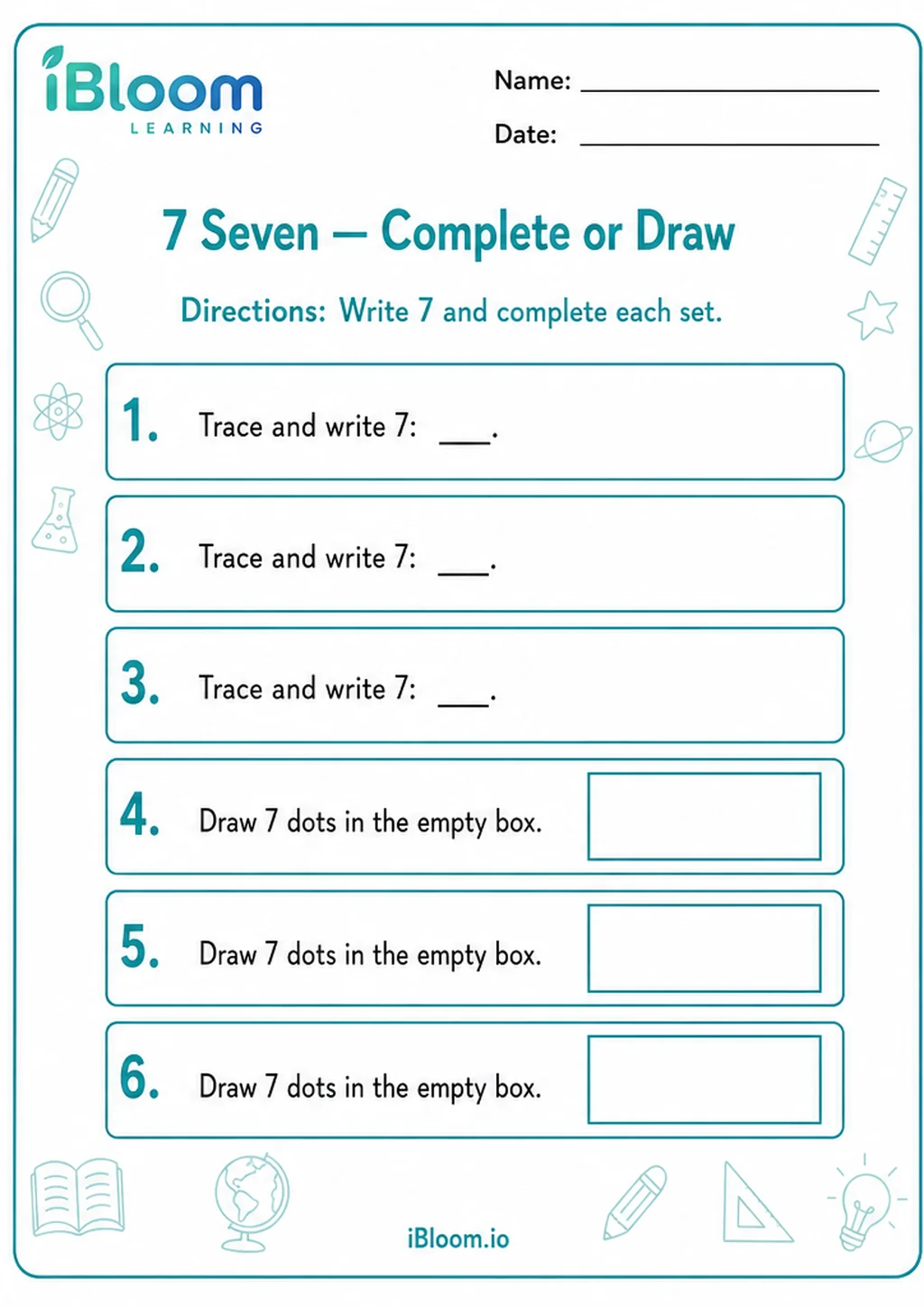
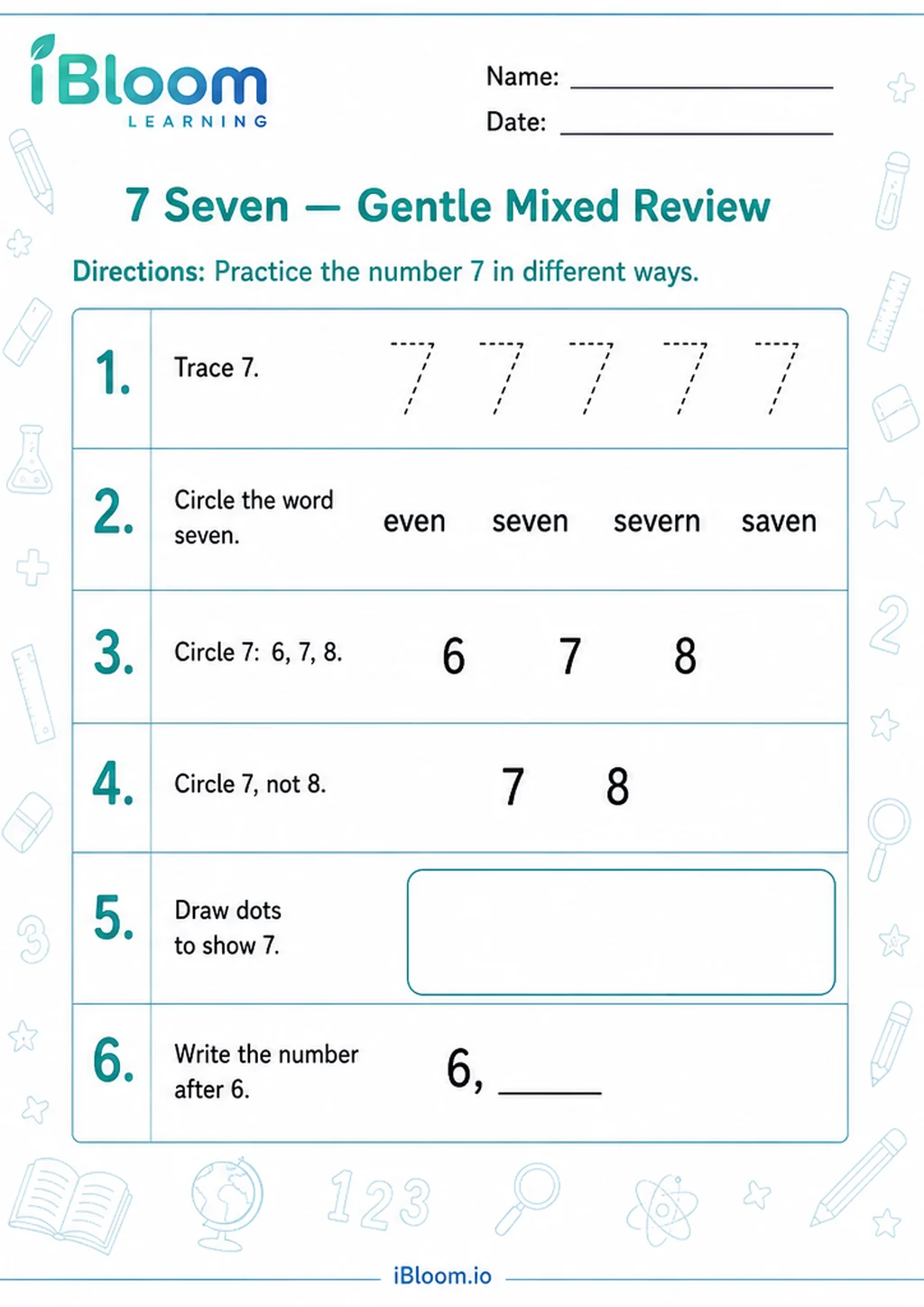
About this worksheet
This preschool and kindergarten math sheet practices the number ten in two ways. Children count five pictured star groups, then fill the missing addend in nine number sentences such as 10 = 4 + ___. The sequence moves from counting a visible group to thinking about number pairs that total ten. It includes a separate answer key and aligns with CCSS K.CC.B.5 and K.OA.A.3.
Aligned to K.CC.B.5 and K.OA.A.3
What does counting a pictured group practice?
The first five questions show groups of stars. Children touch or point to one star at a time, then write the total. For the group of seven, say each number once and check that every star was counted.
How can a missing part complete ten?
A number sentence such as 10 = 4 + ___ asks which number joins four to make ten. A child can count on from four: five, six, seven, eight, nine, ten. The blank is six.
- 110 = 4 + ___
- 2Start at 4 and count on six steps to reach 10.
- 3Answer: 6
What is included in the practice?
Questions 1–5 use star pictures to count groups from three to ten. Questions 6–14 ask for the missing part in number pairs that make ten, including 10 = 1 + ___ and 10 = 9 + ___.
- 5 pictured counting questions
- 9 missing-addend questions
- All number pairs make 10
- Separate answer-key pages
A short counting routine
- 1Point to each star once while counting aloud.
- 2Write the last number said as the group total.
- 3For a missing addend, start with the number shown.
- 4Count on until you reach ten and record how many counts you made.
- 5Check the answer key and build a pair with counters if needed.
Common counting and number-pair slips
The mistake
Skipping a star or counting one twice.
The fix
Touch each star once and move from left to right as you count.
The mistake
Writing the number shown instead of the missing addend.
The fix
Count on from that number to ten; record the number of steps.
The mistake
Stopping one count too early.
The fix
Say the full counting sequence through ten and check the pair by adding both parts.
Common Core alignment
The worksheet connects counting a group with composing ten from two parts.
Count pictured objects to answer how many.
On this sheet: The first five items ask children to count pictured groups of stars.
Show the official wordingHide the official wording
Count to answer “how many?” questions about as many as 20 things arranged in a line, a rectangular array, or a circle, or as many as 10 things in a scattered configuration; given a number from 1-20, count out that many objects.
Find number pairs that make a total of ten.
On this sheet: The missing-addend questions record pairs that make ten as equations.
Show the official wordingHide the official wording
Decompose numbers less than or equal to 10 into pairs in more than one way, e.g., by using objects or drawings, and record each decomposition by a drawing or equation (e.g., 5 = 2 + 3 and 5 = 4 + 1).
What to practice next
Make more practice
Further reading
Questions parents and teachers ask
What does this number ten worksheet ask children to do?
Children count five groups of pictured stars, then complete nine number sentences by finding the missing part that makes ten. For example, in 10 = 4 + ___, the missing number is six because four and six make ten together.
How can I explain a missing addend to a young learner?
Read the known number, then count on until ten. In 10 = 7 + ___, say eight, nine, ten; that is three counts, so three is the missing part. Counters or fingers can make each count visible as you count aloud.
Does the worksheet include pictures?
Yes. The first five questions show star groups for children to count. The later equations use numerals and a blank so learners can focus on the number pair that completes ten. This gives the page both visual counting and number-sentence practice.
Is there an answer key?
Yes. The separate key shows the count for each star group and the missing addend for every equation. Use it after the child has tried the item, then make a counter pair together if an answer was missed together first.
How long does the page take?
About 10 minutes is a reasonable starting point for these 14 short items. Allow extra time to touch-count the stars or build number pairs with counters, especially when a learner is first getting comfortable counting on at a comfortable pace.