





About this worksheet
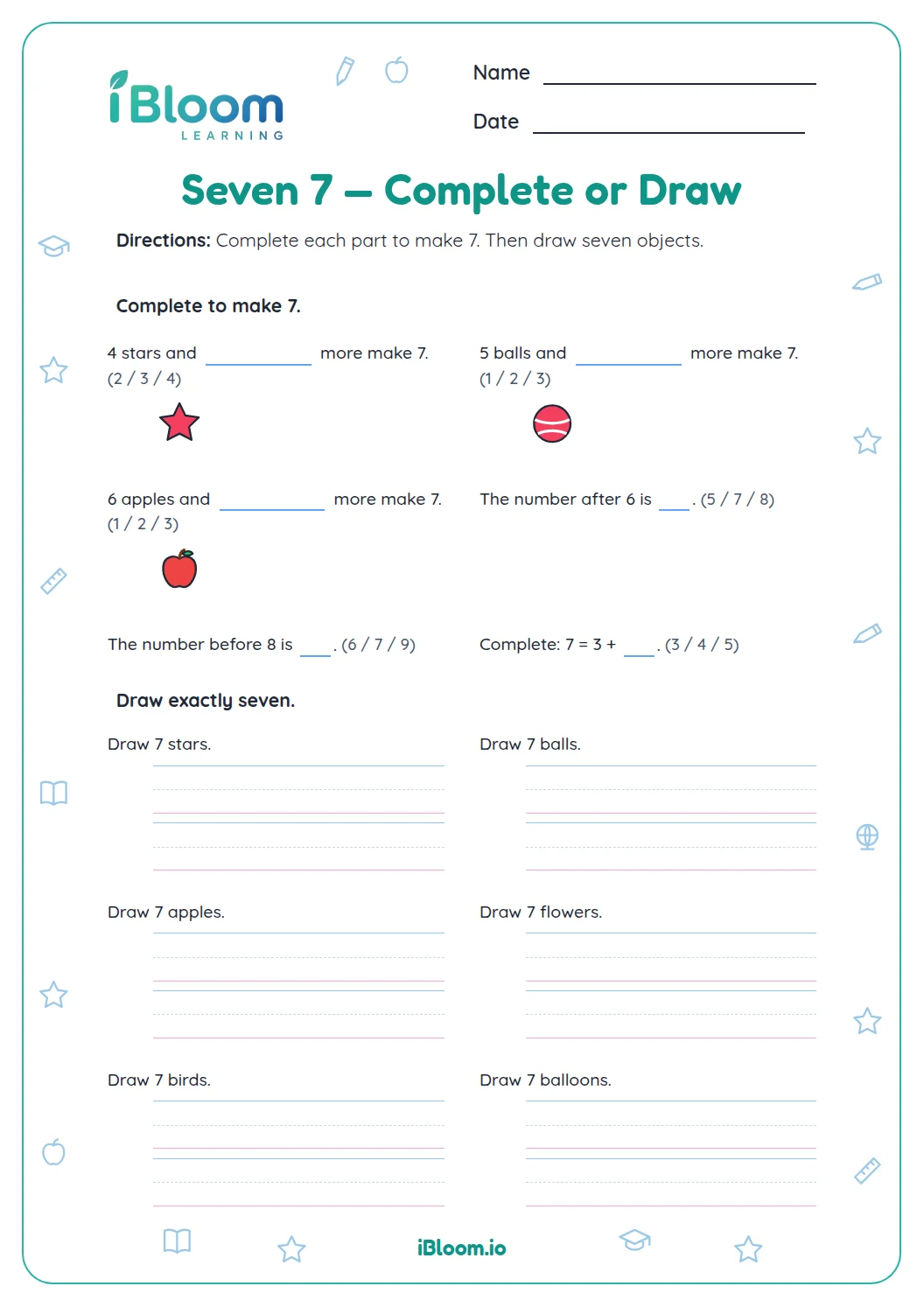
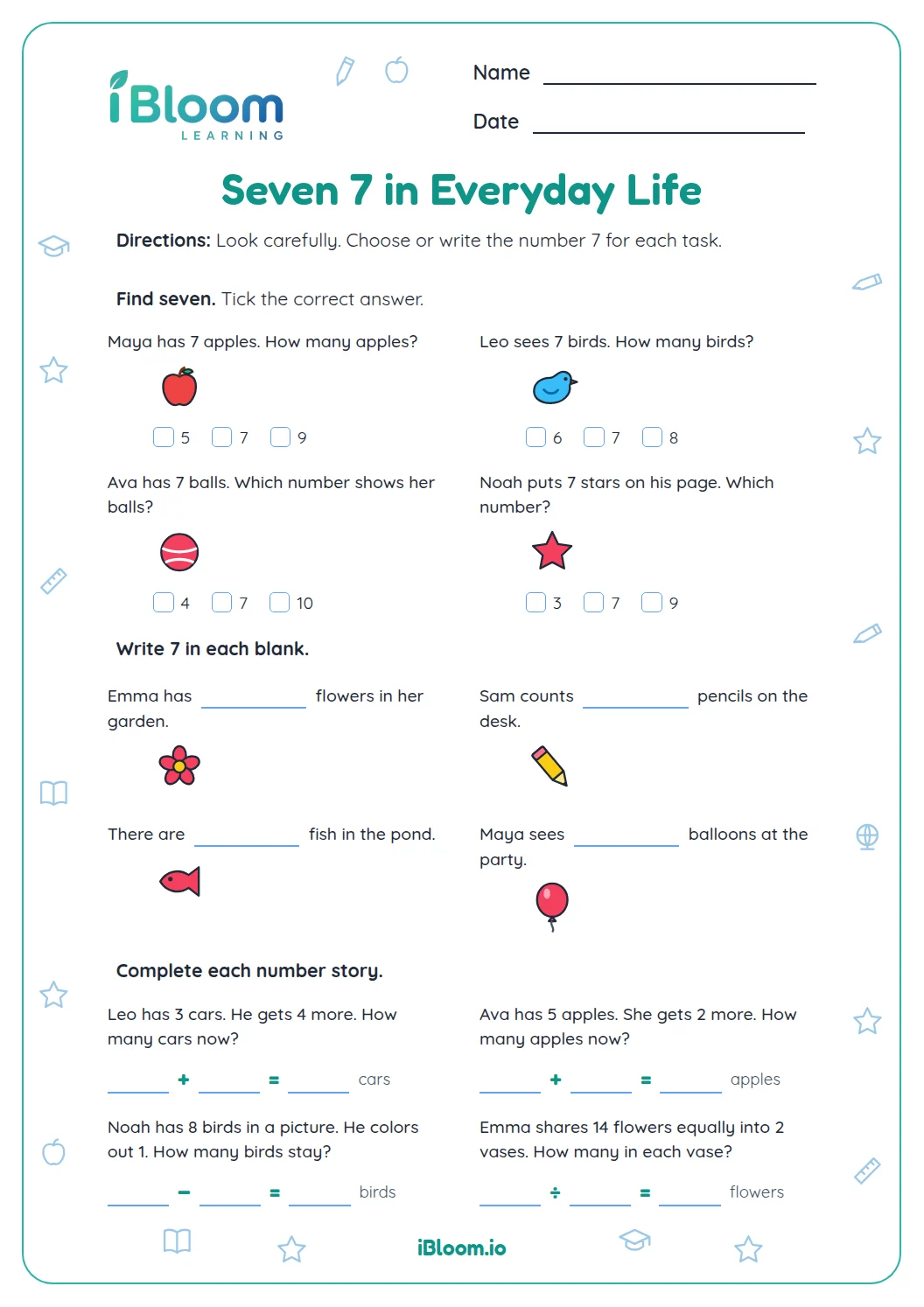
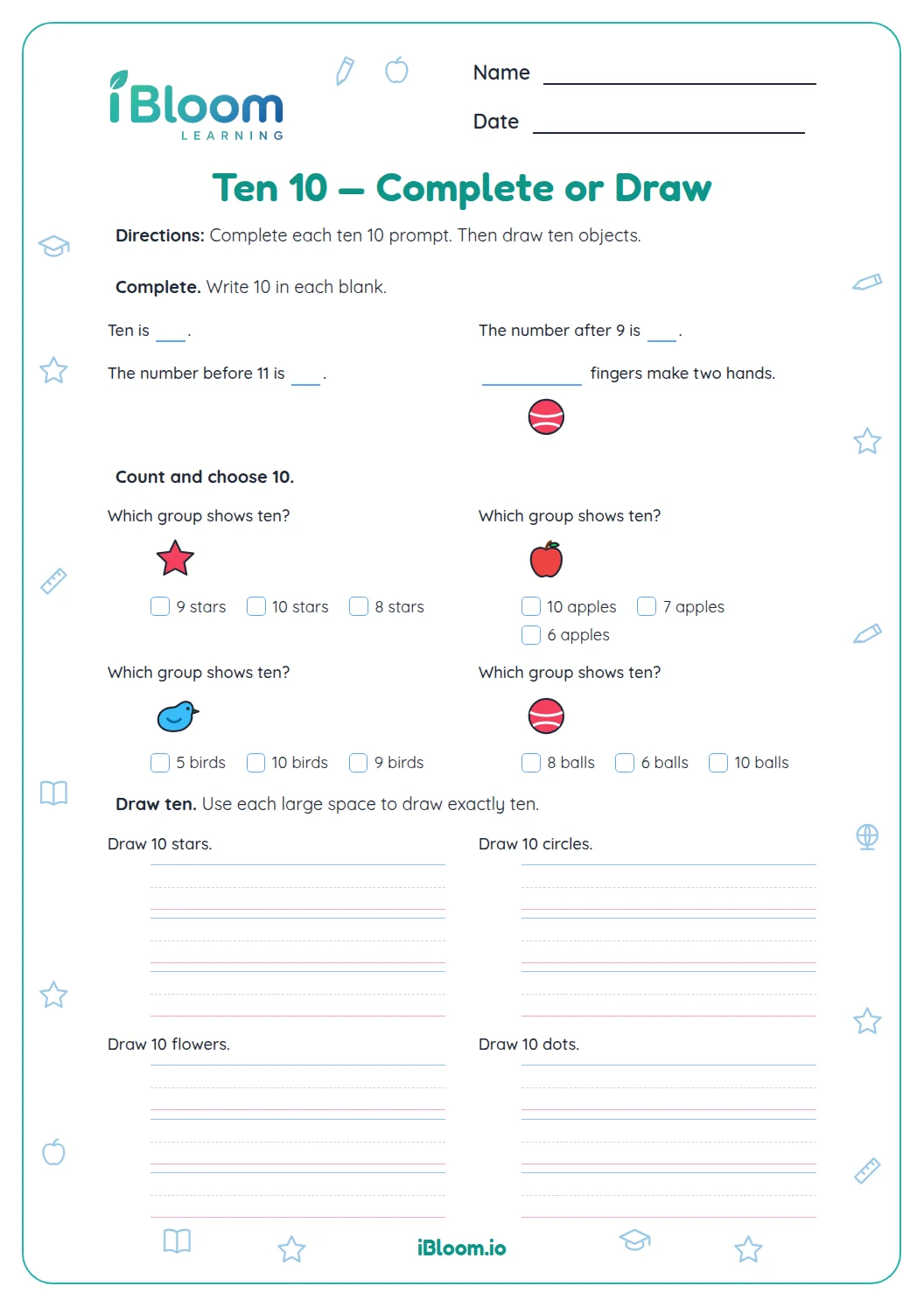
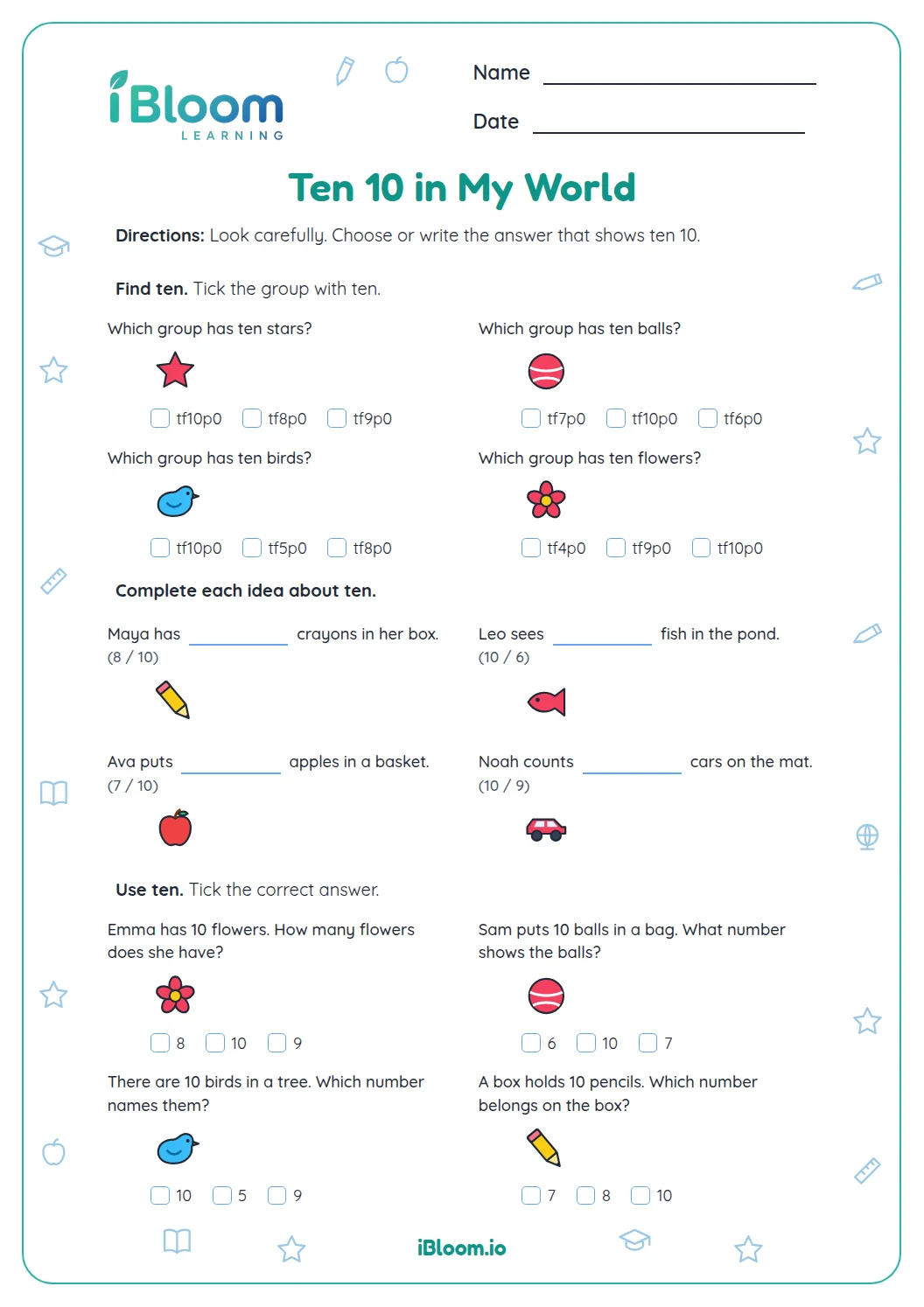
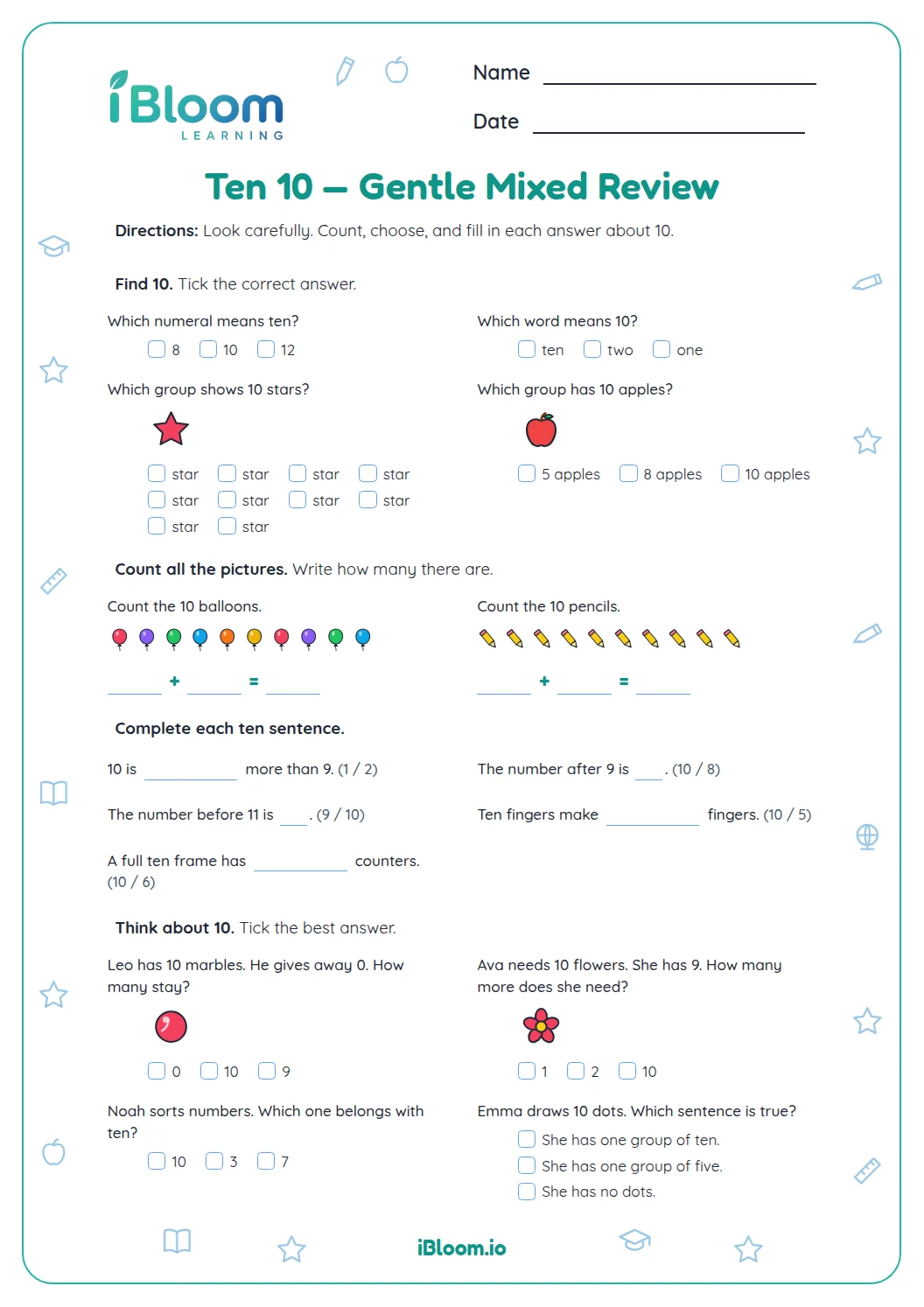
This printable is for preschool and kindergarten learners building familiarity with seven. It combines picture counting, numeral recognition, counting order, addition and subtraction facts, and two short stories. The page practices Kindergarten standards K.CC.A.3 for writing numerals to represent counted groups and K.OA.A.1 for representing addition and subtraction.
Aligned to K.CC.A.3 and K.OA.A.1
How can a child count a group of seven?
Touch each star or apple once while saying the count sequence. In Question 1, count the seven stars and choose 7; saying the last number tells how many are in the group.
How do the number sentences use seven?
The page moves from counting around seven to finding a missing part and solving facts. For 3 + ___ = 7, count on from three: four more makes seven.
Where does seven appear in a story?
The final two questions connect the number to small changes in a group. Start with the amount in the story, then add or subtract the change; check that the answer matches what remains or what is added.
How to use the worksheet
- 1Point to each picture once and count aloud.
- 2Choose the numeral that matches the group.
- 3Read each count sequence from left to right.
- 4For a blank, count on or use fingers to make seven.
- 5Read the story, identify what changes, and check the answer with the key.
Check for these slips
The mistake
Counting one picture twice.
The fix
Touch each star or apple once, moving in a steady direction.
The mistake
Writing the number before instead of after 6.
The fix
Say the counting sequence aloud: 5, 6, 7, 8.
The mistake
Subtracting the change in an addition story.
The fix
Notice whether the group gets larger or smaller before choosing the operation.
Curriculum alignment
This worksheet practices the listed Common Core math skills.
Write numerals to represent groups of objects.
On this sheet: The questions give direct practice with this skill.
Show the official wordingHide the official wording
Write numbers from 0 to 20. Represent a number of objects with a written numeral 0-20 (with 0 representing a count of no objects).
Represent addition and subtraction in several ways.
On this sheet: The questions give direct practice with this skill.
Show the official wordingHide the official wording
Represent addition and subtraction with objects, fingers, mental images, drawings, sounds (e.g., claps), acting out situations, verbal explanations, expressions, or equations.
What to practice next
Make more practice
Further reading
Questions parents and teachers ask
What does the page practice?
It focuses on the numeral 7 through picture counting, numeral recognition, counting order, number sentences, and short stories. The 14 questions include two countable picture groups, number choices, four counting prompts, four addition or subtraction facts, and two stories. in all.
Can I read the directions aloud?
Yes. Read one direction at a time and let the child point, count, or say the number before writing. The picture groups make the set concrete, while the number sentences let the learner practice with familiar quantities without a timer.
How does counting connect to a number sentence?
Counting a group gives the whole amount; a number sentence shows how parts make or change that amount. In 3 + ___ = 7, start at three and count four more. Adding four back to three checks that the total is seven.
How can a child check a subtraction answer?
Start with the number in the story and take away the amount that leaves. For seven birds with one flying away, count back one to six. Ask the child to recount the remaining group or add one back to check the result.
Is there a separate answer key?
Yes. The separate answer key is printed on two pages so an adult can check each number after the child finishes. For the picture questions, invite the learner to touch each object once, count aloud, and name the total; the key marks correct choices.