






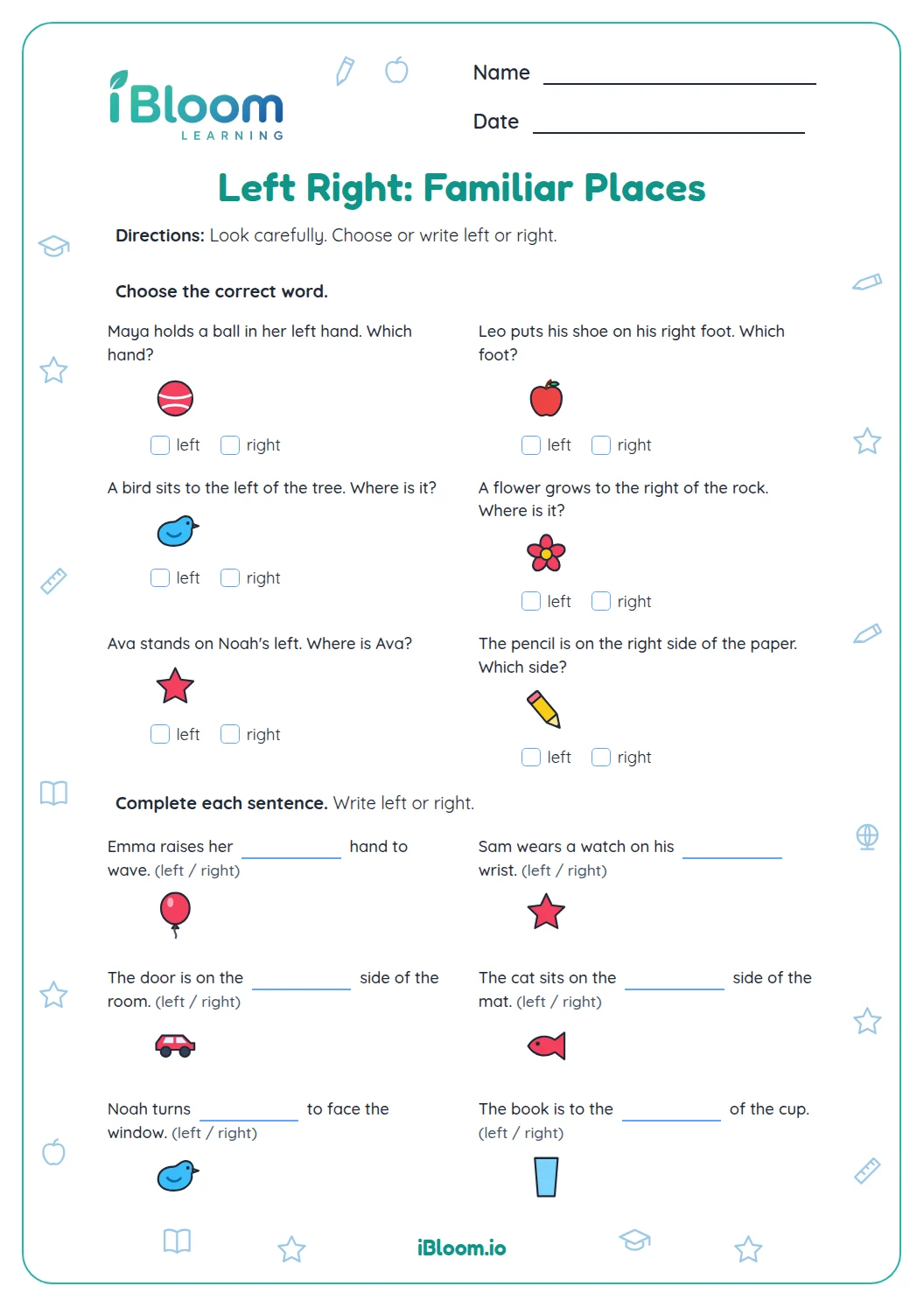
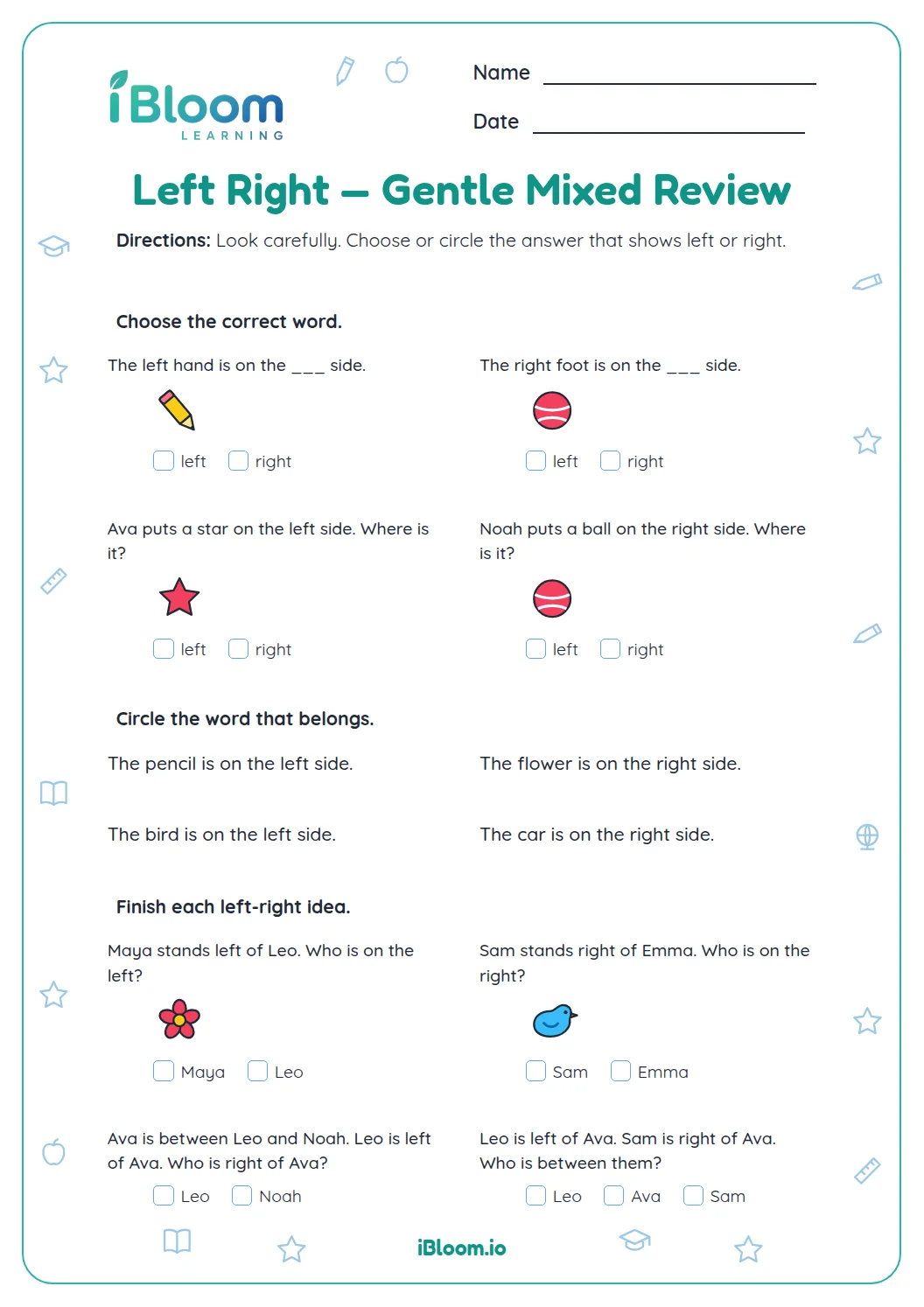
About this worksheet
This free printable worksheet helps preschool and kindergarten children use the position words above and below in places they already know: the sky over a house, a lake under a boat, a hat on your head and shoes on your feet. A grown-up reads each question aloud. In Parts A and B, children mark the picture that is above or below. In Part C, they mark the word that completes a short sentence with pictures in it. The sheet practices Common Core K.G.A.1, describing where things are with words such as above and below. A two-page answer key is included.
Aligned to K.G.A.1
What is on this above and below worksheet?
Part A has four questions about what is above: the sun above you on a sunny day, an airplane above the trees, the moon above the house at night, and a cloud above the rain. Each has three pictures to choose from. Part B has three questions about what is below: a worm below the grass, a fish below a boat, and shoes below a hat.
Part C has three short sentences with small pictures in them, such as “The moon is ___ the house at night.” Children mark above or below. The grown-up reads the sentence and the two words aloud, so no reading is needed.
- Part A: pick the picture that is above (questions 1 to 4)
- Part B: pick the picture that is below (questions 5 to 7)
- Part C: mark above or below in a sentence (questions 8 to 10)
- Every answer choice in Parts A and B is a large picture
How do you explain above and below to a young child?
Link each word to something the child already knows: up high and down low. Above means higher than something else, and below means lower than it. Use the child’s own body and room first, and let the pictures on the sheet repeat the idea.
Read the whole question, point to each picture and name it before the child marks. Naming a worm, a kite and a cloud first lets the child spend their attention on above and below, not on figuring out the picture.
- 1A boat floats on a lake. What swims below the boat?
- 2Think: where is the boat? On top of the water.
- 3Think: what lives in the water, lower than the boat? A fish.
- 4The sun and the cloud are above. The fish is below.
- 5Answer: the fish
How can you practice above and below at home?
Turn it into a game with real objects. Put a teddy bear on a chair and then under it, and ask, “Is the bear above the chair or below it?” Hold a ball above your child’s head, then below their knees. At bath time, place a toy boat above a toy fish. Use the words every time, so the child hears them with real things.
Why do the questions use everyday places?
Children already know that the sun is in the sky, that worms live in the ground and that fish swim in water. Familiar scenes let them use what they know to choose the answer, and then connect the new word, above or below, to something real. The sentences in Part C use the same idea with a moon, a fish and a cloud.
How to use this worksheet at home or in class
- 1Warm up: stand together, reach up high and say “above,” then crouch down low and say “below.”
- 2Read question 1 aloud and point to each picture, naming it before your child marks one.
- 3Ask your child why they chose the picture. Listen for words like high, up, sky, or down, ground.
- 4Move to Part B and say, “This time we are looking for the one that is below.”
- 5In Part C, read each sentence and both words aloud. Let your child mark the word that fits.
- 6Check with the answer key and ask your child to show the answers with their hands, high or low.
Common mistakes and quick fixes
The mistake
Mixing up above and below because the two words are new.
The fix
Pair each word with up and down and a hand motion: hand high for above, hand low for below. Ask, “Is it up high or down low?” before choosing.
The mistake
Picking the sun or a cloud in Part B, because every answer in Part A was up in the sky.
The fix
At the Part B heading, crouch down together and say, “Now we look down low.” Then ask, “Is the sun up high or down low?” before your child marks.
The mistake
Marking the first picture without looking at all three.
The fix
Point to each picture in turn and say its name before the child decides. Then reread the question one more time.
Common Core alignment
The sheet practices the Kindergarten Geometry standard below.
Describe where things are using words like above and below.
On this sheet: Every question asks which thing is above or below another in a familiar scene.
Show the official wordingHide the official wording
Describe objects in the environment using names of shapes, and describe the relative positions of these objects using terms such as above, below, beside, in front of, behind, and next to.
What to practice next
Make more practice
Further reading
Questions parents and teachers ask
What do above and below mean for preschoolers?
Above means higher than something, like the moon above a house. Below means lower than it, like a fish below a boat. Young children usually know up and down first, so connect the new words to those: above is up high, below is down low. This sheet uses familiar places to make the link.
Does my child need to read this worksheet?
No. A grown-up reads each question aloud. The answer choices in Parts A and B are large pictures, and Part C has only two short words, above and below, which the grown-up also reads. Children mark a circle, so the focus stays on position words, not on reading.
What are the answers?
Part A is the sun, the airplane, the moon and the cloud. Part B is the worm, the fish and the shoe. Part C is above, below and above. The answer key is a separate document with each correct choice marked, so a parent or teacher can mark the sheet in under a minute.
Why do some sentences have pictures in them?
In Part C, small pictures stand in for some of the nouns, such as the moon and the house in question 8. They let a child see what the grown-up is reading while thinking about whether it is above or below, which keeps the sentences short and the sheet easy to follow.
What if my child only knows up and down?
That is a good place to start. Ask, “Is it up high or down low?” and then say the matching word, above or below, with every answer. After a few questions, many children start using the new words on their own. Practicing with real objects at home helps the words stick.
How long does this worksheet take, and is there an answer key?
About 10 minutes with a grown-up reading, a little longer if your child likes to talk about each picture. The answer key is a separate two-page document with every correct choice marked, so you can print only the worksheet for your child and keep the key to check.