




About this worksheet
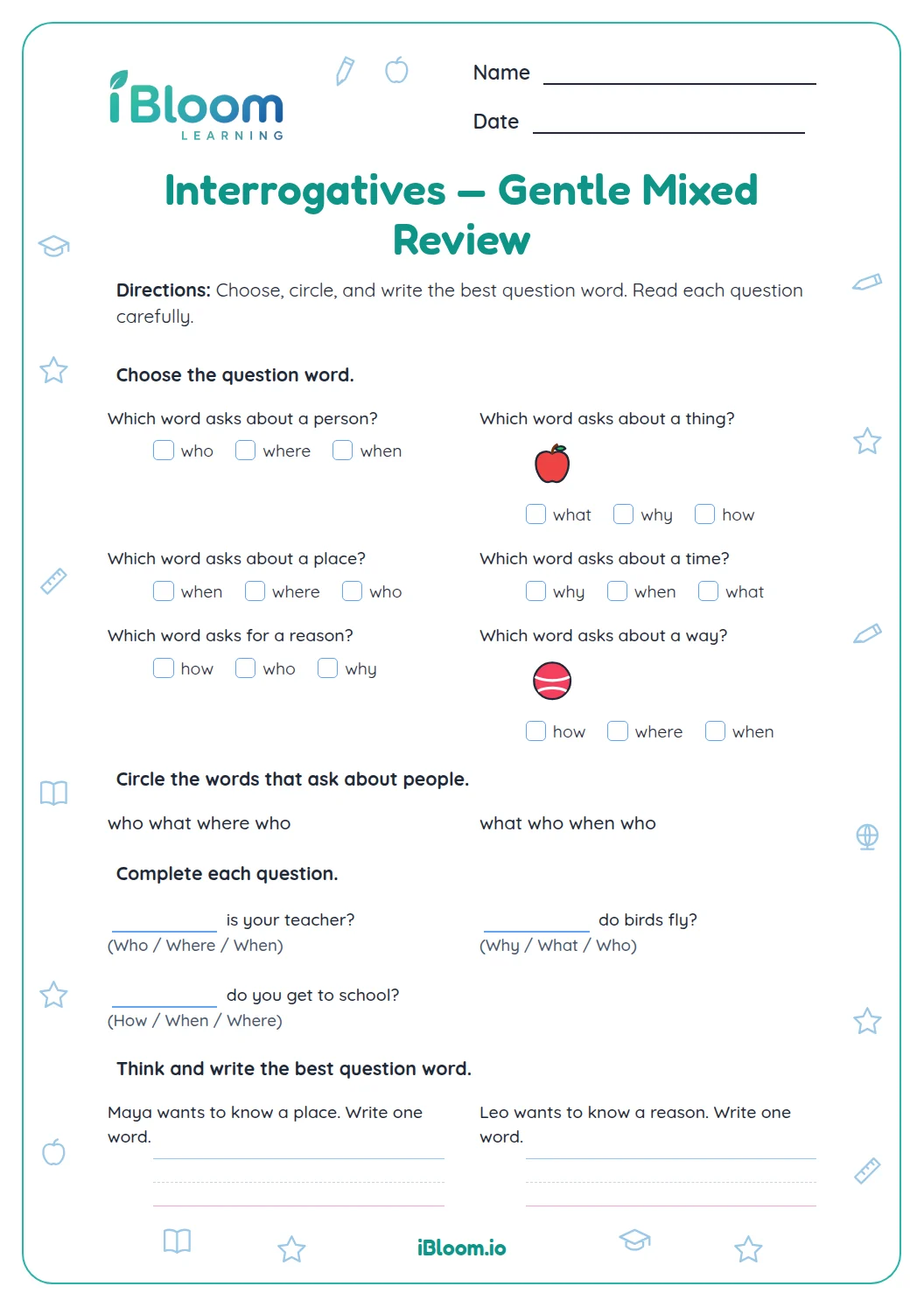
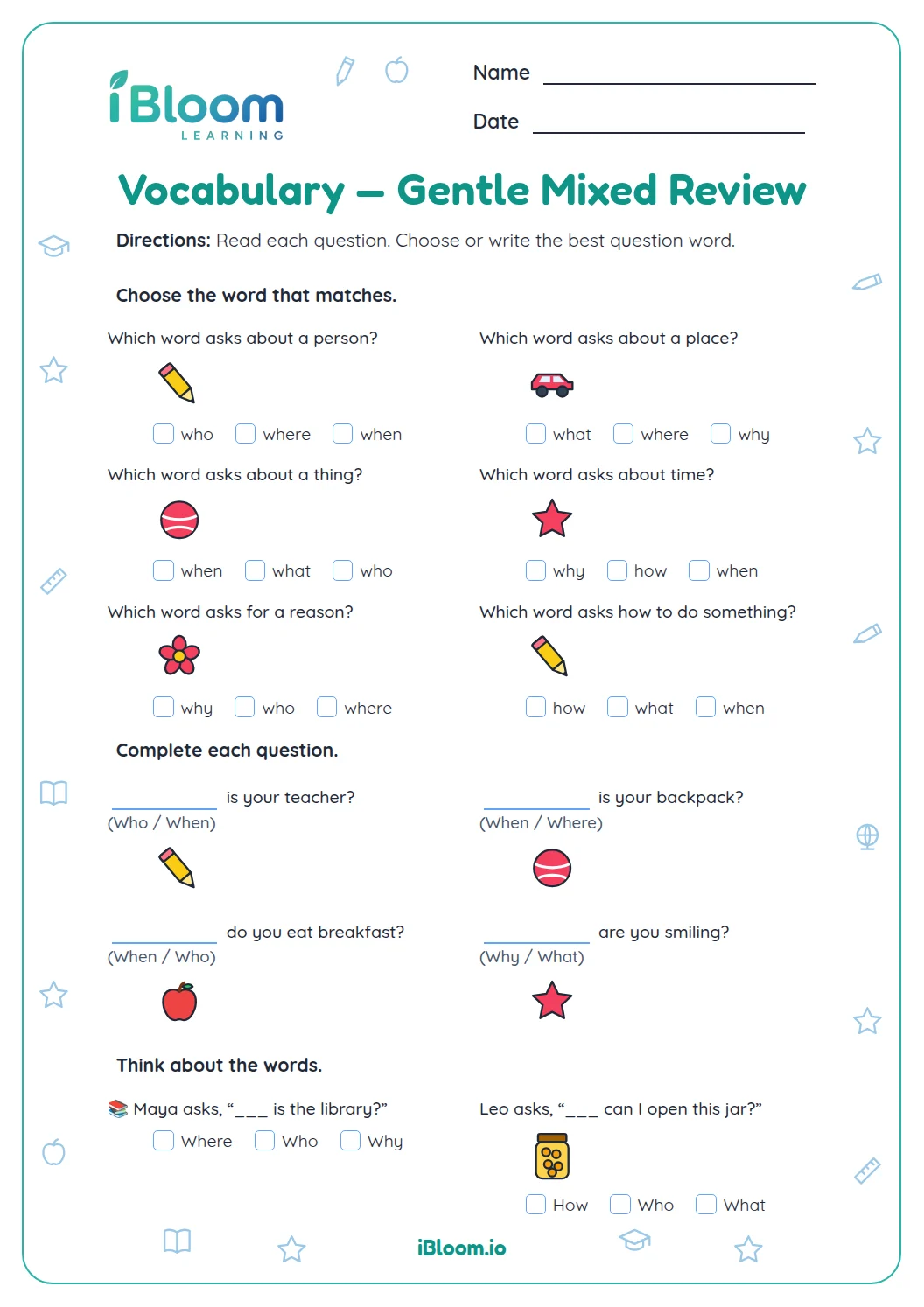
This free printable worksheet is a gentle mixed review of the six question words for preschool and Kindergarten: who, what, where, when, why and how. A grown-up reads each question aloud. Children pick the question word that fits each of six questions, helped by a picture and a short clue such as “Tell the time,” and then circle the question word at the start of four short lines. It practices Common Core L.K.1.d, understanding and using question words, and comes with a separate answer key.
Aligned to L.K.1.d
What is on this worksheet?
The sheet has two short parts, and a grown-up reads every question aloud, so no child needs to read the sheet alone. Every Part A question has a picture above it and ends with a short clue that names the kind of answer the question wants.
All six question words appear in Part A, so the page works as a review of everything children have met so far. Part B then revisits four of the words in a new way.
- Part A, Pick the question word: 6 questions with 3 choices each, one for each of who, when, where, what, why and how, with pictures of a teacher, a clock, a school, an apple, rain with an umbrella, and a shoe
- Part B, Circle the question word: 4 short questions starting with who, when, why and where
- A two-page answer key
What does each question word ask for?
Question words are easiest to learn as answer types. Who points to a person, such as a teacher at the door. What points to a thing, like an apple in a bowl. Where points to a place, when to a time, why to a reason and how to a way of doing something.
The clue after each Part A question names the answer type: Tell the person, Tell the time, Tell the place, Tell the thing, Tell the reason, Tell the way.
- 1___ do we eat lunch? Tell the time.
- 2The clue says the answer is a time.
- 3A time is a when answer.
- 4When do we eat lunch? ✓
Why circle the question word?
Most questions begin with a question word, so Part B asks children to look at the first word and find it: Who is holding the flower? Spotting the word helps children see what the question is asking before they answer it.
With younger children, point to the first word in each line and say it together, then let the child circle it.
How do the pictures help?
Each picture matches the kind of answer the question wants. The teacher is a person, so it goes with who. The clock shows a time, a when answer, and the school is a place, a where answer. The apple is a thing, a what answer. Rain shows the reason we need an umbrella, and the shoe goes with how we tie it.
Look at the picture first, say what it is, and then listen to the question. Matching the two is the same skill children will use later when they answer questions in full sentences.
How to use this worksheet at home or in class
- 1Warm up with a quick game: ask “Who is in our family?” “Where do we sleep?” “What do we eat?” and let your child answer out loud.
- 2Read question 1 aloud, including the clue. Ask what kind of answer it wants, then help your child fill in the bubble for Who.
- 3Let your child do the rest of Part A. Read each question aloud and name the picture together before your child chooses.
- 4In Part B, read each line, say the first word together and have your child circle it.
- 5Ask your child to answer one Part A question out loud, such as “When do we eat lunch?”, to check that the word and the answer match.
- 6Mark with the answer key and ask your child to ask you a question using one of the words.
Common mistakes and quick fixes
The mistake
Picking where for “___ is at the door?” because a door is a place.
The fix
Listen for the clue: Tell the person. A person is a who answer, so the word is Who.
The mistake
Choosing what for “___ do we need an umbrella?” because an umbrella is a thing.
The fix
The clue says Tell the reason. Ask “Do we need an umbrella because of the rain?” A reason is a why answer.
The mistake
Mixing up when and where, since both start with wh.
The fix
Hold up a clock and a house. Say, “When goes with a time, where goes with a place,” and match each question to one of them.
Common Core alignment
Most US states use the Common Core language standards or a close state version.
Understand and use the question words who, what, where, when, why and how.
On this sheet: Part A uses all six question words with clues about the answer, and Part B finds the question word in four questions.
Show the official wordingHide the official wording
Understand and use question words (interrogatives) (e.g., who, what, where, when, why, how).
What to practice next
Make more practice
Further reading
Questions parents and teachers ask
What are question words?
Question words, also called interrogatives, are the words that start most questions: who, what, where, when, why and how. Each one asks for a different kind of answer. This worksheet helps children learn them by matching each word to the person, thing, place, time, reason or way the question wants.
What age is this question words worksheet for?
It is written for preschool and Kindergarten children, ages about 4 to 6, with a grown-up reading every question aloud. Part A suits children who are just meeting the words. Part B gives Kindergartners more independence as they find the question word in each line.
Does my child need to read to do this worksheet?
No. A grown-up reads each question and its choices aloud, and the pictures and clues help children decide. In Part B, point to the first word of each line and say it together. Children who already recognize the words can try the circling on their own.
What should I do if my child confuses when and where?
Connect each word to its answer type: when goes with a time, such as a clock, and where goes with a place, such as a school. Practice with everyday questions, like “Where are your shoes?” and “When do we eat dinner?” and let your child answer out loud.
How long does the worksheet take, and is there an answer key?
Most children finish in about 15 minutes with a grown-up reading along. The two-page answer key matches the worksheet page for page and shows every correct word, so you can print the worksheet on its own and check the answers with your child afterward.
How can we practice question words after this worksheet?
Play a question game at dinner or in the car: take turns asking a question that starts with who, what, where, when, why or how and answering it. Ask your child to choose the word each time. Short, playful practice helps the words stick.