




About this worksheet
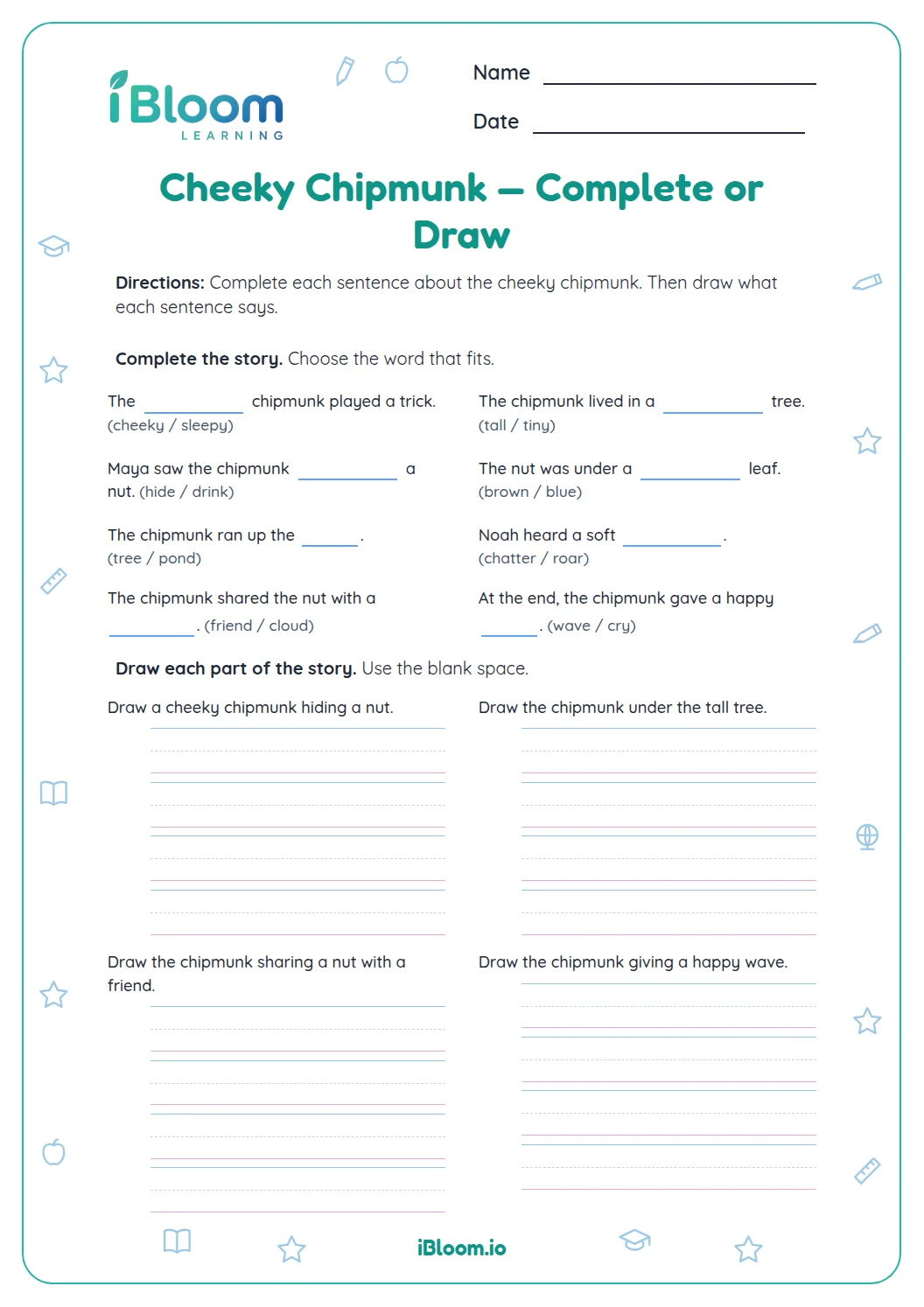
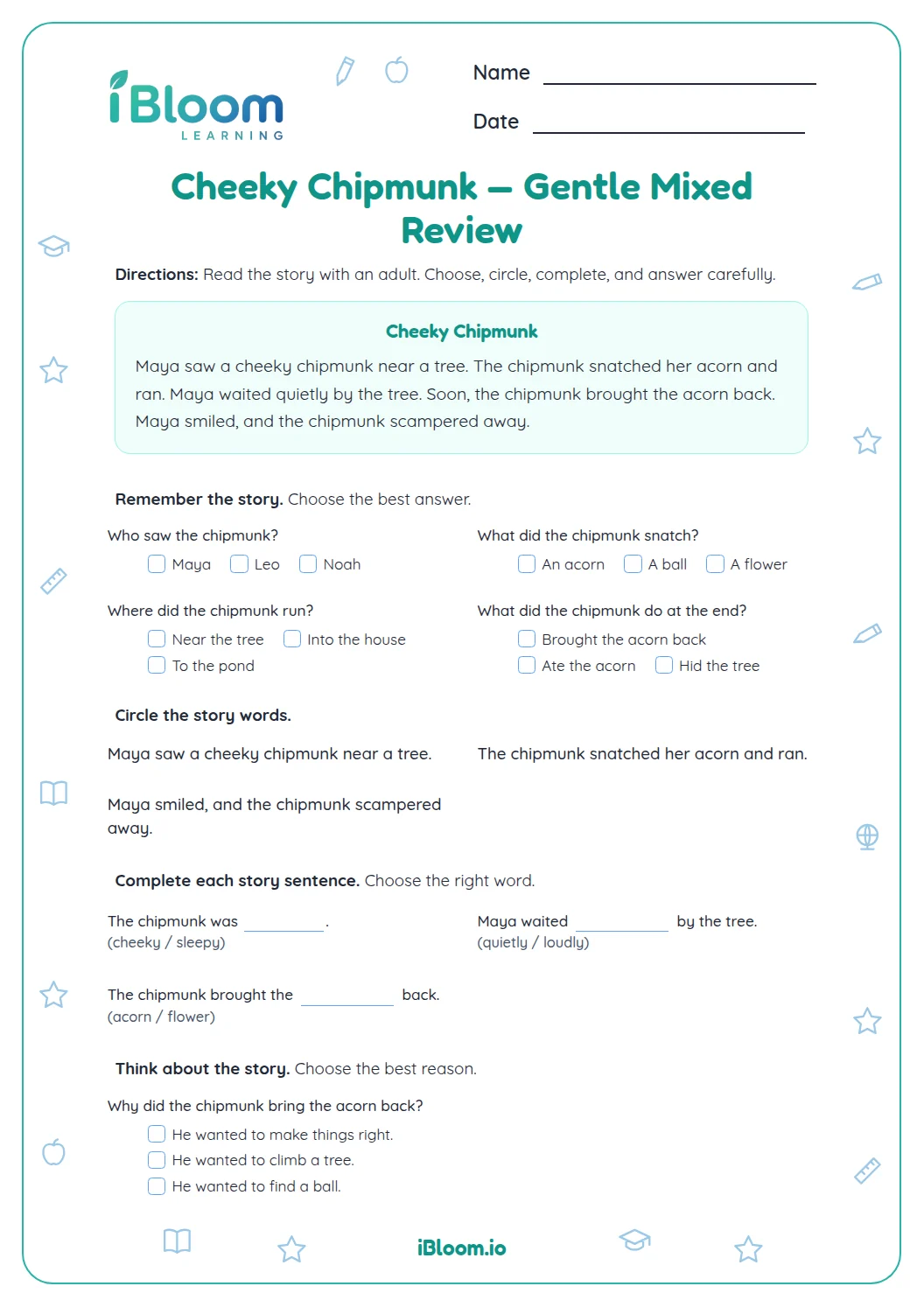
This printable story comprehension page is for preschool and kindergarten learners. Read or listen to Chip’s playful surprises, then answer 14 questions about his actions and the word “cheeky.” Picture choices support one item, and the final questions invite children to respond in their own words.
Aligned to K.RL.1
How can a young learner use this page?
The 14 questions revisit Chip’s playful actions, use the word “cheeky” in context, and connect the story with a picture and open responses. An adult can read the passage aloud, and the separate key includes sample answers.
This printable story comprehension page is for preschool and kindergarten learners. Read or listen to Chip’s playful surprises, then answer 14 questions about his actions and the word “cheeky.” Picture choices support one item, and the final questions invite children to respond in their own words.
Use story clues
Reread or listen again when an answer is hard to remember. The sentence around an unfamiliar word can help explain what it means.
What questions are on the sheet?
The worksheet contains 14 questions in 3 parts. The answer key is on a separate page.
- Recall who found the acorn and what happened.
- Use the surrounding sentences to understand “tugged.”
- Connect the story to a picture and share an idea.
How to use this worksheet
- 1Read the one-sentence directions and complete each part in order.
- 2Pause at the end of each part to check how you reached an answer.
- 3Use the separate answer key to review answers and revisit any missed item.
- 4For open responses, compare your idea with the sample and explain your thinking.
Common slips to check
The mistake
Choosing an answer that does not match a story detail.
The fix
Listen to or reread the sentence that tells what happened.
The mistake
Guessing a new word without using its sentence.
The fix
Look at the nearby action and use it as a clue.
The mistake
Thinking an open response has only one possible idea.
The fix
Tell an idea that fits the story; compare it with the sample answer.
Curriculum alignment
Answer questions about key details in a story read aloud or independently.
On this sheet:
Show the official wordingHide the official wording
With prompting and support, ask and answer questions about key details in a text.
What to practice next
Make more practice
Further reading
Questions parents and teachers ask
What playful surprises does Chip make?
Chip hides Maya’s acorn under a leaf, moves Leo’s pencil, peeks from behind a flower, taps a tree, and wears a leaf like a hat. Emma laughs at the leaf hat and calls Chip cheeky. The questions ask children to remember and interpret those actions.
How can a preschool learner complete this page?
An adult can read the passage aloud while the child listens and answers by speaking, pointing, or marking a choice. The questions revisit what Chip did at home, school, and in the yard, then ask about his playful surprises.
What does the word “tugged” mean in the story?
In this story, cheeky describes playful, slightly naughty behavior. Chip hides an acorn, moves a pencil, and surprises Emma with a leaf hat. Children can use those actions and Emma’s amused reaction to work out the word’s meaning.
What reading skills do the questions practice?
The page asks children to recall who, what, and where details, infer a word’s meaning from actions, and connect a story detail to a picture. Two open responses invite children to describe Chip’s behavior or imagine another playful surprise.
Can a child answer without reading independently?
Yes. An adult can read the short passage and each question aloud, then let the child answer by pointing, speaking, or choosing an option. The page is designed for supported listening and discussion as well as early independent reading.