




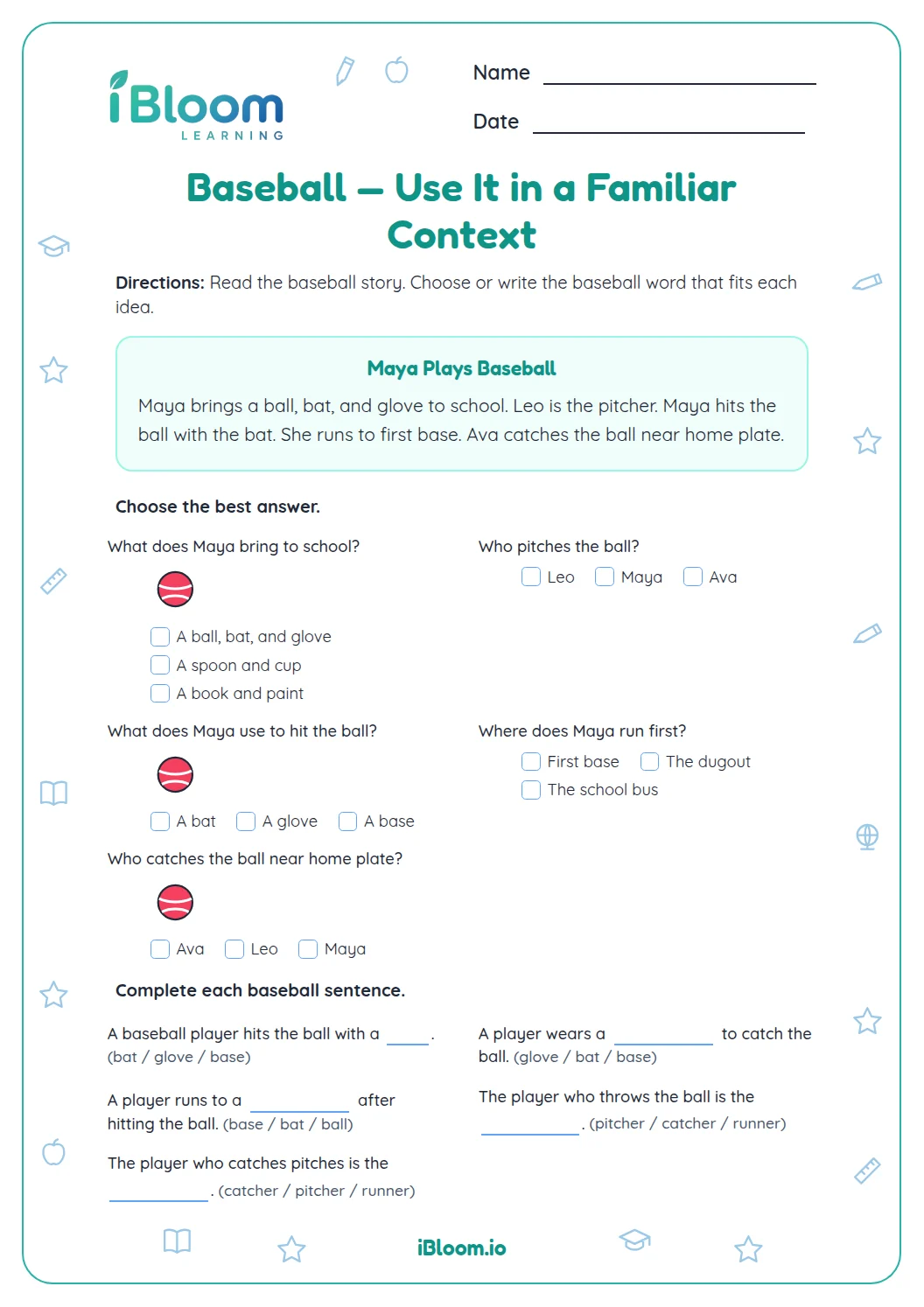
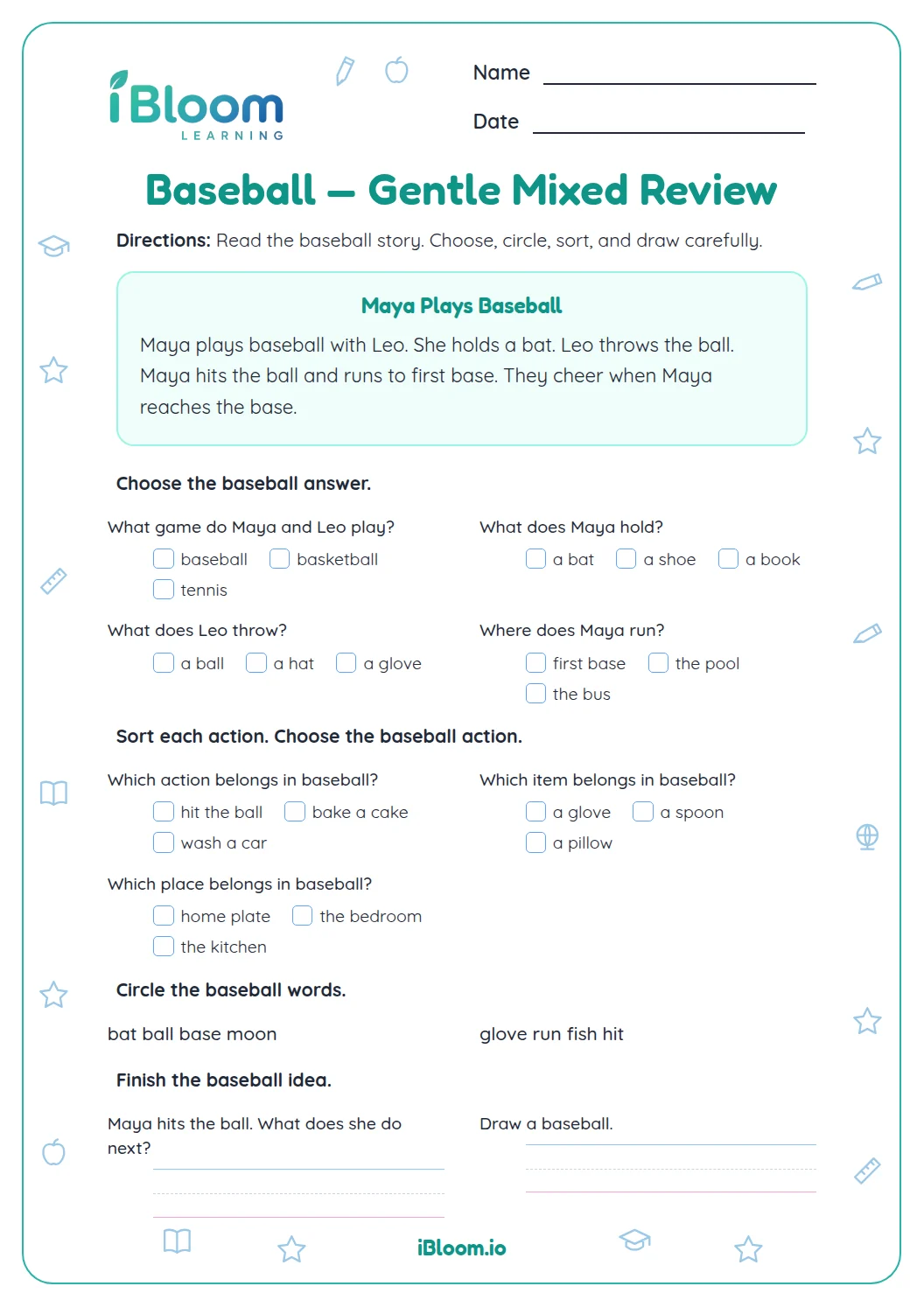
About this worksheet
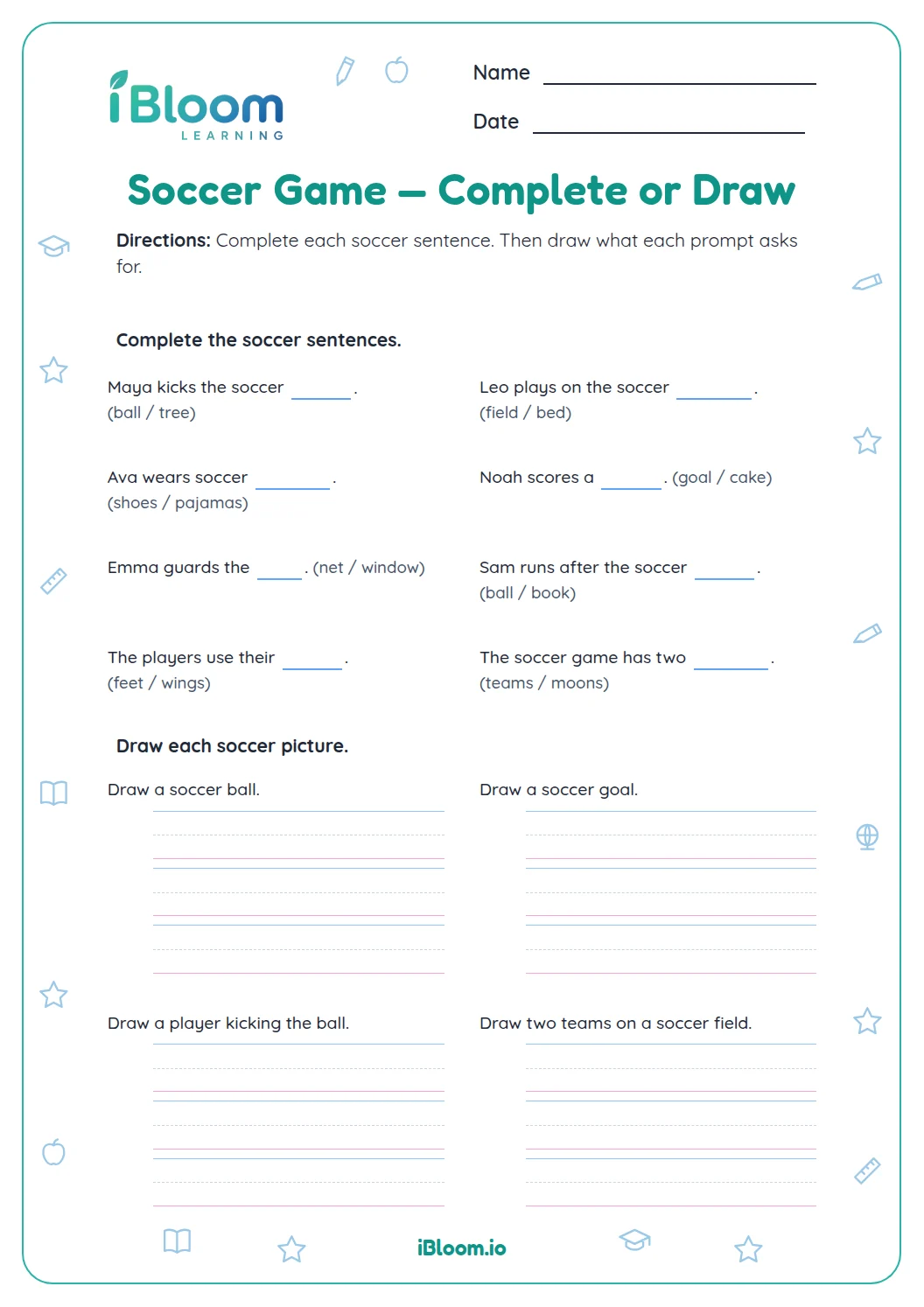
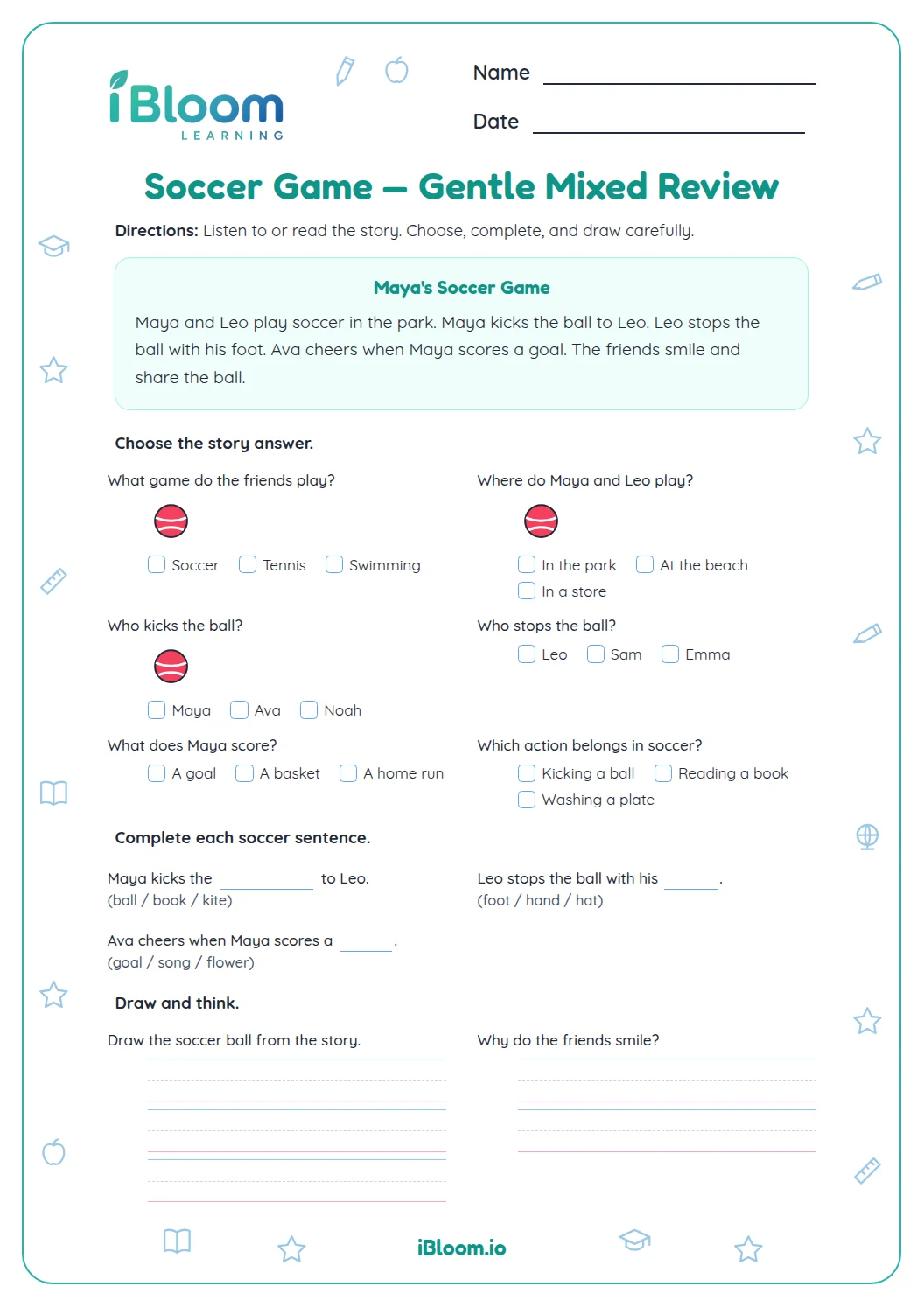
This free printable is for preschool and kindergarten learners listening to or reading a short soccer story. Children answer 15 questions about where the game happens, what the players do, and what happens afterward. Picture choices support familiar soccer words, and the last questions connect the story to taking turns and encouraging a teammate. A separate answer key includes a sample response for the open-ended question.
What happens in the soccer story?
Maya and Leo play at school. Maya kicks the ball to Leo, Leo sends it into the goal, and Ava cheers. After the game, the friends carry the ball home. The questions ask children to recall those details before making familiar connections.
How can a child find a story detail?
Read or listen to the question, then return to the matching sentence. For example, the story says Maya kicks the ball to Leo, so “a ball” answers what she kicks.
- 1What does Maya kick?
- 2The story says she kicks the ball to Leo.
- 3Choose “A ball.”
How does the page connect story and play?
Picture choices show familiar soccer objects, and the final items ask about passing, kind cheering, and what the friends do when the game ends. Children can answer aloud or write a reason for their own choice.
How to use this worksheet
- 1Read the short story aloud or listen as an adult reads it.
- 2Ask the child to point to a detail before choosing an answer.
- 3Name familiar soccer pictures together.
- 4Talk about taking turns and cheering kindly.
- 5Use the separate key to check the choices and sample response.
Common mistakes and quick fixes
The mistake
Guessing before listening to the whole story.
The fix
Reread the sentence that tells what happened.
The mistake
Mixing up the players’ actions.
The fix
Say who kicks, runs, or cheers in each sentence.
The mistake
Treating the sample response as the only possible reason.
The fix
Accept another clear choice and child’s own reason for question 15.
What to practice next
Make more practice
Questions parents and teachers ask
How many questions are included?
There are 15 questions about Maya and Leo’s soccer game. Children recall story details, use picture choices, and think about taking turns and cheering for a teammate. The last question invites a personal choice with a short reason, so answers can vary.
Can an adult read the story aloud?
Yes. The story is short and can be read aloud while the child listens. Pause to let the child point to a detail or name a picture before choosing an answer. The activity is designed to use the story’s details and familiar soccer ideas.
Are there picture questions?
Yes. Several questions include pictures of a soccer ball and familiar objects. The pictures help young learners connect the story to recognizable things used during play, while the answer choices still ask them to think about what happened. Read the printed question again, explain the choice or calculation, and then use the separate key to confirm the result.
What is the final question asking?
The final question asks whether the child would rather pass the ball or take a shot and why. There is no single required personal choice. The key gives one sample reason, and another sensible reason should be accepted. Read the printed question again, explain the choice or calculation, and then use the separate key to confirm the result.
Does the page include an answer key?
Yes. A separate answer key page lists the expected choices and gives a sample response for the final question. For that open-ended item, use the sample as a model rather than requiring the exact same words. Read the printed question again, explain the choice or calculation, and then use the separate key to confirm the result.