






About this worksheet
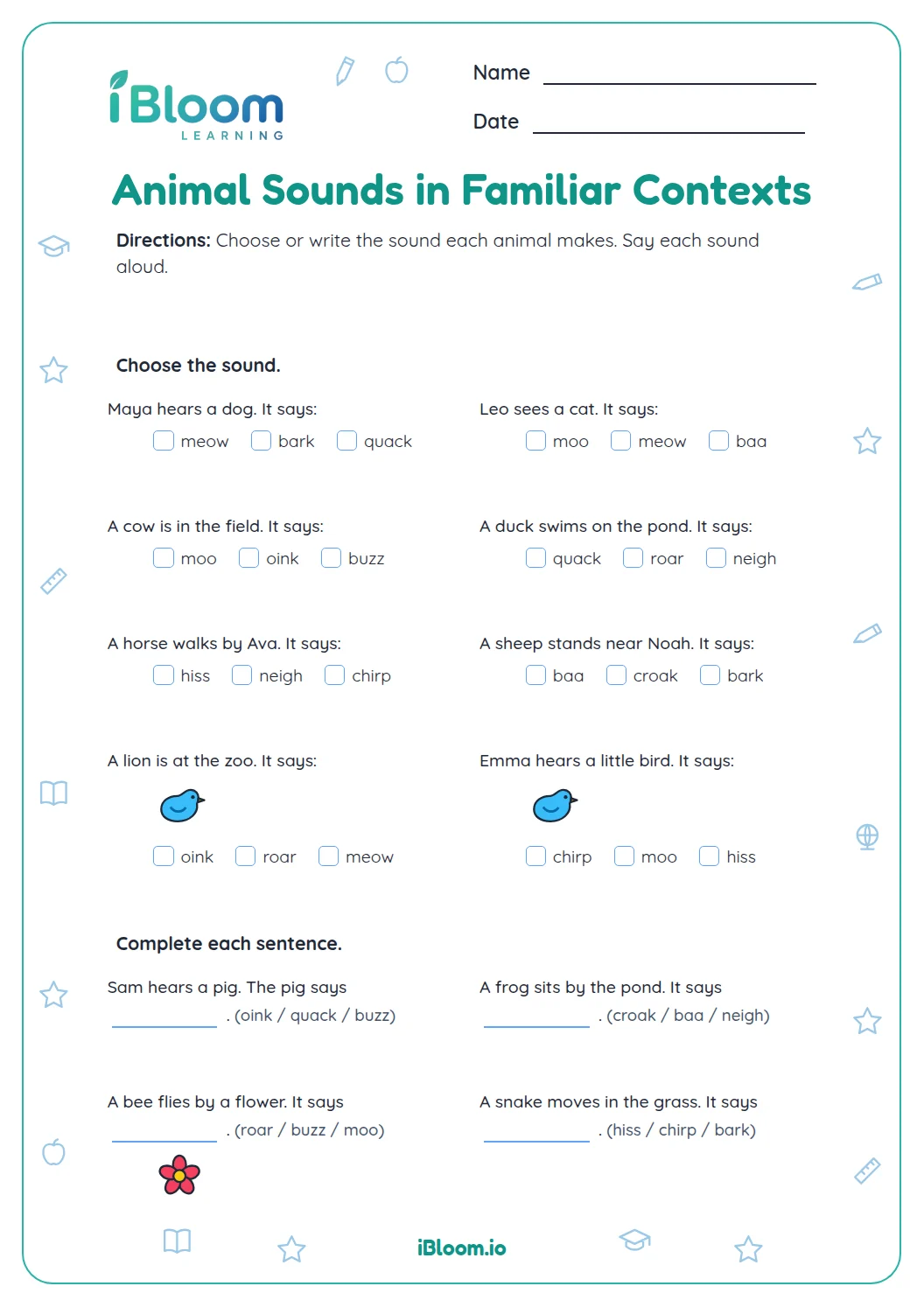
This free printable is for preschool and kindergarten learners connecting familiar animals with their sounds. Children choose a sound for six animal pictures, finish six sound words, and draw a dog and a duck showing their sounds. The separate answer key gives the six sound words and a sample target for each drawing. Use it as a picture-supported activity at home or in class.
What does this worksheet practice?
The page begins by matching animal pictures to sounds, then asks children to write those sound words. Two final drawing prompts invite them to show an animal making its sound.
- Choose a sound for each of six animal pictures.
- Complete six animal-sound words.
- Draw a dog and a duck with sound bubbles.
How can I solve one example?
Name the animal first, then say a sound that fits it. For the dog picture, “woof” is the matching sound.
- 1Which sound does the dog make?
- 2Choose woof from the three choices.
- 3For the blank, write: The dog says woof.
What should the drawings show?
Draw the named animal and add a speech bubble with its sound. A clear animal drawing and a sound such as “woof” or “quack” make the connection easy to check.
How to use this worksheet
- 1Name each animal picture before choosing a sound.
- 2Read the three choices and select the sound that fits.
- 3For a blank, say the sound aloud and write it on the line.
- 4Use the last two boxes to draw an animal and show its sound.
- 5Check the word answers with the key; discuss the drawings together.
Common mistakes and quick fixes
The mistake
Choosing a sound that belongs to a different animal.
The fix
Say the animal name first, then compare each sound choice.
The mistake
Leaving off a beginning or ending sound when writing a sound word.
The fix
Stretch the word slowly and listen for each part.
The mistake
Drawing an animal without showing its sound.
The fix
Add a speech bubble, sound marks, or a sound word to the drawing.
What to practice next
Make more practice
Questions parents and teachers ask
What animals are on the worksheet?
The picture choices and sound blanks use a dog, cat, cow, duck, pig, and sheep. The two drawing prompts ask for a dog and a duck. The answer key lists woof, meow, moo, quack, oink, and baa for the matching and writing items.
Does the answer key accept different sound spellings?
The key uses woof, meow, moo, quack, oink, and baa, matching the choices and blanks. Some sound words have familiar spelling variations, so a clear version that names the same sound can be accepted when a child writes it. The choices themselves use the printed spelling.
How can we use the drawing questions?
Ask your child to draw a dog for one prompt and a duck for the other, then add a speech bubble with the animal’s sound. The key gives a simple sample for each. The drawings can be pictures rather than written sentences, so the child can focus on the animal and its sound.
Can we do the worksheet without making animal noises?
Yes. A child can point to a choice, say the sound quietly, or write it on the blank. Making an animal noise is optional; the printed task is to connect the animal with the sound word. The picture choices and separate answer key support checking without requiring spoken imitation.
What should my child try next?
After naming the animals and their sounds, learners can explore what animals need or where they live. The Animal Names, Animal Babies, and Animal Habitats pages linked above offer related practice. Ask your child to name one animal from this sheet and tell one thing it needs or where it might live.