


About this worksheet
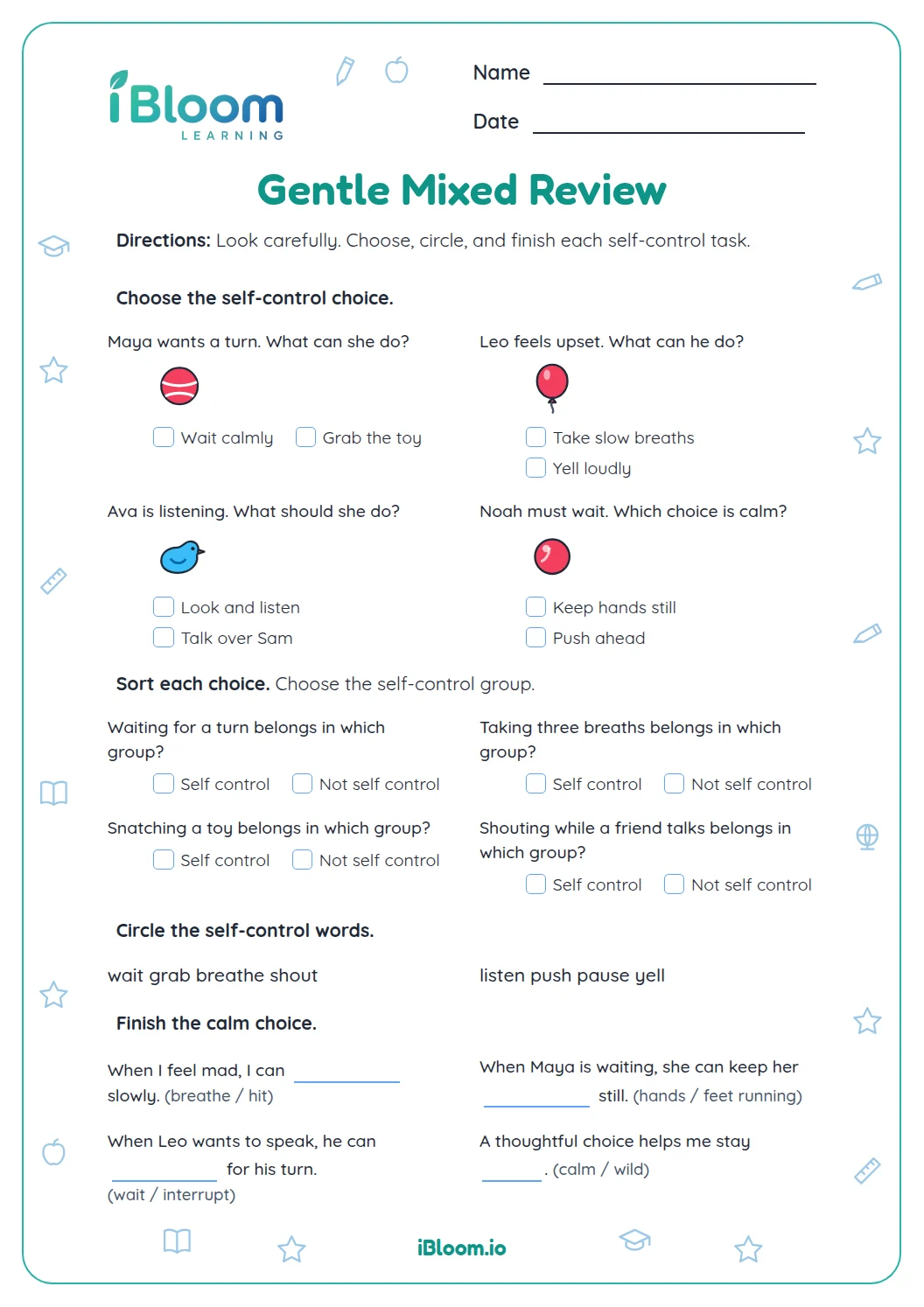
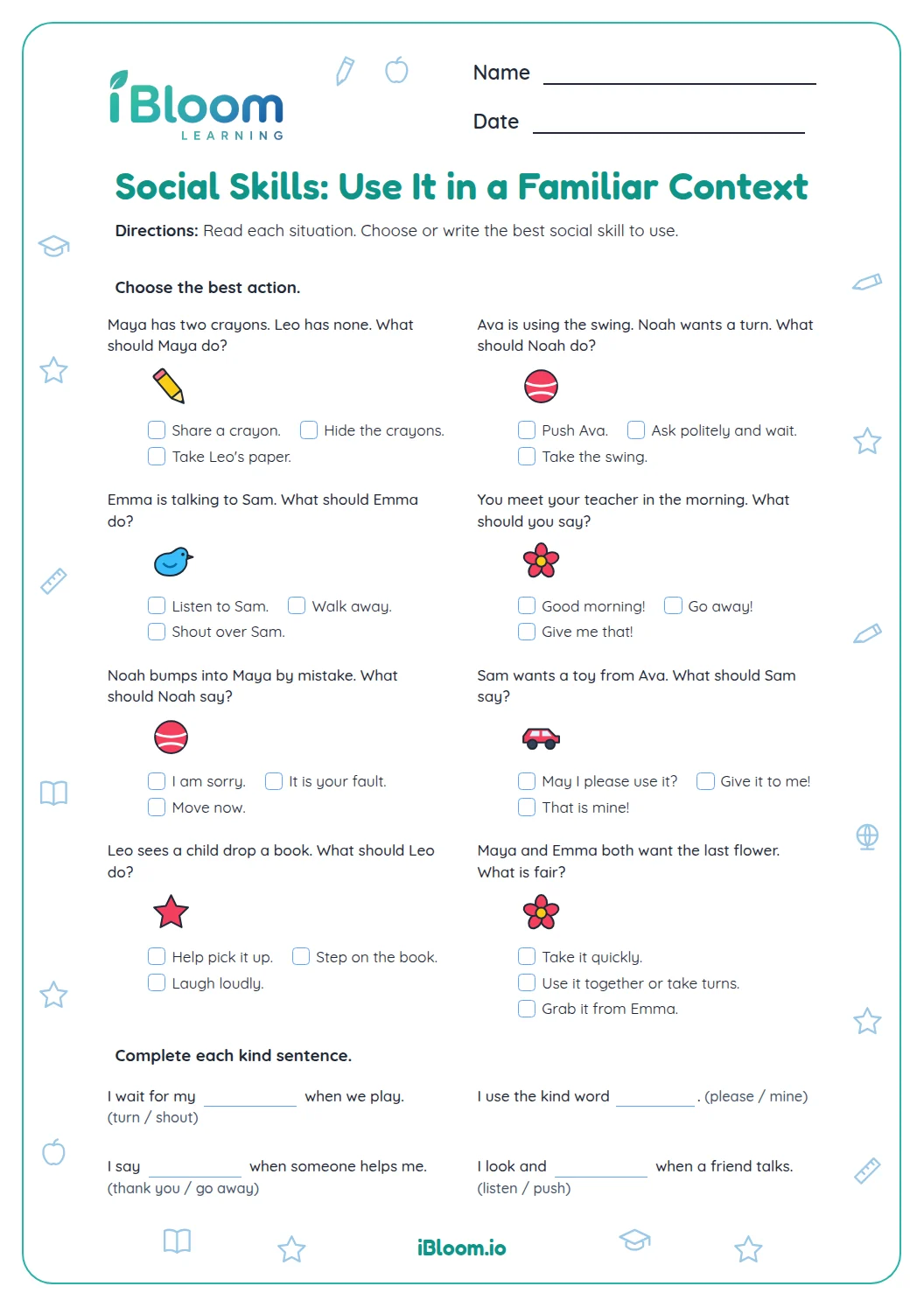
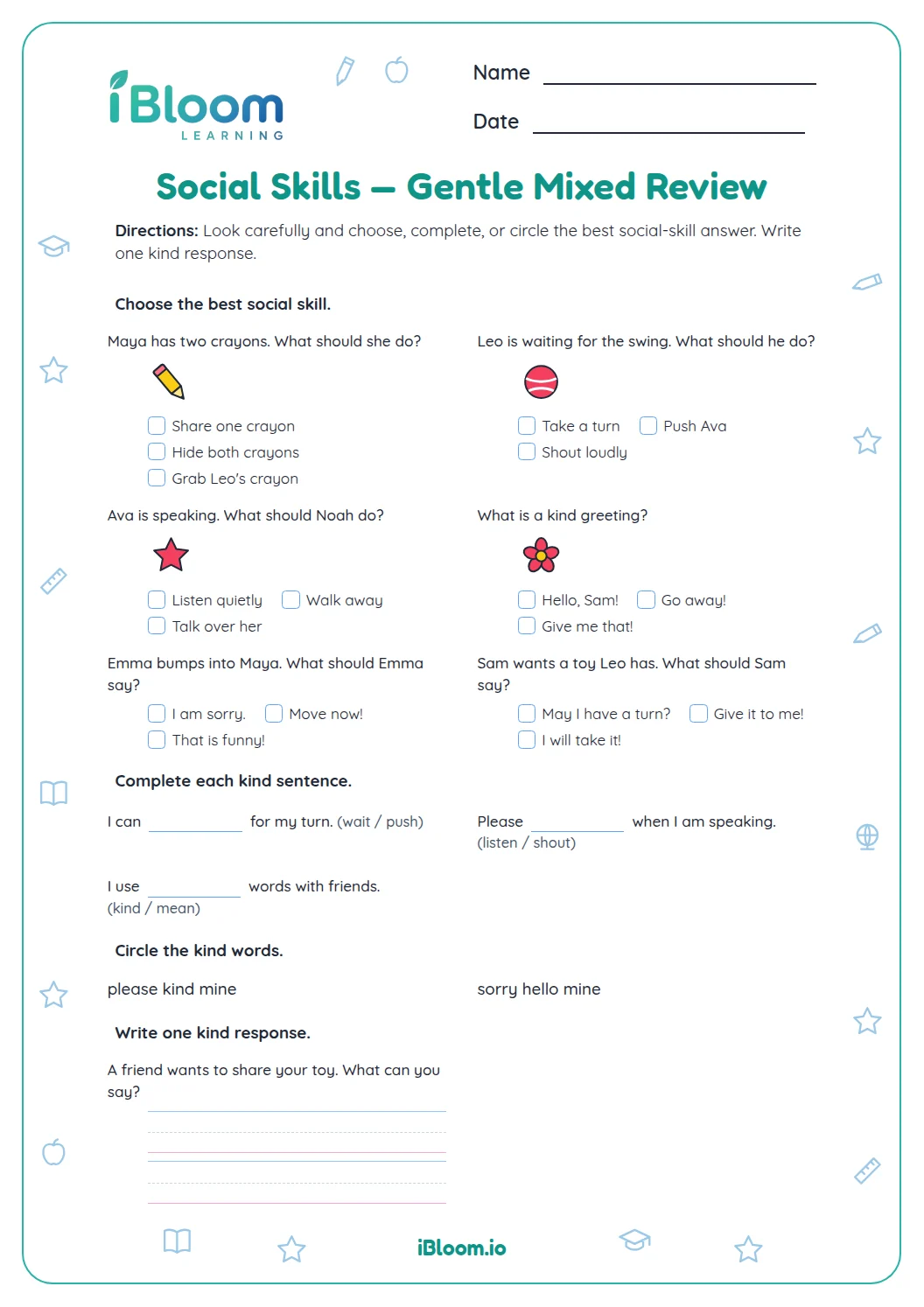
This printable gives preschool and kindergarten children practice choosing a safe, calm action in familiar moments: waiting for a swing, feeling upset after a game, or finding that a tower fell. Eleven questions offer picture cues and answer choices; three invite a spoken or written response. The key accepts reasonable answers that show waiting, calming, listening, or asking for help. An adult can read each prompt aloud.
Which choice helps in the moment?
Part A uses familiar situations with picture cues. Children choose an action that keeps people and materials safe, such as waiting for a turn or asking to fix a tower.
What can help a child calm down?
Part B asks children to notice a feeling or a hard moment and choose a calm response. Taking a breath, asking for help, and trying again are examples in the answer choices.
What words or tools could you use?
Part C has three open prompts. A child may answer aloud or write a short response; the key gives examples rather than requiring one exact phrase.
How to use the page together
- 1Read each situation aloud and let the child look at its picture cue.
- 2Ask what the person might be feeling or wanting.
- 3Have the child choose the response that is safe and helpful.
- 4For the last three prompts, accept a sensible spoken or written idea.
Ways to support a thoughtful choice
The mistake
Choosing the fastest action without thinking
The fix
Pause and ask which choice keeps everyone safe.
The mistake
Thinking a calm choice means a child cannot feel upset
The fix
Name the feeling, then choose what to do with it.
The mistake
Expecting one exact answer to an open prompt
The fix
Accept different words when they describe a helpful action.
What to practice next
Questions parents and teachers ask
What situations appear on the worksheet?
Children respond to situations involving a swing, a puzzle, a game, a conversation, blocks, a line, a snack, a tower, and asking for a crayon. The prompts focus on choices a young child can recognize and talk through with an adult. Children can point to a choice before explaining why it might help in that moment.
Can I read the questions aloud?
Yes. An adult can read each short situation and its choices aloud while the child looks at the picture cue. Invite the child to explain the choice in their own words, especially when more than one calm action might help. Keep the discussion short and let the child answer before offering a suggestion.
Do the last questions have only one right answer?
No. The final three prompts invite a reasonable response, such as taking a slow breath while waiting or asking politely for the next turn. The answer key includes sample responses; it is not a script children must repeat. Encourage the child to tell what could help the character feel ready to try again.
How many questions are included?
There are 14 prompts in three parts. Eleven are picture-supported multiple-choice questions, and three ask children to name a helpful action, calming tool, or kind phrase. The answer key gives sample ideas for adults to use when reviewing the open prompts.
What does self-control mean in these examples?
Here it means pausing and choosing an action that is safe and considerate, even when a child feels impatient or disappointed. The examples include waiting, taking a breath, asking for help, and trying again. A child might also use words to name the feeling before choosing a next step.
How can I respond if my child picks a different choice?
Ask the child to explain what might happen next with that choice. If it is safe and kind, acknowledge the reasoning; if not, talk about another action that protects people and belongings and helps solve the problem. The goal is to talk through a choice, not to score a child’s feelings or behavior.