

About this worksheet
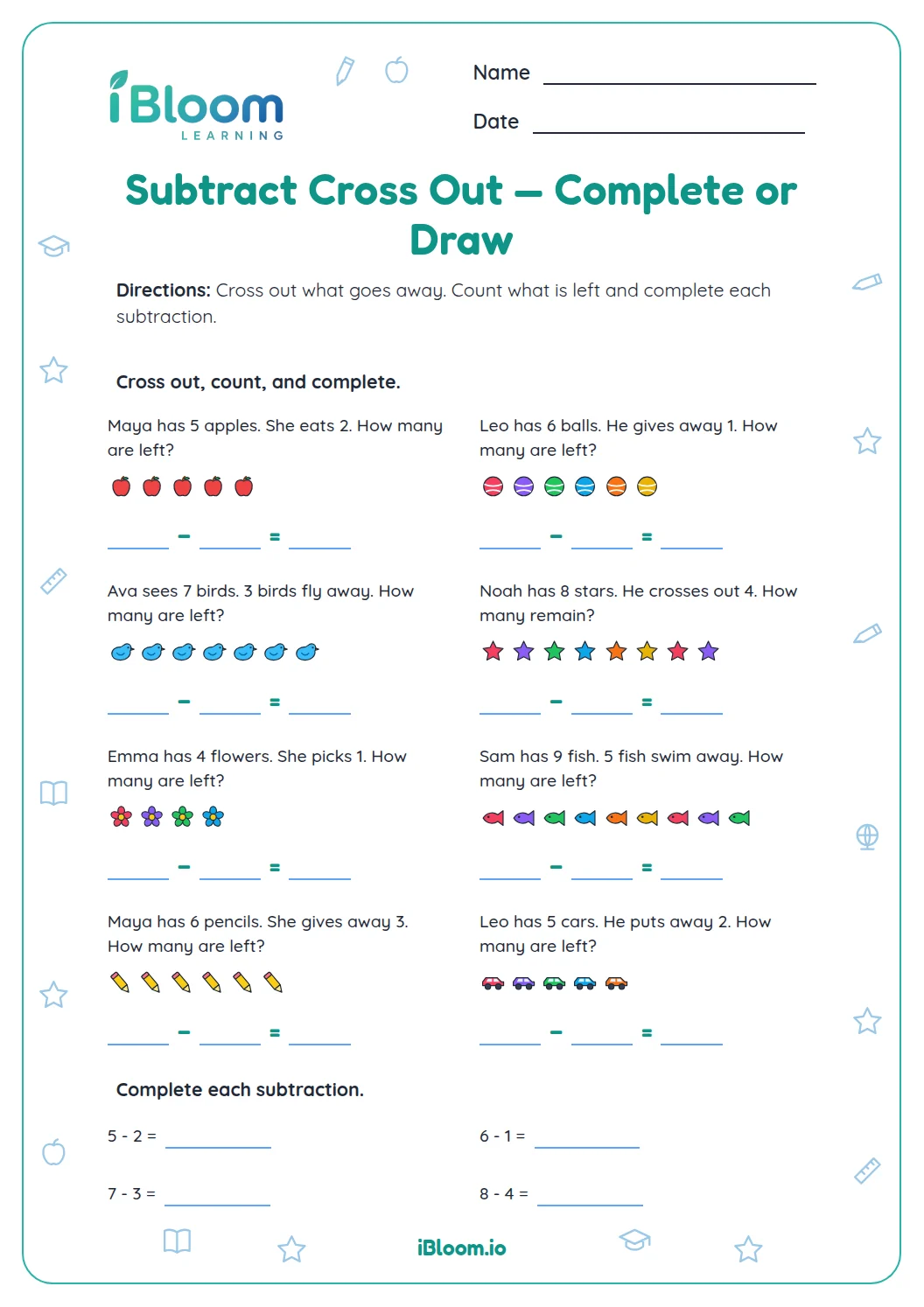
This printable Kindergarten subtraction page starts with objects children can cross out and count, then moves to subtraction sentences within 10. It replaces the old mismatched shape-coloring task with 16 subtraction problems in two parts. A separate answer key is included.
Aligned to K.OA.A.1
How does crossing out show subtraction?
The starting group represents the whole amount. Crossing out removes the amount being taken away; the unmarked objects show what remains.
For question 1, eight apples lose three, leaving five. Count only the apples that are not crossed out.
- 18 apples − 3 apples
- 2Cross out 3 of the 8
- 35 apples remain
What changes in the second part?
Part B removes the pictures and uses number sentences. Children use the same idea: begin with the first number and take away the second.
How is the page organized?
Part A has eight picture problems, followed by eight subtraction sentences in Part B. Every result stays within 10.
Common mistakes and quick fixes
The mistake
Check the operation or unit before answering.
The fix
Reread the prompt and keep the unit with the result.
The mistake
Skip a step in the process.
The fix
Write each step clearly before checking the answer.
The mistake
Use one detail to describe the whole task.
The fix
Check that your answer fits the full question.
Common Core alignment
This sheet practices the listed skill through its worksheet questions.
Cross out objects to model subtraction and find how many remain.
On this sheet: Kindergarten
Show the official wordingHide the official wording
Represent addition and subtraction with objects, fingers, mental images, drawings, sounds (e.g., claps), acting out situations, verbal explanations, expressions, or equations.
What to practice next
Further reading
Questions parents and teachers ask
What does this worksheet practice?
This sheet practices subtraction within 10 with short picture-free prompts and number sentences. Children take away a stated amount, count what remains, and record the difference. An adult can use the separate key to check each response and talk through a missed step.
How should a child check the answers?
Invite the child to solve each problem before looking at the key. If an answer differs, reread the starting number and the amount taken away, then count backward or use counters to find the difference. The key gives one correct result for every question.
How many questions are included?
There are 16 questions across two parts. The first part asks children to subtract from familiar groups, and the second part uses number sentences. All answers stay within 10, so learners can focus on taking away and finding what remains.
How can I use the answer key?
Keep the answer key nearby while reviewing the completed worksheet. Compare each number with the key, then ask the learner to explain how many were taken away and how many remain. Recounting the starting group can help locate an error.
Can this be printed for practice?
Yes. Print the worksheet for the learner and keep the separate answer key for checking. A pencil is enough for recording answers. Counters such as buttons or blocks may help a child model a problem before writing the difference.