


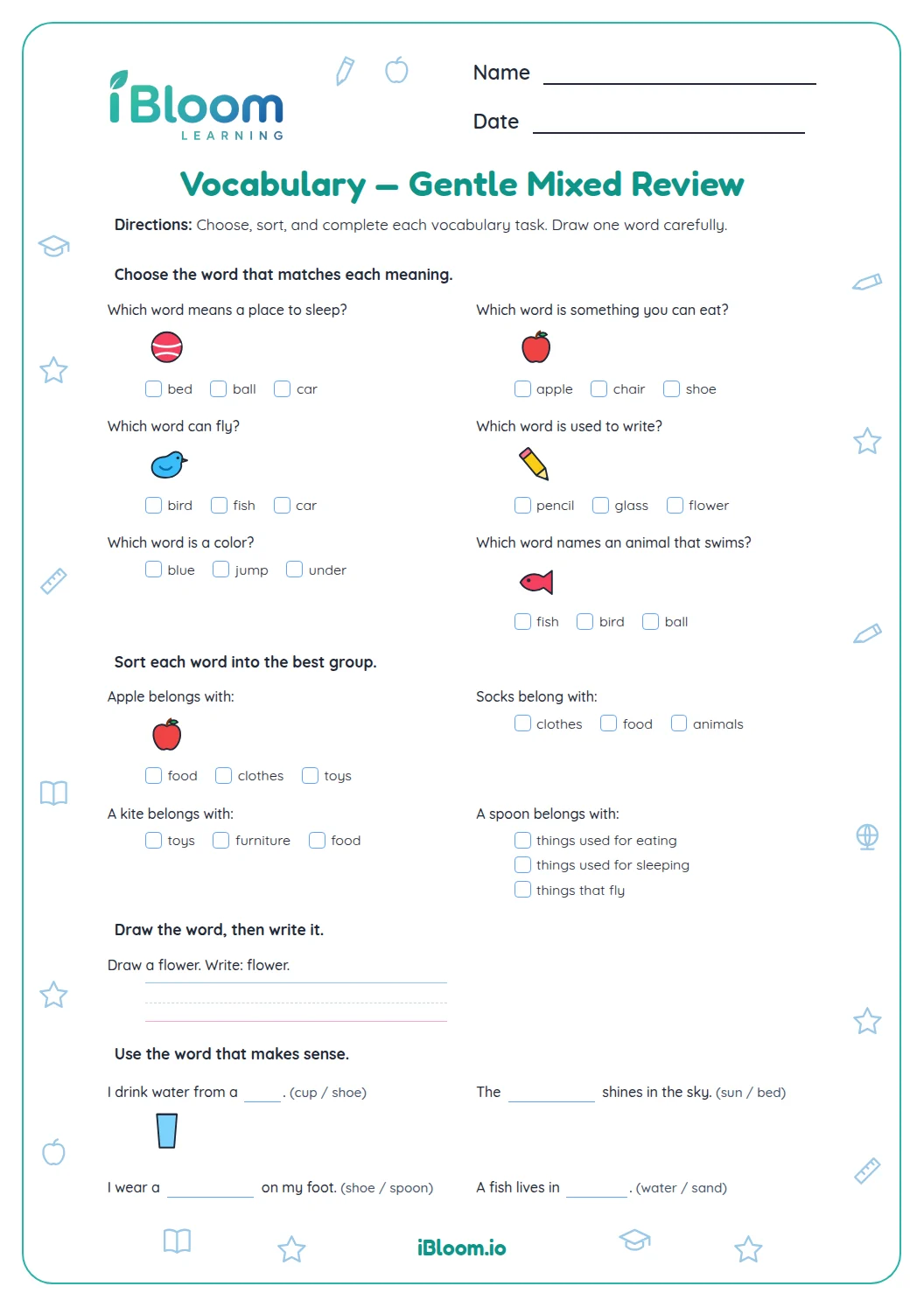
About this worksheet
This free preschool and kindergarten worksheet connects everyday words with pictures and familiar uses. Part A has six picture-supported sentences about things children eat, read, ride, wear, or use. Children choose between two words and copy the missing word; an adult can record an oral response. Part B asks children to draw the same six objects, two in each of three drawing boxes. The nine tasks practice real-life connections between words and their use under Common Core L.K.5c. The answer key supplies the six missing words and describes what each drawing should show.
Aligned to L.K.5c
How do the picture sentences work?
Read the sentence, name the pictured object, and try the two choices in the blank. Children copy the word that matches both the picture and the everyday action. The choices stay beside each sentence so there is no separate word bank to search.
- 1Question 1 shows an apple.
- 2I eat an ___. (apple / chair)
- 3An apple is something to eat, and it matches the picture.
- 4Write or say: apple.
What should the six drawings show?
Part B repeats the six words from Part A in three pairs: apple and book, bus and shoe, pencil and cup. Children draw both named objects in each box. They can look back at Part A for picture clues.
Accept a simple recognizable sketch. Ask children to point to their drawing and name it; the goal is linking the word to its meaning, not reproducing an adult’s artwork.
How can adults help without choosing the word?
An adult can read the directions and choices aloud and write down a spoken answer. Leave the choice itself to the child. If a word is unfamiliar, look for a real example in the room or discuss when the family uses it.
After finishing, ask for one new sentence about an object on the sheet. “I read my book at night” connects the printed word with the child’s own experience.
How to use this worksheet
- 1Name the first picture together and read both word choices.
- 2Have the child say the full sentence with the selected word.
- 3Let the child copy the word or dictate it to an adult.
- 4Read both object names in each drawing prompt and leave room for two sketches in its box.
- 5Ask the child to name each drawing and tell how the object is used.
Mistakes to notice and fix
The mistake
Choosing chair for “I eat an ___.”
The fix
Name the apple picture and try both words aloud. Ask which one is food.
The mistake
Copying both choices into a sentence blank.
The fix
Say the sentence with one choice at a time, then write only the word that fits.
The mistake
Drawing only one object in a Part B box.
The fix
Point to the word and between the two names. Ask the child to name both objects and add the missing one.
Common Core alignment
Connect familiar object words to eating, reading, traveling, and daily routines.
On this sheet: Picture sentences and drawings link everyday object names with familiar uses.
Show the official wordingHide the official wording
Identify real-life connections between words and their use (e.g., note places at school that are colorful).
What to practice next
Make more practice
Further reading
Questions parents and teachers ask
Can preschool children answer orally?
Yes, an adult can read each sentence and record the child’s chosen word. The child can still look at the picture, select a meaning, and say the completed sentence aloud. For the drawing section, let the child sketch independently and name each object when the drawing is finished.
What words are practiced in the sentence blanks?
The six answers are apple, book, bus, shoe, pencil, and cup. Each word appears with a picture and a familiar action, such as reading a book or riding a bus. Two printed choices help children focus on matching the word to the meaning of the whole sentence.
Do the drawings need to look like the pictures?
No exact copy is needed: the drawing prompts repeat the six objects pictured in Part A. Each box asks for two objects, so children draw all six across three boxes. They can look back for help, then name each drawing and explain a familiar use.
How should I use the answer key for drawings?
Use the key’s short descriptions to check the intended object. Different shapes, sizes, and details are welcome as long as the drawing represents the named word. If a sketch is hard to recognize, ask the child to explain it before suggesting a detail that could make it clearer.
How can we practice the same words away from the page?
Look for one of the worksheet objects during a normal routine and name it together. At a meal, ask which object is a cup and how it is used. During reading time, ask for a book. These short exchanges connect the printed words with objects your child actually uses.