




About this worksheet
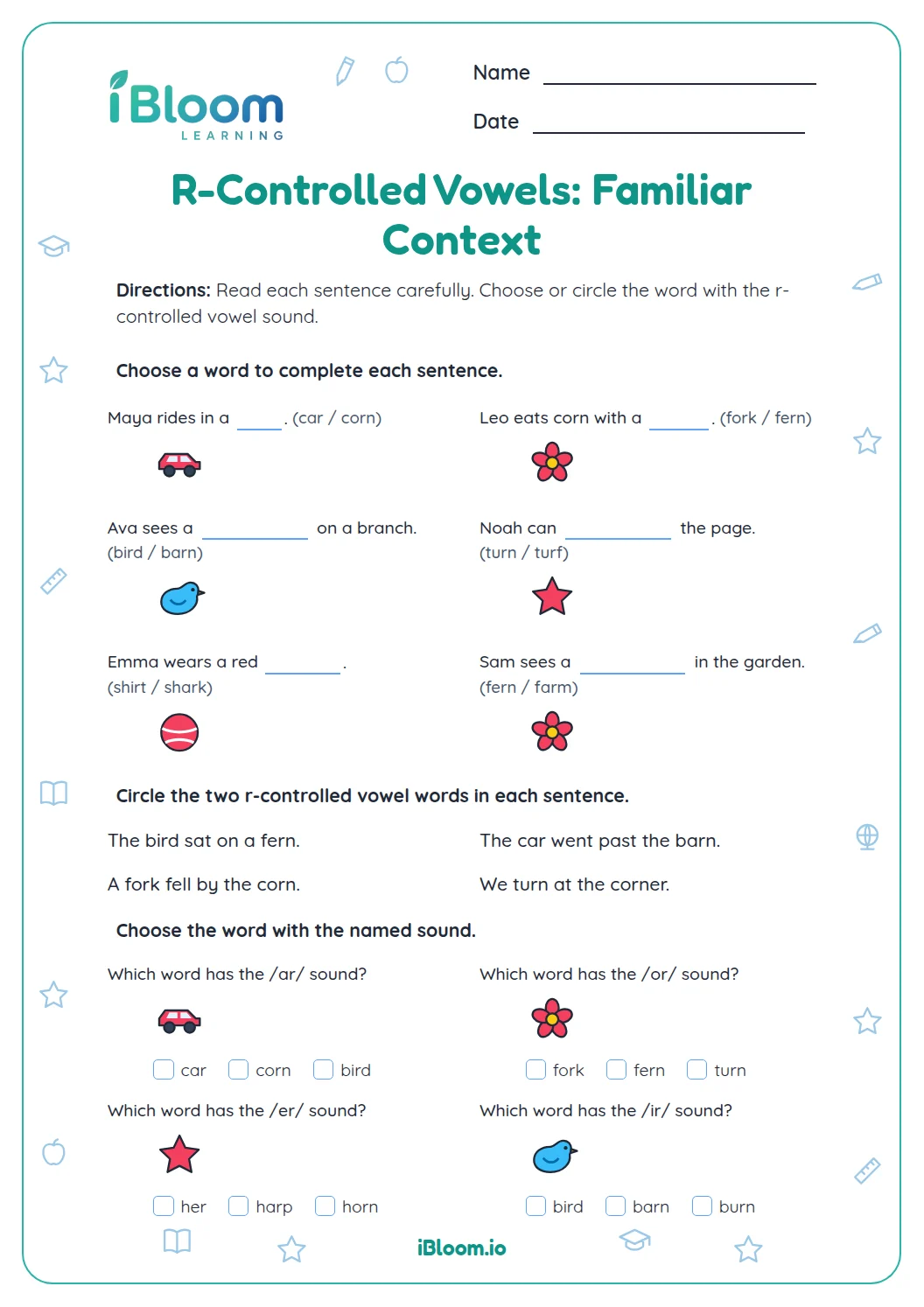
This free printable phonics worksheet offers preschool and kindergarten children a gentle, adult-supported review of vowel-plus-r spellings. Part A has six picture clues with two word choices each. Part B asks children to find ar, or, er, ir, and ur in short words, and Part C provides her and fur to trace. Reading these regularly spelled one-syllable words supports Common Core RF.1.3b. A separate answer key shows the choices and tracing words.
Aligned to RF.1.3b
What does the r do in these words?
In these words, a vowel followed by r is read as a connected spelling pattern. Start with car and corn, saying each whole word naturally while pointing to ar or or. Then introduce bird, shirt, and purse from the picture choices.
The er in her, ir in bird, and ur in fur often represent the same vowel sound in US English. Looking at the printed word helps children learn which spelling belongs in that particular word.
How do the picture choices work?
Each picture has two short printed choices. An adult can name the image, then help the child look through both words. Ask the child to check the ending as well as the first letter.
- 1Picture: car
- 2Choices: car or cat
- 3Read c-ar, choose car, and point to ar.
How can the review stay gentle?
Do one part at a time and say the words together. Part B makes the spelling pattern explicit, giving a familiar comparison word such as car before asking for farm. Children can point to the matching letters before choosing the word.
Part C traces her and fur. Say “her bag” and “soft fur” aloud to make their meanings clear, then return to the printed er and ur. The goal is to connect a spoken word to its letters without asking the child to guess a spelling from sound alone.
How to use this worksheet
- 1Name each Part A picture together before looking at its word choices.
- 2Read the two choices and point to all the letters in the matching word.
- 3In Part B, find the named vowel-plus-r letters before reading the word.
- 4Trace her and fur slowly, then say a short phrase using each.
- 5Check the key together and reread one word the child wants to practice.
Mistakes to check together
The mistake
Choosing cat for the car picture because both begin with ca.
The fix
Point to the final letter and read the whole word c-ar.
The mistake
Treating er, ir, and ur as three reliably different sounds.
The fix
Compare her, bird, and fur aloud; use the printed words to identify their spellings.
The mistake
Choosing form when asked to find ar.
The fix
Point to the a in farm and the o in form, then read farm with the ar in car.
Curriculum alignment
Read regularly spelled one-syllable words such as car, corn, bird, and fur.
On this sheet: Children read and distinguish one-syllable words with vowel-plus-r spellings.
Show the official wordingHide the official wording
Decode regularly spelled one-syllable words.
What to practice next
Make more practice
Further reading
Questions parents and teachers ask
Which vowel-plus-r spellings appear?
The sheet includes ar, or, er, ir, and ur. Picture choices feature car, corn, bird, shirt, star, and purse. Six more choices focus on printed letter patterns, and the tracing words are her and fur. Say each word with the child while pointing to its vowel and r.
Should a preschooler read this alone?
An adult should guide a preschooler through this review. Name each picture, read the choices together, and let the child point or mark an answer. Children who already know some of the words can try those independently. Keep the focus on connecting the spoken word with its printed letters.
Why do her, bird, and fur sound alike in the middle?
In many US pronunciations, er, ir, and ur represent the same vowel sound in those words. The spelling must be learned as part of each word. This sheet supplies printed models and choices so children can look at the letters instead of guessing which spelling they heard.
What does the child do in the tracing part?
The child traces and copies her and fur, says each word with a helper, and points to er or ur. Before tracing, use a short spoken phrase such as her bag or soft fur to establish meaning. The key repeats the words so an adult can check both reading and letter formation.
How can I help when the picture word is unclear?
Name the picture directly, then return to the printed choices. For example, identify the small clasp purse before reading purse and pan together. Each image cues a spoken word. Help the child find the letters that match it, then point to the vowel-plus-r spelling and reread the word.