
About this worksheet
This Grade 1 reading worksheet uses an original short passage about Ava and her family on a summer night. Sixteen written questions ask children to recall story details, follow what happens next, and identify the setting and characters. A separate answer key includes sample responses. The questions practice Common Core reading standards RL.1.2 and RL.1.3.
Aligned to RL.1.2 and RL.1.3
How do you put story events in order?
Notice time words such as “soon,” then connect each event to what happens next. After Dad brings lemonade, Ava hears crickets; later, Mom points to the moon.
How do details show the setting?
A setting tells where and when a story happens. Ava sits on the porch with her family on a summer night; the fireflies, crickets, and moon are clues.
How do you answer with story details?
Find the sentence that gives the needed clue. For example, the story says Mom points to the moon, which answers question 13.
How to use this worksheet
- 1Read the whole story once.
- 2Reread and notice words that mark time.
- 3For an order question, compare what happens before and after.
- 4Find a story clue before choosing an answer.
- 5Answer written questions in a few clear words.
Common mistakes and quick fixes
The mistake
Mixing up the order of events.
The fix
Retell the story aloud using first, then, and last.
The mistake
Choosing an answer from memory alone.
The fix
Point to the sentence that provides evidence.
The mistake
Naming a place without the time clues.
The fix
Use details such as fireflies to identify when the story happens.
Common Core alignment
The questions give practice with first grade story reading skills.
Retell key events and show understanding of the story.
On this sheet: Questions ask children to identify and retell events and details.
Show the official wordingHide the official wording
Retell stories, including key details, and demonstrate understanding of their central message or lesson.
Describe story characters, setting, and major events.
On this sheet: The questions cover the story’s characters, setting, and major events.
Show the official wordingHide the official wording
Describe characters, settings, and major events in a story, using key details.
What to practice next
Make more practice
Further reading
Questions parents and teachers ask
What story does the worksheet use?
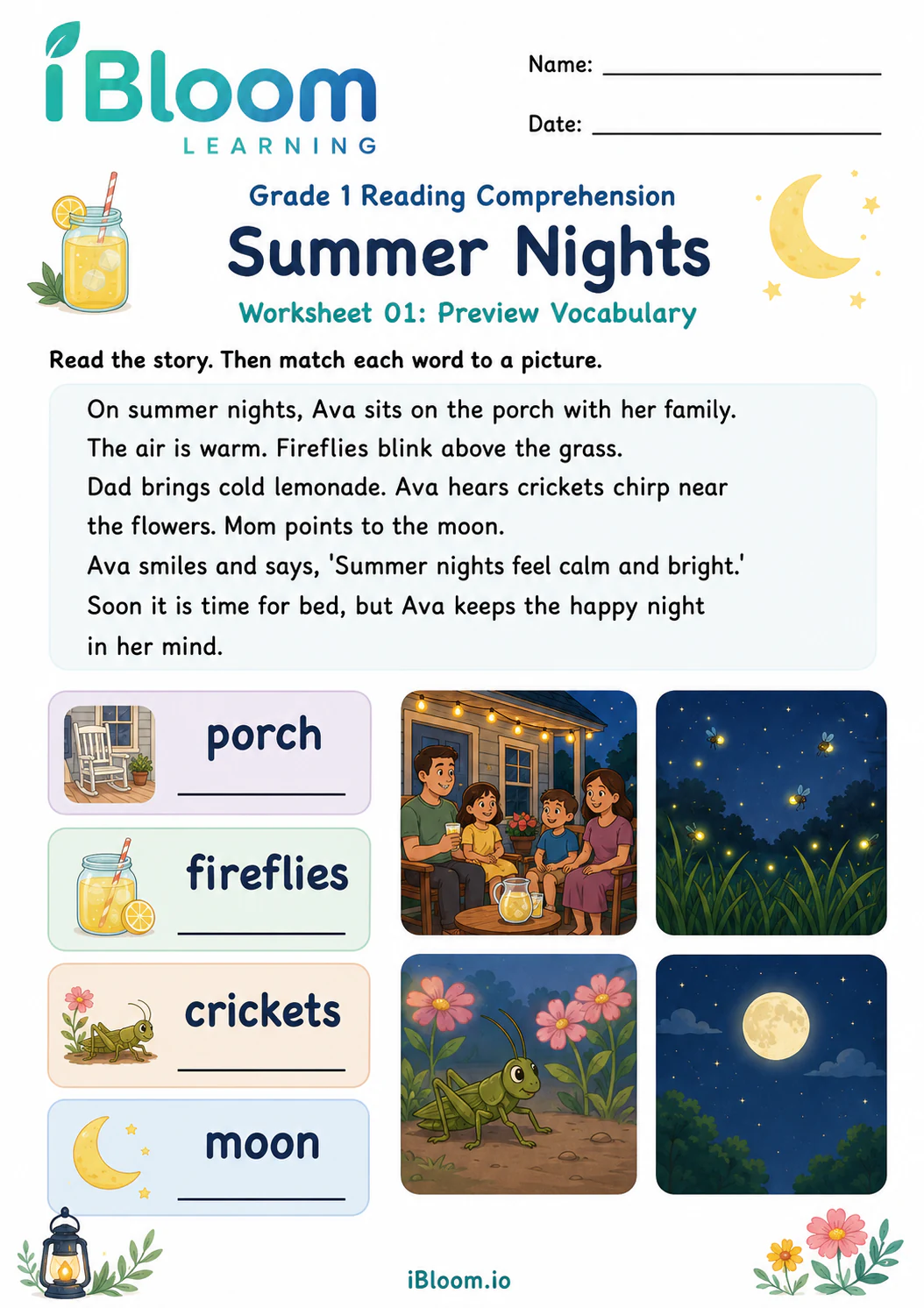
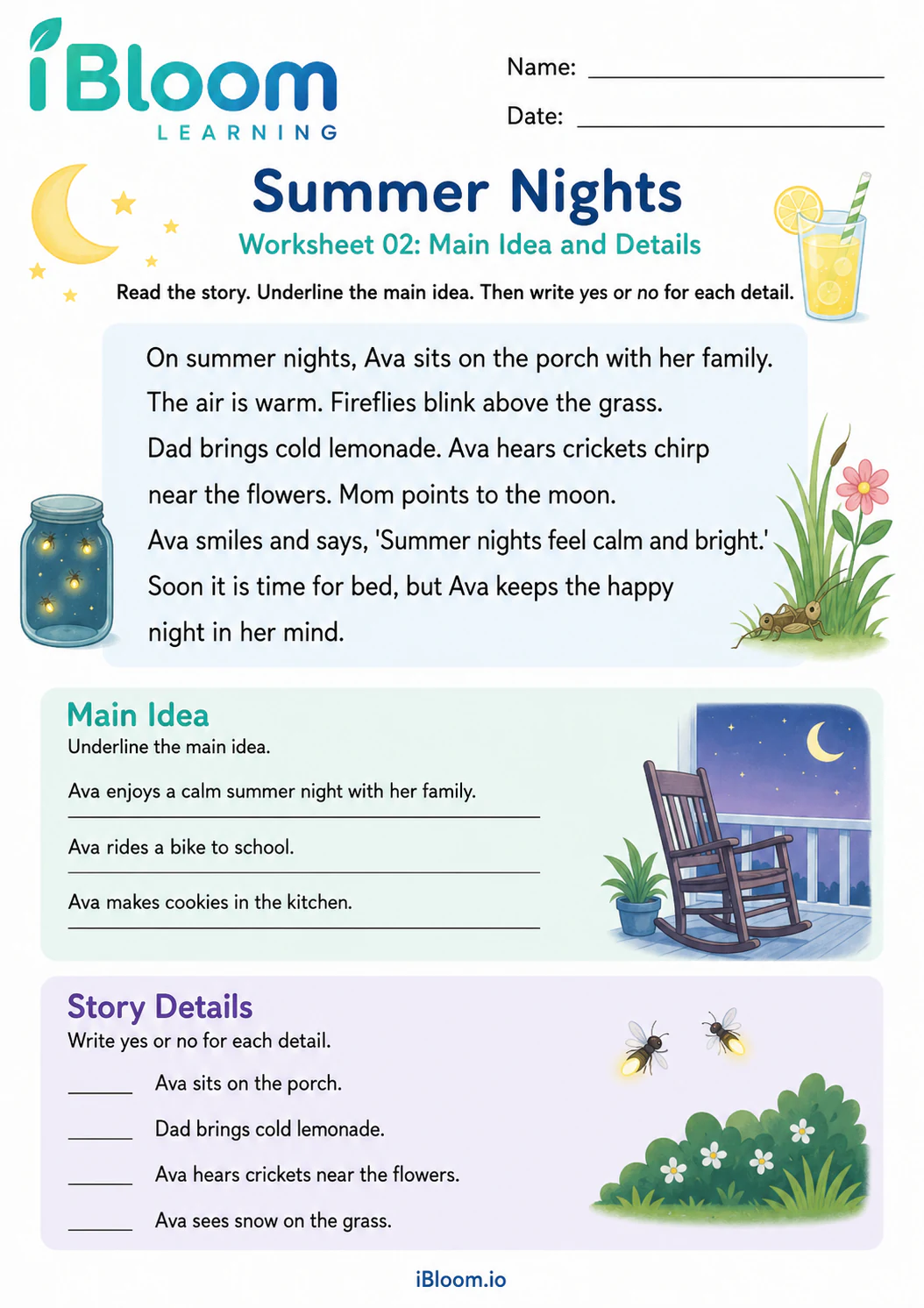
It uses “Summer Nights,” a short passage about Ava sitting on the porch with her family. Fireflies, lemonade, crickets, and the moon appear as the evening unfolds. Children can reread the passage to find evidence for their answers. Rereading one sentence at a time helps keep the events in the right order.
Which events should children put in order?
Children follow the events from Ava sitting outside through the family’s evening activities and bedtime. They answer questions about what happens after fireflies blink, after Dad brings lemonade, and after Ava hears crickets. Children can point to the sentence that gives evidence for each response.
How can a child find the setting?
Look for clues about both place and time. Ava sits on the porch with her family, and details such as fireflies and the moon show that it is a summer night. The worksheet asks children to name where and when.
Should answers be complete sentences?
The short-response items can be answered in a few clear words, unless the child prefers a complete sentence. The answer key gives sample wording for responses that can have more than one correct form. A few words from the story are enough when they clearly answer the question.
What reading skills do the questions practice?
The 16 questions ask children to recall details, follow events, identify setting and characters, and notice a time-order word. Children write short responses and return to the passage to support their answers. Look back at the passage before checking the sample answer.
Is an answer key included?
Yes. A separate answer key lists responses for all 16 questions, including samples for open-ended items. Children can compare the key with their own words and point to the part of the story that supports an answer. The story details support both recall and simple sequence reasoning.