
About this worksheet
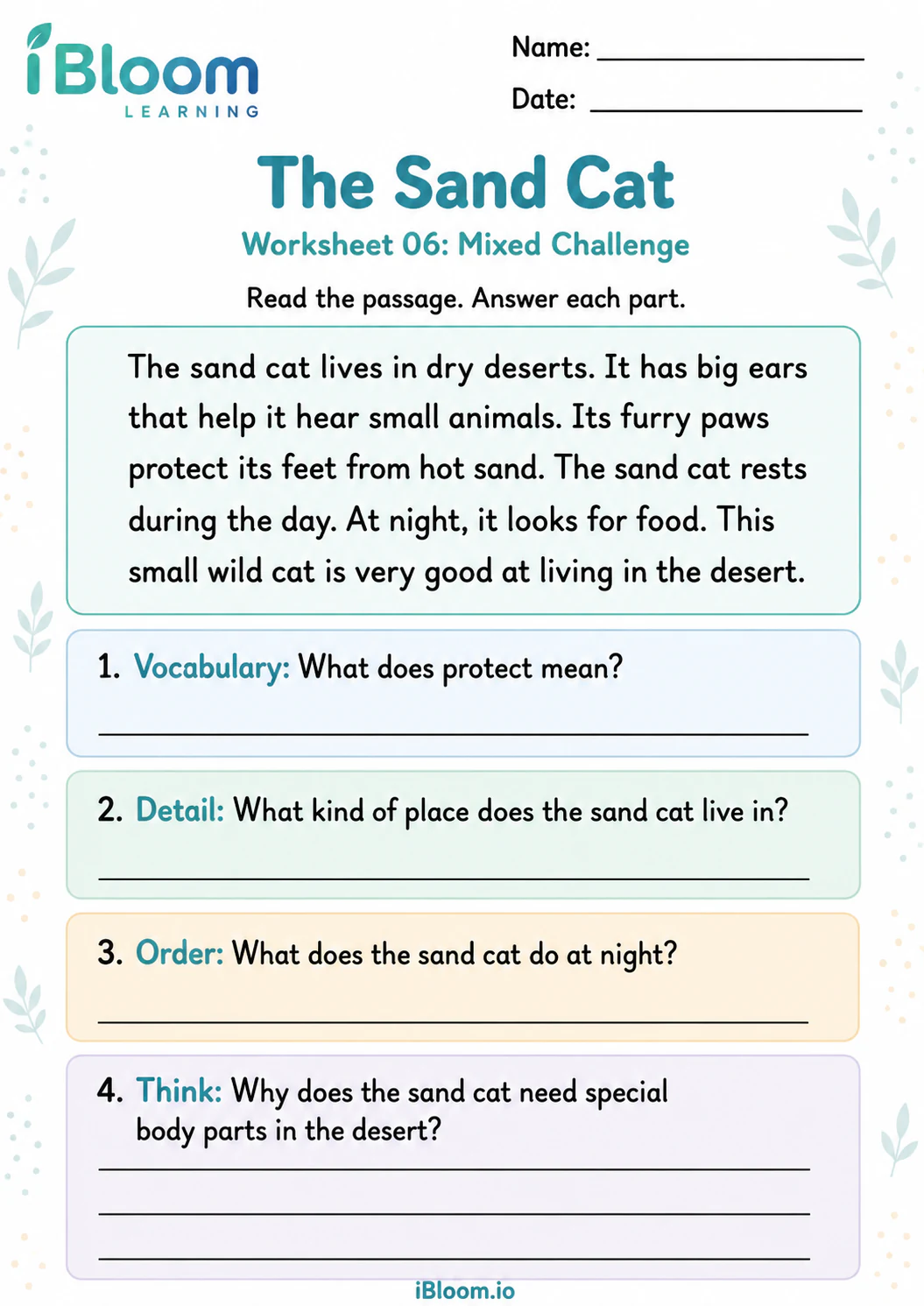
This Grade 1 written-response worksheet pairs an original 77-word story about Nora visiting a sand cat with 14 questions. Children select six answers, recall four short details, and write four responses supported by the passage. It practices CCSS RL.1.1 by asking children to answer questions about key story details. The three-page answer key includes sample wording for open responses.
Aligned to RL.1.1
What details does Nora notice about the sand cat?
The passage tells where Nora visits, where the cat rests, what it hears, and how its fur protects its paws. Part B begins with six choices about details stated directly in the story.
- 1What could the cat hear under the sand?
- 2Find the matching sentence in the passage.
- 3Answer: A mouse
Which story details can children recall in a few words?
Part C asks for four brief details, including what Nora drew and what the cat was ready for. A word or short phrase is enough when it answers the question accurately.
How can children support a written response with the passage?
Part D asks children to explain how the cat’s ears and fur help, why it comes out in the evening, and what shows Nora paid attention. Encourage a short answer that includes the relevant story detail.
How to use this worksheet
- 1Read the passage once to understand Nora’s visit.
- 2Reread the matching sentence for each Part B choice.
- 3Answer Part C with a word or short phrase from the story.
- 4For Part D, include a passage detail in each response.
- 5Check the key; accept other wording that keeps the same story fact.
Common mistakes and quick fixes
The mistake
Answering from what is usually true about cats instead of this story.
The fix
Look back for the detail the passage gives.
The mistake
Writing “food” when asked what moved under the sand.
The fix
Find the sentence that says what the cat could hear: a mouse.
The mistake
Giving a reason the story never states.
The fix
For the evening question, use the stated purpose: the cat came out to look for food.
Common Core alignment
This worksheet gives children focused practice with a specific Common Core skill.
Answer questions with key details from a short story.
On this sheet: Answer questions with key details from a short story.
Show the official wordingHide the official wording
Ask and answer questions about key details in a text.
What to practice next
Make more practice
Further reading
Questions parents and teachers ask
What is the passage about?
Nora visits a desert animal center and watches a sand cat. The story describes its shady den, wide ears, protected paws, and evening search for food, giving children concrete details to use in their answers. The question sequence returns to those story details in later parts.
How many written responses are included?
There are four written-response questions in Part D. Earlier sections add six multiple-choice questions and four short-answer questions, for 14 questions total. The answer key offers sample answers for the open responses. The key lists each sample response beside its prompt.
What should count as a correct written answer?
A response should answer the question and match a fact in the passage. The sample key gives one possible wording, but children may use different words if they preserve the story detail, such as explaining that the fur guards the paws from hot ground.
How long is the story?
The original passage is 77 words, appropriate for a short Grade 1 reading task. Children can reread it while answering; the questions ask them to retrieve stated details rather than rely on outside information. The passage gives this length for a quick Grade 1 read.
How does this page support written-response practice?
Children first locate details in multiple-choice questions, then recall details in short answers, and finally explain ideas in sentences. The gradual sequence lets a learner practice finding evidence before writing a fuller response. The written prompts ask children to return to the same passage.