
About this worksheet
This Grade 1 reading worksheet pairs a short original story with 14 questions about story details, event order, and plot. Children read how Maya plants a seed, then recall what happened, put events in order, and use story clues to explain a character’s feelings and choices. The questions follow the passage, and a matching answer key is included. The page supports Grade 1 work with key details and major events.
Aligned to RL.1.1 and RL.1.3
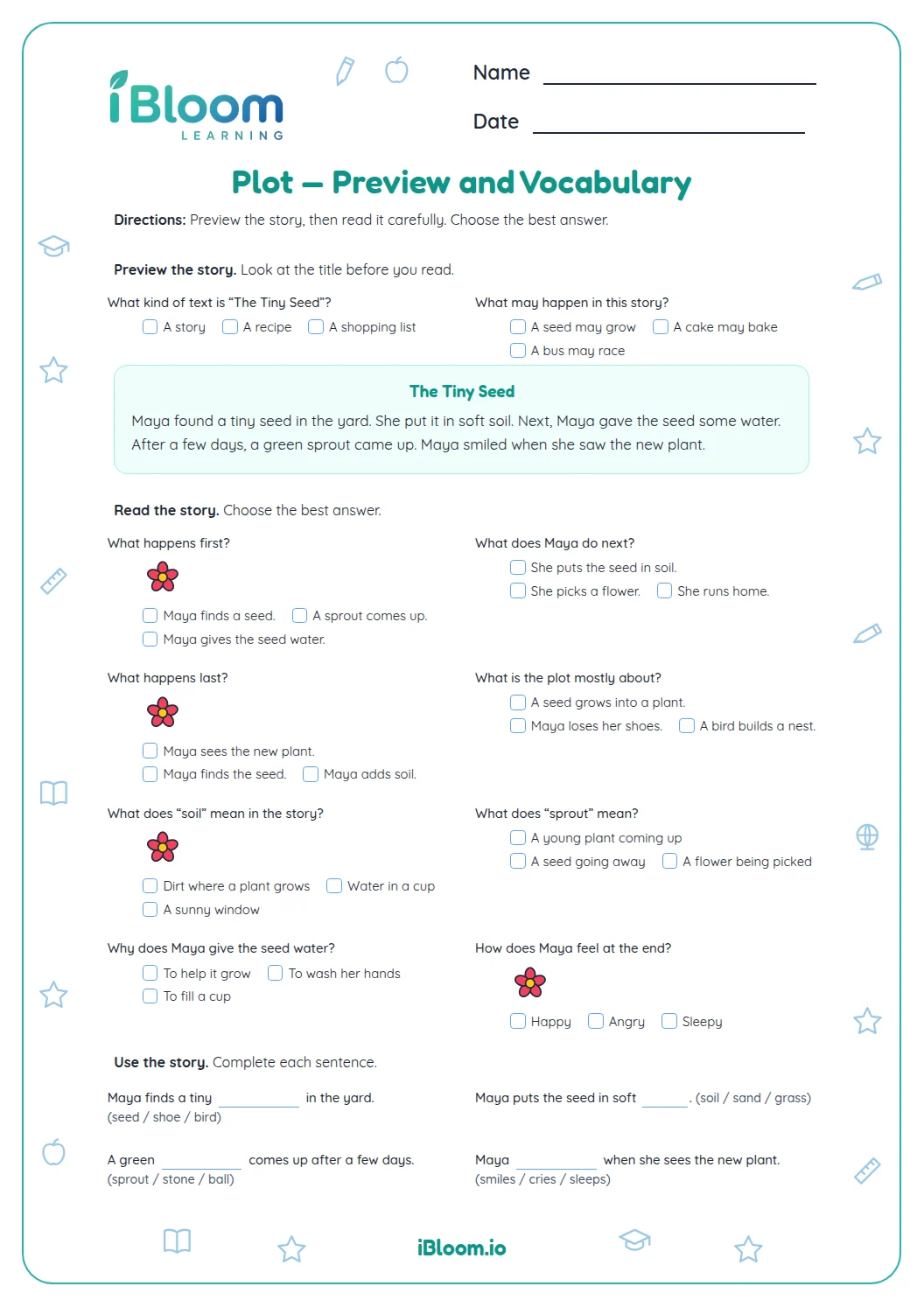
What happens in “The Missing Seed”?
Maya finds a seed by the garden gate and plants it in a pot with Grandpa’s help. After waiting and watering, she sees a green shoot. The questions ask children to follow those events and connect the ending to Maya’s actions.
How can a reader put the events in order?
For example, question 11 asks which came first: Maya watered the pot or found the seed. The passage says she found the seed before planting and watering it, so “found the seed” is the answer. Looking back at time words such as “First,” “Next,” and “One morning” helps track the plot.
How do details help explain the plot?
Question 13 asks why Maya kept watering the soil. The story says she hoped the seed would grow, and a green shoot eventually appeared. Children can use that detail to explain why she continued caring for the pot.
How to use this worksheet
- 1Read the story once to learn who Maya is and what she wants.
- 2Reread the part named in a question before answering.
- 3For order questions, notice words such as “First,” “Next,” and “One morning.”
- 4For “why” questions, find a story detail that supports the answer.
- 5Check the answer key after finishing and discuss any response that needs a story clue.
Common slips and fixes
The mistake
Mixing up the order of finding and planting the seed.
The fix
Reread the first paragraph, then follow the time words in the next paragraph.
The mistake
Answering why Maya watered without using the story.
The fix
Connect her repeated watering to her hope that the seed would grow.
The mistake
Treating a feeling guess as a stated fact.
The fix
For the final question, use “likely” and point to the green shoot and Maya’s smile.
Common Core alignment
This Grade 1 reading practice supports comprehension of key details and event order.
Ask and answer questions about key details in a story.
On this sheet: Questions ask readers to recall and explain details from the story.
Show the official wordingHide the official wording
Ask and answer questions about key details in a text.
Describe characters, settings and major events.
On this sheet: Questions follow the events that make up the story plot.
Show the official wordingHide the official wording
Describe characters, settings, and major events in a story, using key details.
What to practice next
Make more practice
Further reading
Questions parents and teachers ask
What story does the worksheet use?
It uses “The Missing Seed,” an original story about Maya finding a seed and planting it with Grandpa. The plot moves from finding the seed to preparing a pot, waiting, and seeing a green shoot. Children use those events to answer detail, sequence, and plot questions.
How many questions are on the page?
There are 14 questions after the passage. They ask readers to recall story details, track what happened, and explain a choice or likely feeling. The answer key includes sample answers where more than one child-friendly wording can fit. The key follows the same question order.
What does the sequence practice ask children to do?
Children compare events in the story and identify what happened first or after another event. They can look for time clues such as “First,” “Next,” and “One morning,” then check that their answer follows the story’s order. This page asks them to use those clues as they follow Maya’s actions.
Can a child answer the last question in different words?
Yes. The final question asks how Maya likely felt when she saw the shoot. “Happy” or “excited” are reasonable sample answers because the passage says Maya smiled; a child may use another feeling word supported by that clue. The answer key also accepts those choices.
How can an adult help without giving away an answer?
Ask the child to point to the sentence that helped them decide. For a sequence question, have them retell two events in order; for a “why” question, ask which story detail supports the explanation. Then compare the response with the key.