






About this worksheet
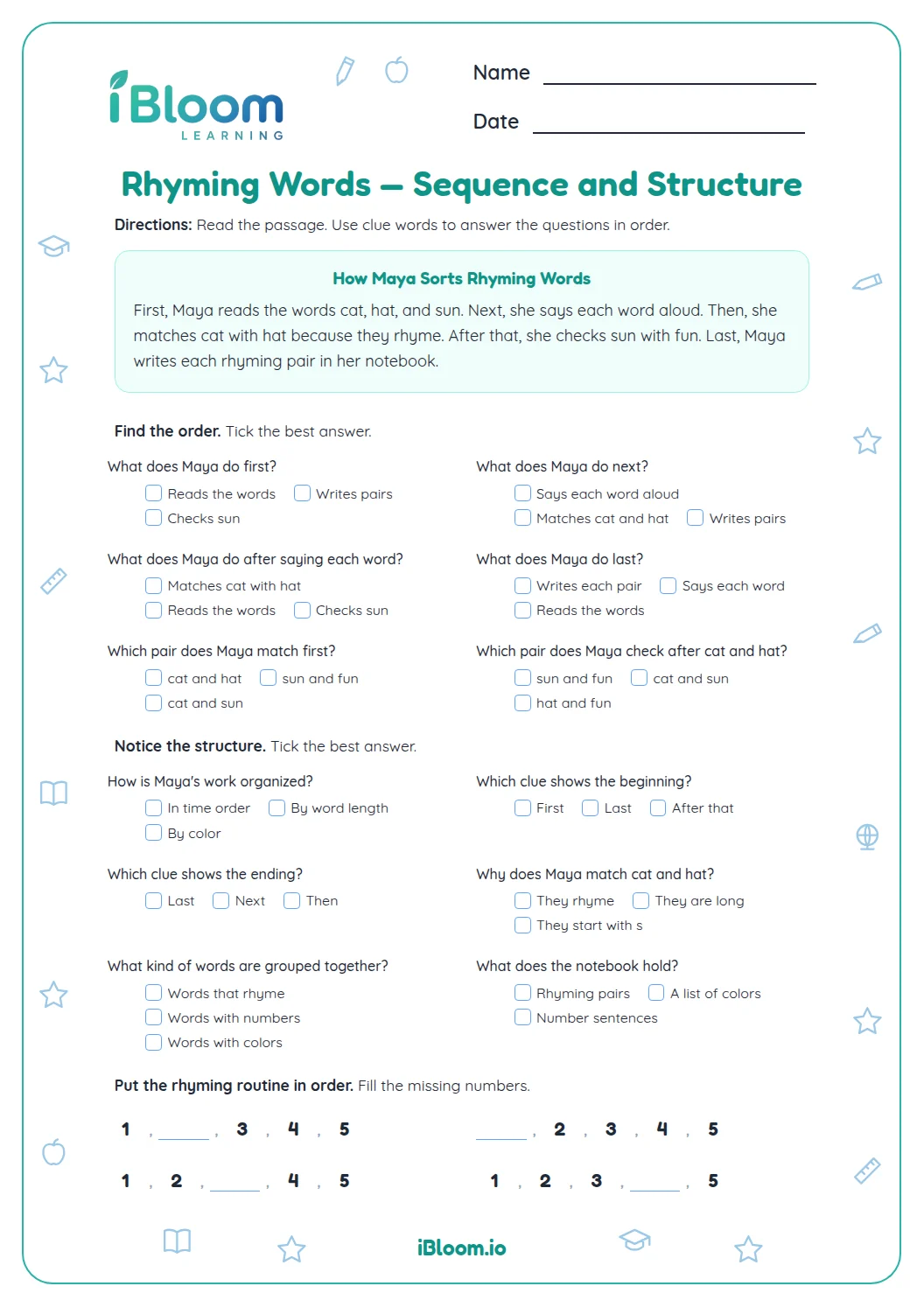
This Grade 1 reading worksheet uses a short how-to passage about counting syllables. Students follow Maya’s sequence, notice words that signal order, and count the spoken parts in eight familiar words. The 16 questions appear across three worksheet pages with a matching three-page answer key. Passage questions practice CCSS RL.1.2 by asking students to retell key details and events in order.
Aligned to RL.1.2
What is on the worksheet?
The passage describes a routine in time order: say a word slowly, listen for its spoken parts, clap once for each part, then count and record. Eight questions check the sequence and its structure.
Eight more questions ask students to count syllables in words such as sunset, window, and butterfly.
How can a reader keep events in order?
Order words help a reader track a process. “First” introduces the opening action, while “last” signals the final action. The steps are organized in time order, from the first action to the last.
Question 1 asks what Maya does first: she says the word slowly.
- 1The passage says, “First, she says the word slowly.”
- 2The first action is saying the word slowly.
- 3Answer: She says the word slowly.
How do you count syllables?
Say each word naturally, then clap once for each spoken syllable. Sunset has two parts, sun and set; butterfly has three, but-ter-fly. The question asks for spoken parts, not written letters.
How to use this worksheet
- 1Read the passage once all the way through.
- 2Reread the question and find the matching story detail.
- 3Use time words to put actions in order.
- 4For each word, say it aloud and tap one time for each syllable.
- 5Check answers with the key and reread any missed line.
Common mistakes and quick fixes
The mistake
Choosing an event that happened in the story but at the wrong time.
The fix
Point to time clues such as “Then,” “A few days later” and “Soon” before choosing.
The mistake
Counting letters instead of spoken parts in a word.
The fix
Say the word aloud and tap its vowel beats; “flower” has two spoken parts here.
The mistake
Assuming every question asks what happened next.
The fix
Check whether the question asks first, after, last, or why before looking back.
Common Core alignment
The story questions ask readers to retell key details and follow the events in a short narrative.
Retell this story with its key details and events in order.
On this sheet: Questions ask students to identify details and order the events in Mia’s story.
Show the official wordingHide the official wording
Retell stories, including key details, and demonstrate understanding of their central message or lesson.
What to practice next
Make more practice
Further reading
Questions parents and teachers ask
What does the passage teach?
Maya follows four steps to count syllables: say a word slowly, listen for its spoken parts, clap once for each part, then count and write the number. Students answer eight questions about those steps and order words before counting eight words themselves.
How many questions are included?
There are 16 questions across three worksheet pages. Eight check the passage’s steps and sequence words, and eight ask students to count syllables. The separate three-page answer key provides the expected response for every question. Students can work through the sequence first, then complete the word-counting section.
How should my child count syllables?
Say the word aloud at a natural pace and listen for its spoken vowel beats. Clap once for each beat, then count the claps. The worksheet passage models this process with sunset, which has two spoken parts: sun and set.
Does the worksheet teach event order?
Yes. The first eight questions ask students to recall what Maya does first, next, and last, and to identify order words in the passage. Retelling the four actions in order is a useful way to prepare before answering.
Can the story be read aloud?
Yes. An adult can read the short passage aloud, then invite the student to repeat the steps and clap the example word. Students can also read it independently and use the answer key after completing the questions. Reading aloud also lets the child clap each syllable while following the written directions.