




About this worksheet
This free Grade 1 worksheet pairs a short garden passage with sentence tracing and reading questions. Part A introduces Maya and Leo’s garden visit. In Part B, children read, trace, and copy four sentences from the passage. Part C asks about the text, its visitors, and words such as nest, bright, twig, and shady. Part D checks understanding with three passage-based blanks. The answer key includes the traced sentences and all reading answers.
Aligned to RF.1.4a and L.1.4a
What should children do before they trace?
Read “A Visit to the Garden” once, then help your child find Maya, Leo, the bird, and the flower in the passage. The tracing sentences come from the story, so the handwriting work reinforces reading the same details.
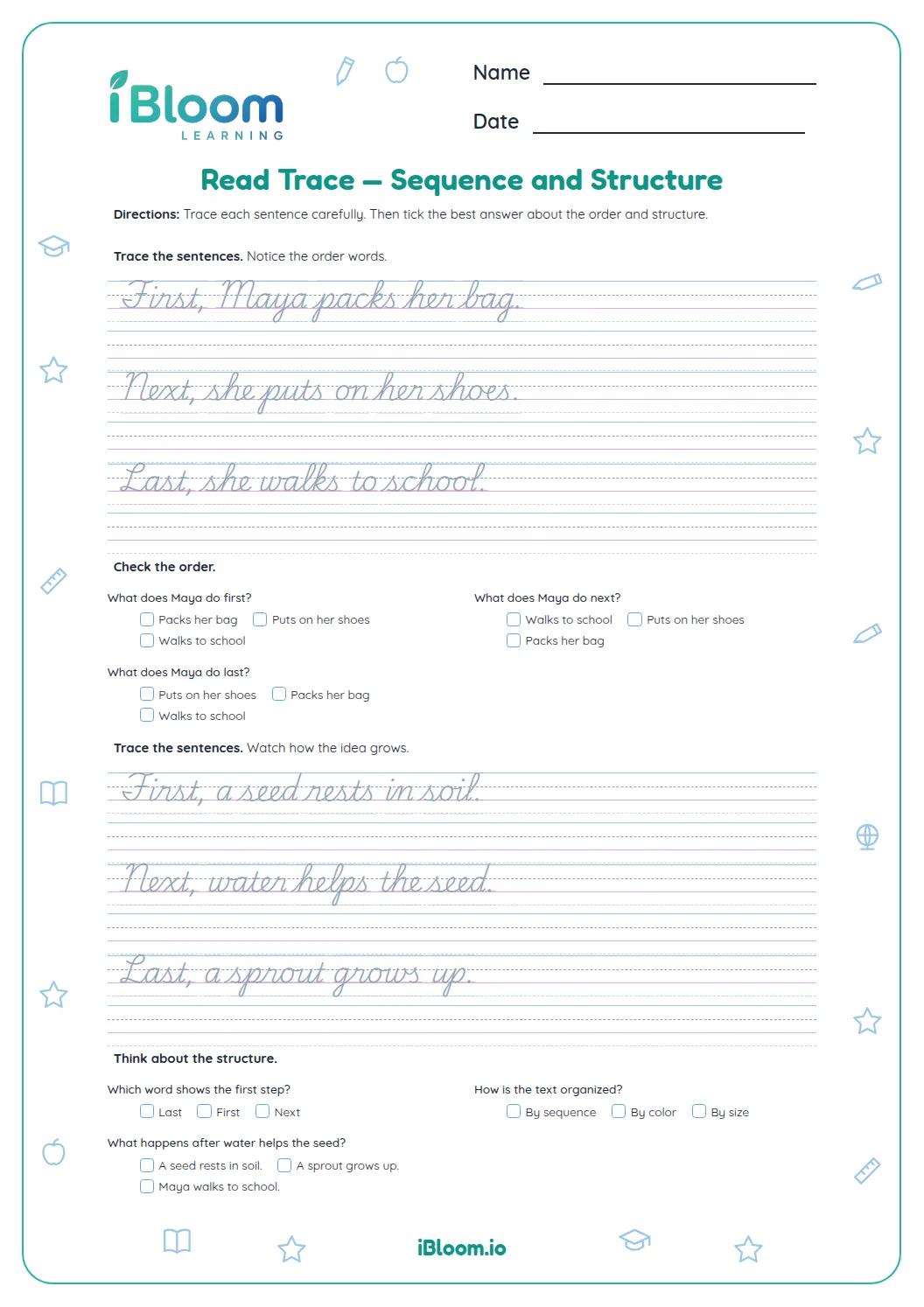
Part B has four sentences to read, trace, and copy. Ask your child to say each sentence before tracing it.
How do the garden words help readers?
The passage gives clues for bright, nest, twig, shady, and waters. It describes the nest as the bird’s small home and says Maya waters a flower with a blue can. Children can reread those details to check the word choices.
- 1Question 12: Maya and Leo visit a ___.
- 2The first sentence says Maya and Leo visit a garden.
- 3Write “garden” in the blank.
What reading work follows the tracing?
Part C includes seven choices about the text type, visitors, and garden words. Part D asks children to complete three short sentences with details from the same passage. Leave the passage available so children can point to evidence for each response.
How to use this worksheet
- 1Read the title and passage together.
- 2Have your child read, trace, and copy each sentence in Part B.
- 3Reread the nearby sentence before answering each word question.
- 4Use the passage to find details for the final blanks.
- 5Check spelling against the passage and use the key afterward.
Mistakes to notice and fix
The mistake
Tracing letters without reading the sentence.
The fix
Read the sentence aloud first and ask what it tells about Mia.
The mistake
Choosing a meaning from memory instead of the sentence clue.
The fix
Reread the line with the word and use the nearby detail.
The mistake
Writing seed in the final blank.
The fix
Reread what pops up at the end: a tiny green leaf.
Common Core alignment
Read Mia’s seed story and answer questions about its details.
On this sheet: Children reread the passage to identify the seed, pot, window, and leaf.
Show the official wordingHide the official wording
Read grade-level text with purpose and understanding.
Use clues such as “a little wet” to understand story words.
On this sheet: Vocabulary choices ask what damp and tiny mean in their sentences.
Show the official wordingHide the official wording
Use sentence-level context as a clue to the meaning of a word or phrase.
What to practice next
Make more practice
Further reading
Questions parents and teachers ask
Does my child trace words or whole sentences?
Your child traces four whole sentences and then copies each one on the line underneath. The sentences come directly from “A Visit to the Garden,” so you can reread them in the passage first. Ask your child to keep spaces between words and include the capital letter and period.
Should I read the story aloud first?
You can read the story aloud first if your child needs help getting started. Then invite your child to reread a sentence and tell what it means. Help with words such as shady and twig while leaving the vocabulary choices and story answers for your child to decide.
What vocabulary does this sheet teach?
The word questions include bright, nest, twig, shady, and waters. The passage explains them with nearby details, such as the bird carrying a twig to its nest and the children sitting under a shady tree. Have your child reread the sentence before choosing.
Why are there blanks after the choices?
The final three blanks ask children to supply words from the passage, including garden, can, and read. Invite your child to find each answer in the story and copy it carefully. The words are used in sentences about the garden visit.
What does the answer key include?
The answer key includes all four tracing sentences, the seven correct choices, and the three missing words. Use it after your child has tried the reading questions. For handwriting, compare the copied sentence with its model and check word spacing, letter order, capitals, and periods.