







About this worksheet
This Grade 1 printable begins with clues about Little Kitty, a small gray kitten Maya finds after hearing a meow. Children use the title and clues to preview the story, then read what happens and answer 14 questions: four preview choices, five story-detail questions, five word-meaning questions and one sentence completion. The story and questions practice key details and word meaning in context under CCSS RL.1.1 and L.1.4a. A separate answer key is included.
Aligned to RL.1.1 and L.1.4a
What happens in the Little Kitty story?
The title and opening clues introduce a small gray kitten, a meow and Maya. Use those clues to make a simple prediction before reading the full story. Then check what the passage says happened.
How can young readers use word clues?
Read the whole sentence around a story word. The action may show what it means. In the story, “Kitty drank the milk slowly,” then rubbed her head on Maya’s hand; other details help readers understand words such as “peeked” and “safe.”
- 1“The kitten peeked out and looked at Maya.”
- 2The kitten is partly hidden, then looks out.
- 3Answer: looked out a little.
What is on the worksheet?
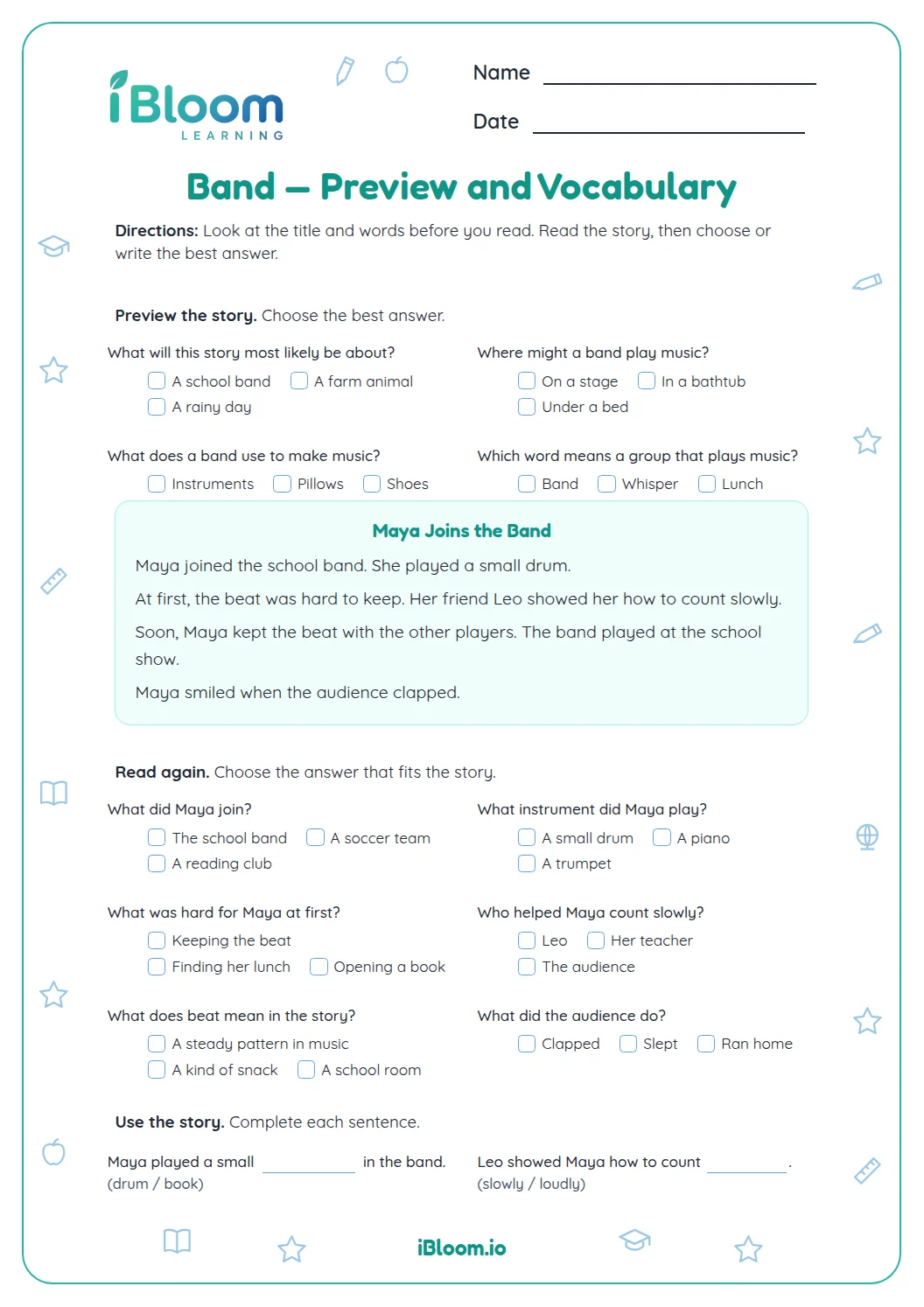
Part B begins with four choices using the title and preview clues, then asks four questions about story details. Part C has five word-meaning questions, and Part D asks children to complete one sentence from the story.
How to use this worksheet
- 1Read the title and preview clues first.
- 2Use the clues to answer the first four questions.
- 3Read the story and find the sentence for each detail question.
- 4For a word question, notice the action or description nearby.
- 5Complete the final sentence with a word from the story.
- 6Check the key and return to the passage for any missed answer.
Common mistakes and quick fixes
The mistake
Guessing without checking the story.
The fix
Point to the sentence that tells the detail.
The mistake
Using a word’s familiar meaning even when the story gives a clue.
The fix
Try the answer in the sentence and see whether it fits.
The mistake
Mixing up who did an action.
The fix
Name the person in each sentence before choosing an answer.
Common Core alignment
The passage and questions connect story details with word meaning in context.
Answer questions about important details in a story.
On this sheet: Part B asks children to identify details and events in the story.
Show the official wordingHide the official wording
Ask and answer questions about key details in a text.
Use the sentence around a word to help find its meaning.
On this sheet: Part C uses story context to determine the meanings of vocabulary words.
Show the official wordingHide the official wording
Use sentence-level context as a clue to the meaning of a word or phrase.
What to practice next
Make more practice
Further reading
Questions parents and teachers ask
What is the Little Kitty story about?
Little Kitty is a small gray kitten who hears a soft meow near the door. Maya finds her under a chair, speaks gently and brings warm milk. Kitty drinks, rubs against Maya’s hand, feels safe and curls up on a rug. The worksheet starts with clues to preview this story.
How many questions are on the worksheet?
There are 14 questions: four use the title and preview clues, four ask about story details, five ask about word meaning, and one asks the child to complete a sentence. The story and questions use three worksheet pages, followed by a separate three-page answer key.
How should a child use the preview clues?
Read the title and opening clues before reading the full story. Use them to think about what the story may be about and what a kitten might need. Then read the passage and answer the questions that ask what actually happened.
What does “peeked out” mean here?
The story says the kitten “peeked out and looked at Maya.” That suggests she looked out a little while still partly hidden. Ask the child to picture the action and try the meaning in the sentence to see if it fits.
Can an adult read the passage aloud?
Yes. Read the title and clues first, pause for the preview questions, then read the story aloud together. The child can answer detail questions by pointing to a sentence and use the nearby action or description to reason about a word.
What does the answer key show?
The separate key gives answers for all 14 questions, including the word that completes the final sentence. When a choice is missed, return to the matching clue or story sentence and talk through how it supports the answer in the story.