






About this worksheet
This free Grade 2 reading worksheet pairs phonics and comprehension in an original two-paragraph passage about oi, oy, ou and ow. Children identify the main idea, choose a fitting title, and find details and word patterns stated in the text. The questions give practice rereading for evidence instead of relying on a remembered sound alone. The page practices CCSS RI.2.2, identifying a multiparagraph text’s main topic and the focus of its paragraphs, and includes a separate answer key.
Aligned to RI.2.2
How can a reader find the main idea?
The main idea covers the passage as a whole. Here, both paragraphs explain how vowel teams show gliding sounds, while each example word supplies a smaller detail.
- 1Ask what connects both paragraphs.
- 2They describe letter teams and the sounds those teams spell.
- 3Choose “Vowel teams show sounds.”
What counts as a supporting detail?
A supporting detail is a fact or example stated in the passage. For instance, coin and boil are examples of oi. Reread the sentence before choosing so the answer matches the text.
- Part A is the passage.
- Part B chooses the central idea or a fitting title.
- Part C checks examples, spellings and a reading detail.
Which vowel teams does the passage use?
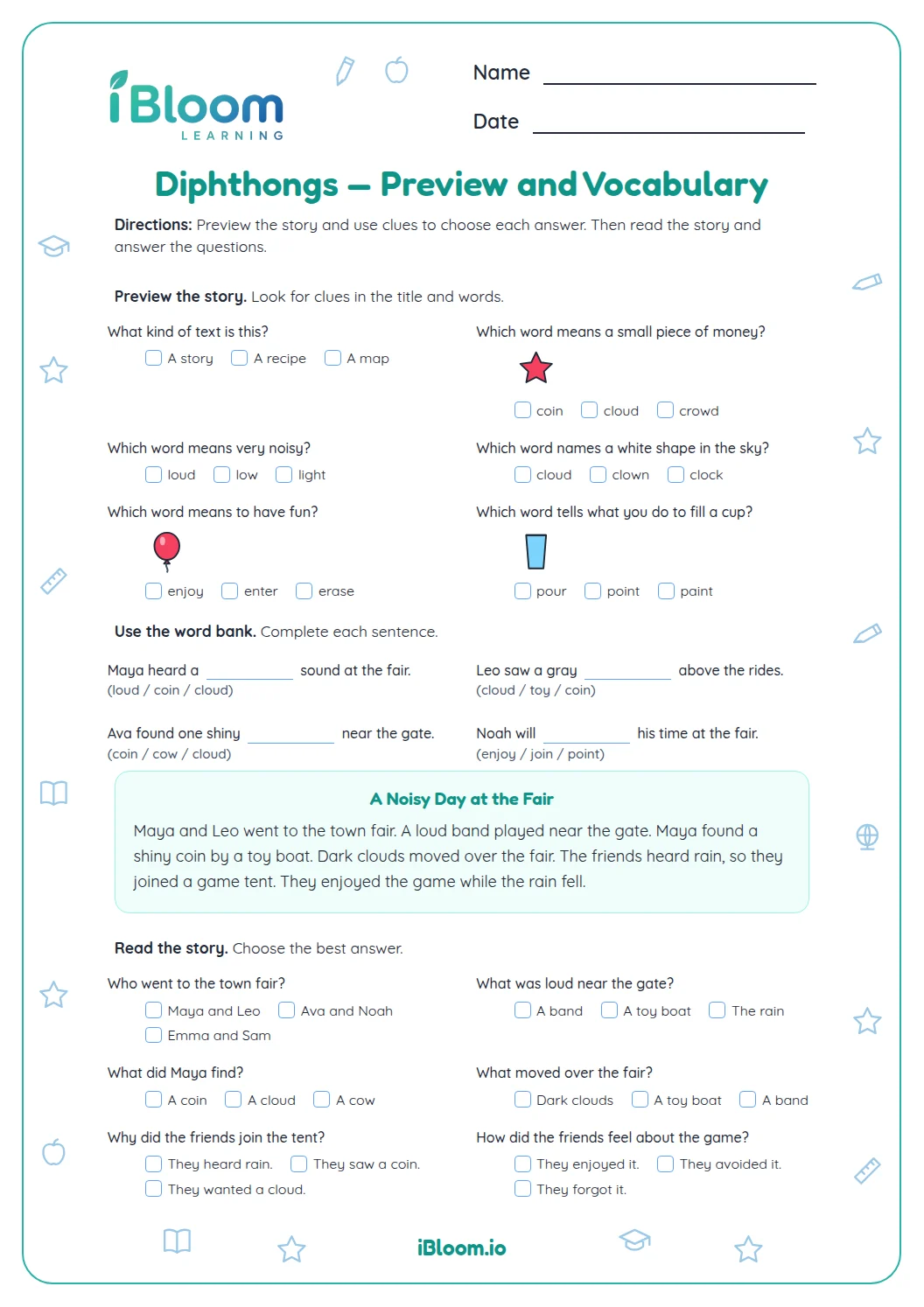
The examples include oi in coin and boil, oy in toy and enjoy, ou in loud and found, and ow in brown and town. Say each word and listen for its vowel glide, then use the sentence to understand the word.
How to use this worksheet
- 1Read both paragraphs once to understand their shared topic.
- 2For a main-idea item, check that the choice fits the whole passage.
- 3For a detail item, return to the sentence with the example.
- 4Look at the letters in the target word before choosing a spelling.
- 5Use the answer key to check the text evidence for each choice.
Common mistakes and quick fixes
The mistake
Choosing one example word as the passage’s main idea.
The fix
Check that the choice describes both paragraphs, not just one word.
The mistake
Selecting a detail that sounds reasonable but is not in the text.
The fix
Find the sentence that states the detail before marking a choice.
The mistake
Mixing up oi, oy, ou and ow.
The fix
Look at the letters in each example word, then say it aloud to hear the glide.
Common Core alignment
Identify the main topic and describe supporting details.
On this sheet: The questions identify the passage topic and details stated in its paragraphs.
Show the official wordingHide the official wording
Identify the main topic of a multiparagraph text as well as the focus of specific paragraphs within the text.
What to practice next
Make more practice
Further reading
Questions parents and teachers ask
What is the main idea of the passage?
The passage explains that vowel teams can spell gliding sounds. The details name oi in coin and boil, oy in toy and enjoy, ou in loud and found, and ow in brown and town. The first three questions ask children to identify that central idea.
Which vowel spellings appear in the passage?
The passage uses oi, oy, ou and ow. Its examples are coin and boil, toy and enjoy, loud and found, and brown and town. Ask your child to point to the two-letter team in each word before reading the word aloud.
How should my child find a supporting detail?
Have the child reread the paragraph and locate the sentence that gives the example or fact. For instance, coin and boil support the statement about oi. A detail should be present in the passage, while the main idea should fit both paragraphs.
How many questions are included?
There are 15 questions. Three ask about the main idea or a title, and 12 check stated details and vowel patterns. The original passage has two short paragraphs, so children can reread the whole text while checking an answer. This helps children practice checking evidence in both paragraphs.
Is there an answer key?
Yes. A separate answer key marks the correct choices. For each item, children can point to the sentence or word that supports the answer, especially when distinguishing a central idea from one example. The key follows the same question order as the printed worksheet.