


About this worksheet
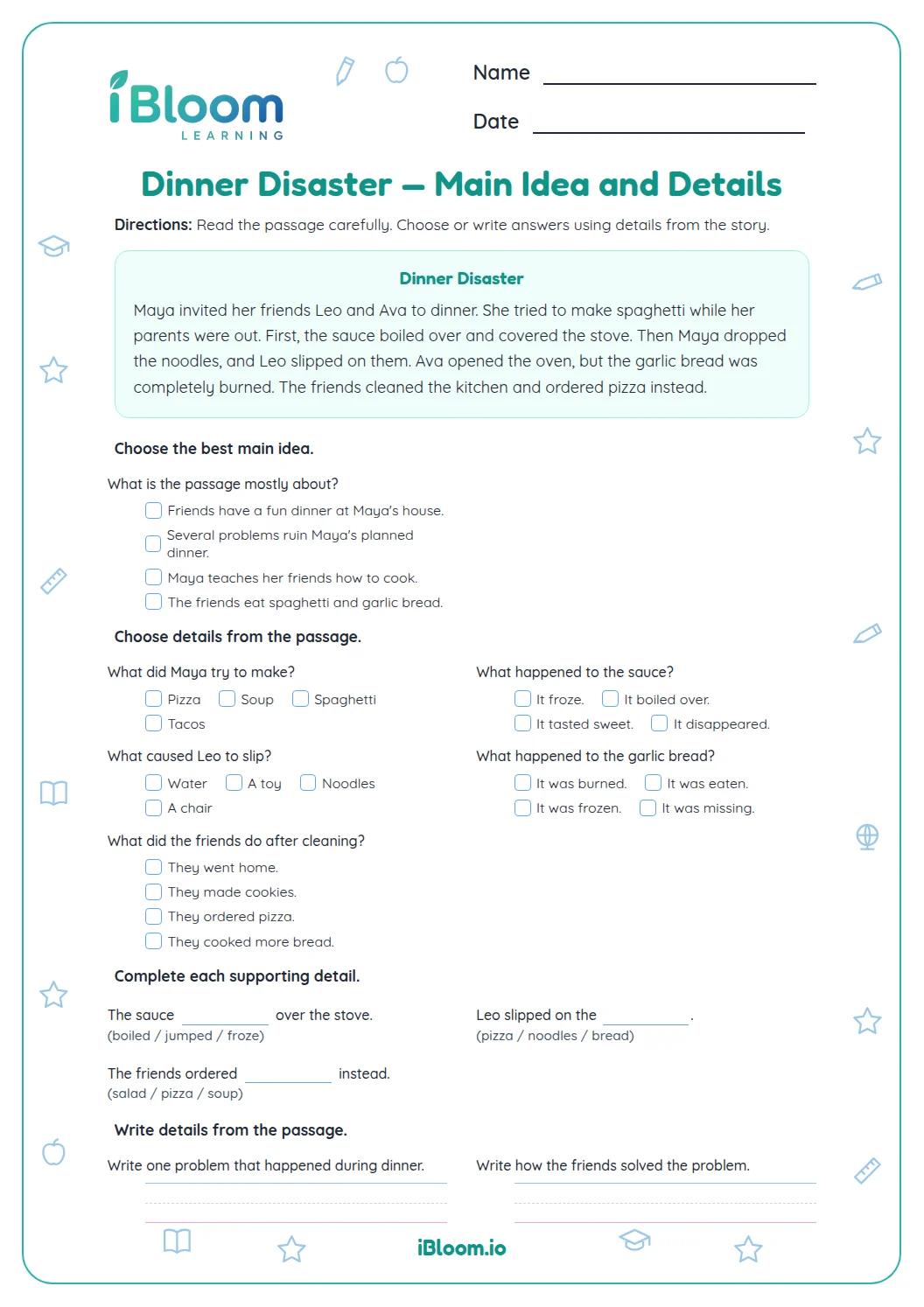
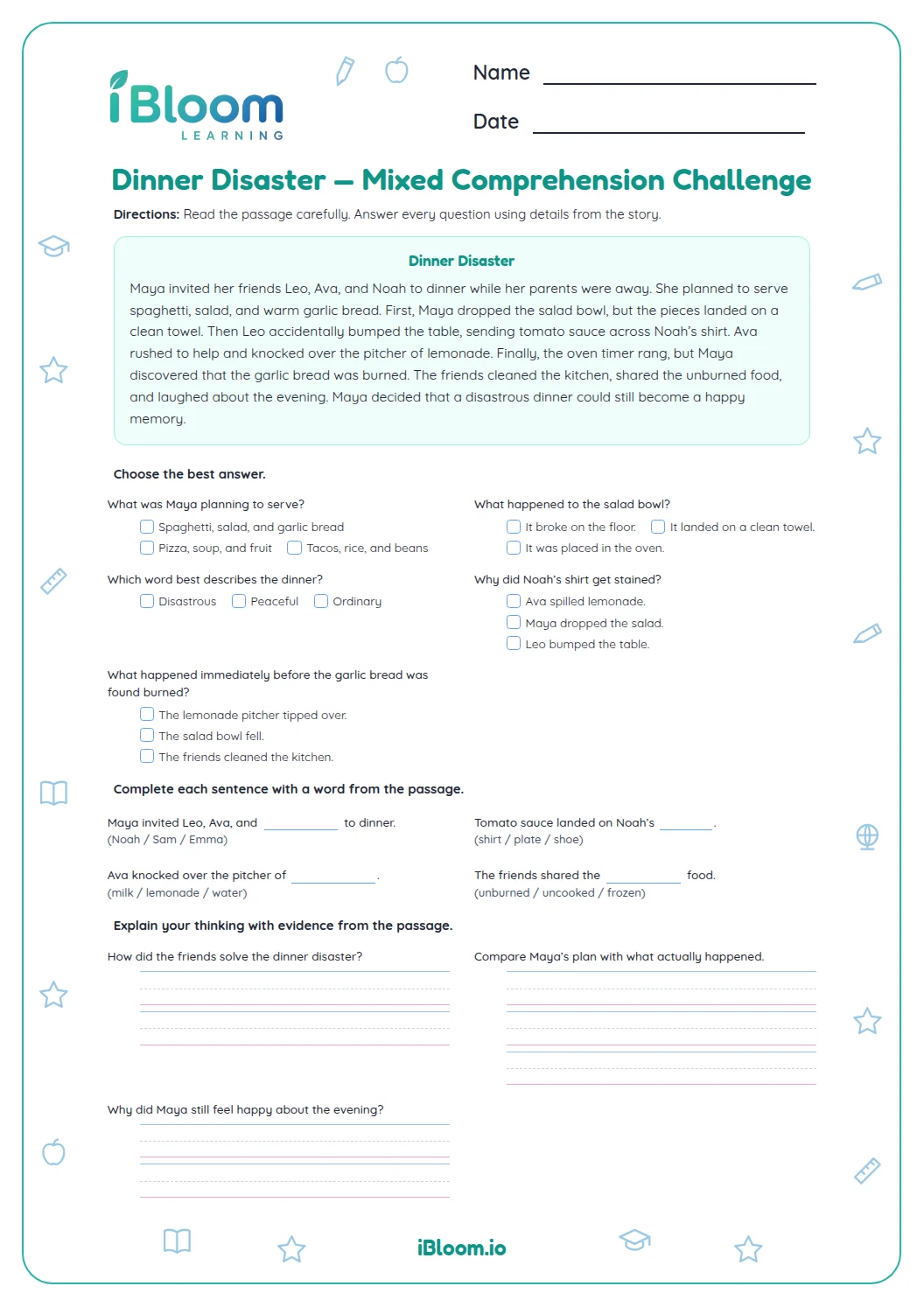
This Grade 5 reading worksheet keeps the Dinner Disaster story and replaces the old questions with a full practice set. Students preview the title and opening, interpret six words from context, check details and event understanding, and write two short evidence-based responses. The passage follows Maya and Leo as a dinner mishap spills sauce and water before the family cleans up together. The questions practice Common Core RL.5.4 and RL.5.1. A separate answer key gives the selected answers and sample written responses.
Aligned to RL.5.4 and RL.5.1
How can a title help a reader preview a story?
A title offers a first clue about the kind of problem or event a story may contain. Predictions should stay connected to that clue and to the first events, then be checked while reading.
Here, “Dinner Disaster” suggests trouble around a meal. The opening image of a wobbling bowl gives a specific prediction to test.
How do story details clarify an unfamiliar word?
Look around the word for an action, result, or nearby description. In this story, sauce splashes, water spills, the family searches for towels, and the tablecloth stays soggy. Those details help distinguish each word’s meaning.
- 1Sentence: “In the sudden commotion…”
- 2Clue: water spills and everyone searches for towels.
- 3A careful plan does not fit the scene.
- 4Answer: noisy confusion
How can a reader support an answer with story evidence?
For a detail question, return to the sentence that names the action. For a written response, state the answer and add the relevant action from the story.
Part D asks why towels were needed and what shows the family worked through the mess together. The key gives sample wording; a child’s answer may vary if the story detail is accurate.
How to use this worksheet at home or in class
- 1Read the title and note one prediction before starting.
- 2Read the full passage once for the sequence of events.
- 3Reread the sentence around each vocabulary word.
- 4For detail questions, locate the sentence that answers the question.
- 5Write a complete thought for the final two questions.
- 6Use the answer key to check meaning and evidence.
Common mistakes and quick fixes
The mistake
Choosing a familiar definition that does not fit the scene.
The fix
Read the sentence before and after the word, then test the meaning against the action.
The mistake
Treating a prediction as a fact stated in the story.
The fix
Use “most likely” for predictions and check them as the events unfold.
The mistake
Giving a written answer without evidence.
The fix
Add one action from the passage that directly supports the explanation.
Common Core alignment
This printable gives students focused practice with the listed English language arts skill.
Determine the meaning of words and phrases as they are used in a text.
On this sheet: Students use surrounding story details to interpret words such as wobble, commotion, frantic, and salvaged.
Show the official wordingHide the official wording
Determine the meaning of words and phrases as they are used in a text, including figurative language such as metaphors and similes.
Use accurate details from a story to explain explicit information and inferences.
On this sheet: Questions ask students to support predictions and explanations with details from the story.
Show the official wordingHide the official wording
Quote accurately from a text when explaining what the text says explicitly and when drawing inferences from the text.
What to practice next
Make more practice
Questions parents and teachers ask
What skills does this Dinner Disaster worksheet practice?
Students preview a story, use context to determine word meanings, locate details, and write brief answers with text evidence. The answer key includes choices and sample responses for the written questions. Ask the student to point to the exact word or event that supports the response, then explain the connection in their own words.
How long is the passage?
The story is a short, single-scene passage about a family cleaning up a dinner mishap. Students can reread it while answering the vocabulary and comprehension questions, then return to the relevant sentence for evidence. Ask the student to point to the exact word or event that supports the response, then explain the connection in their own words.
Are the last answers exact sentences?
The key provides sample answers for the two written responses. Other complete responses are acceptable when they use accurate story details. Encourage a child to explain which event supports the answer. Ask the student to point to the exact word or event that supports the response, then explain the connection in their own words.
Can an adult read the story aloud?
Yes. An adult may read the passage aloud, then invite the student to find the sentence that supports each answer. This keeps the focus on understanding the story, its word choices, and how the events fit together. Ask the student to point to the exact word or event that supports the response, then explain the connection in their own words.