





About this worksheet
This original passage follows Nora as she revises a flipbook animation. Questions check sequence, vocabulary, explicit details, and evidence-based inference.
Aligned to RL.5.1 and RL.5.4
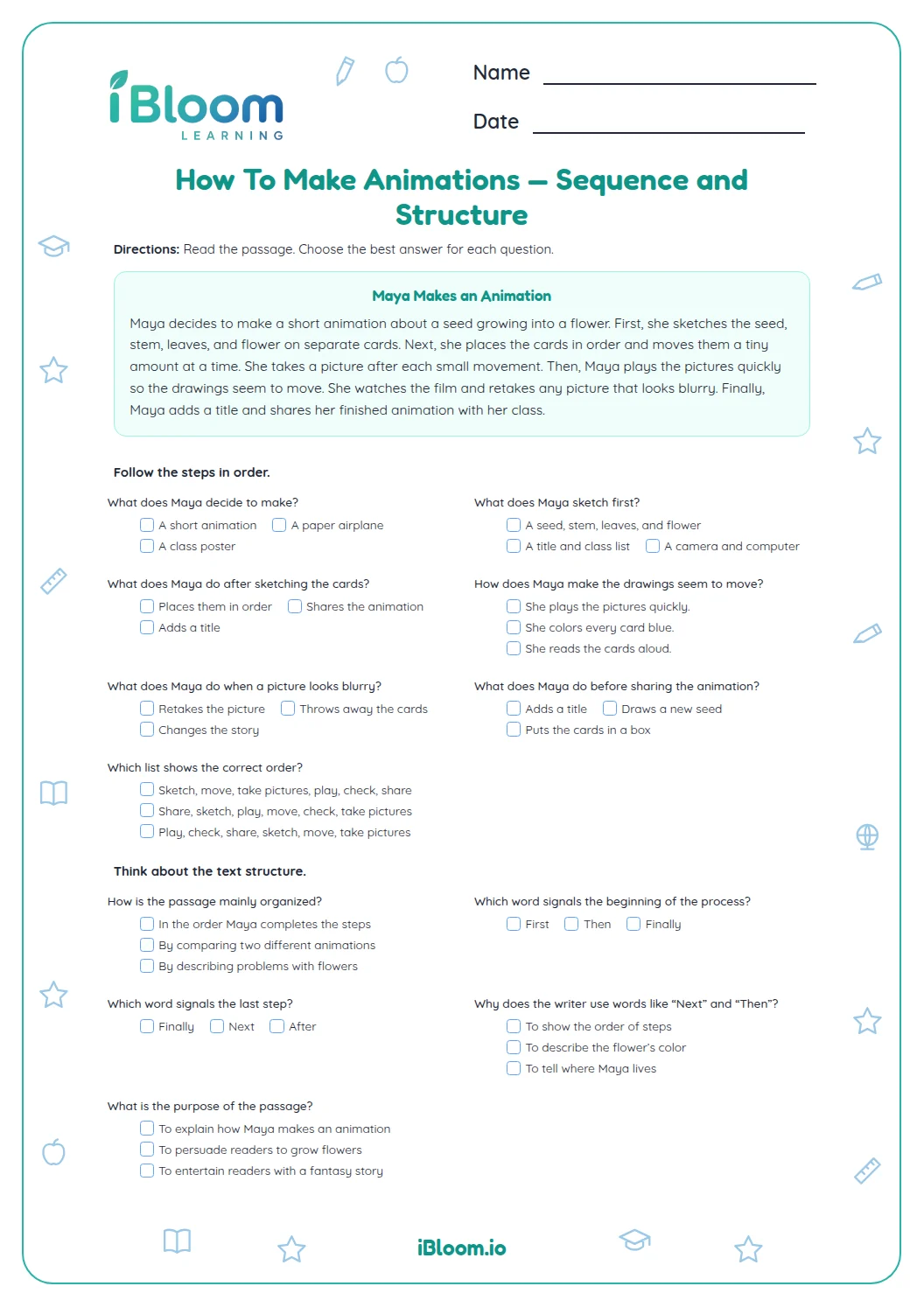
How does a flipbook create motion?
A flipbook uses a stack of drawings that change a little in sequence. When a reader flips the stack quickly, the eye sees the drawings as one moving image.
In this passage, Nora tests the motion, notices a jump, and revises the drawings. Readers can track the sequence and use details to explain why her changes help.
Which words matter in this passage?
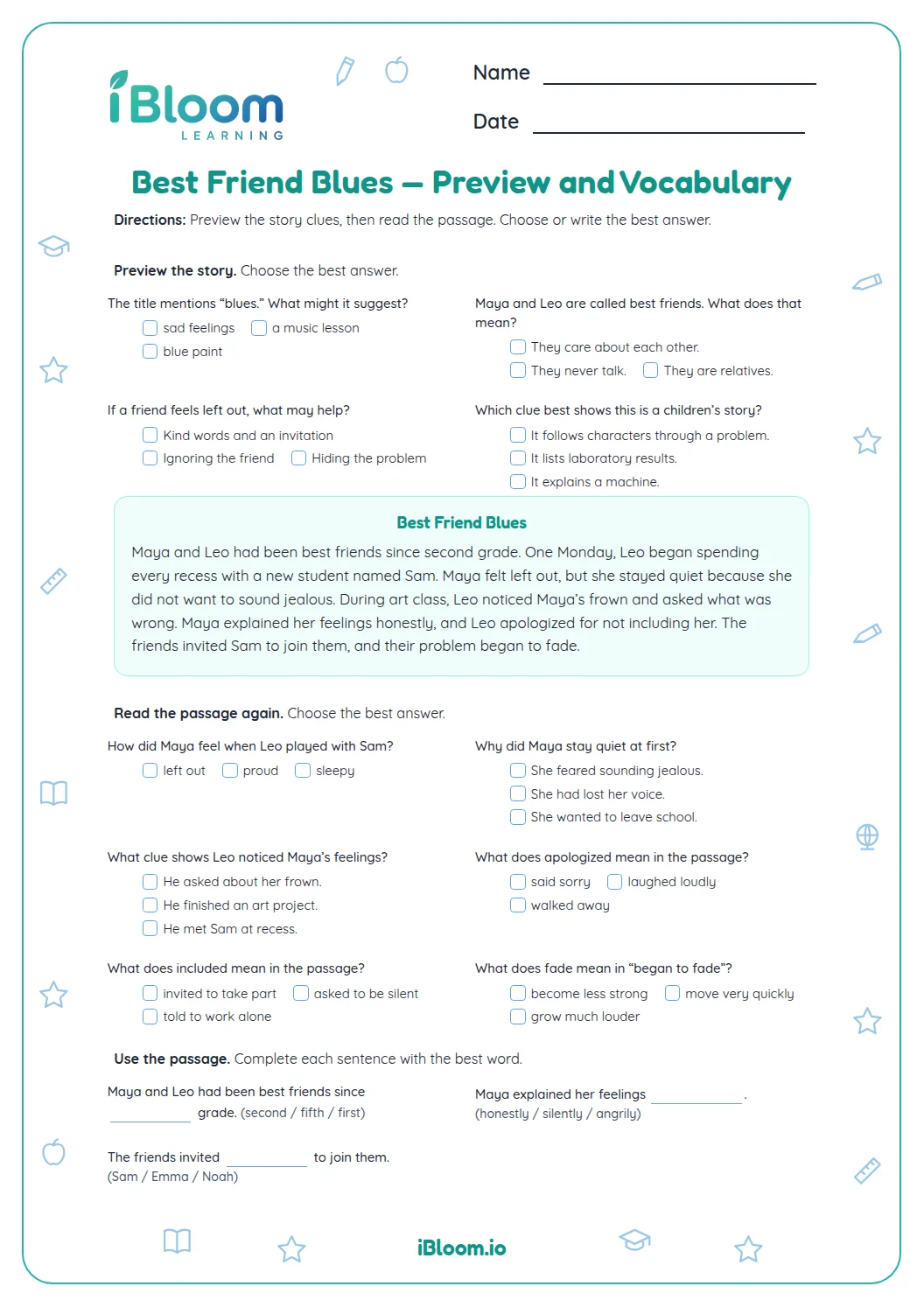
A frame is one still image in a sequence. An illusion is an effect that appears real, even though it is created. Context helps readers select the meaning that fits the animation project.
What is on the worksheet?
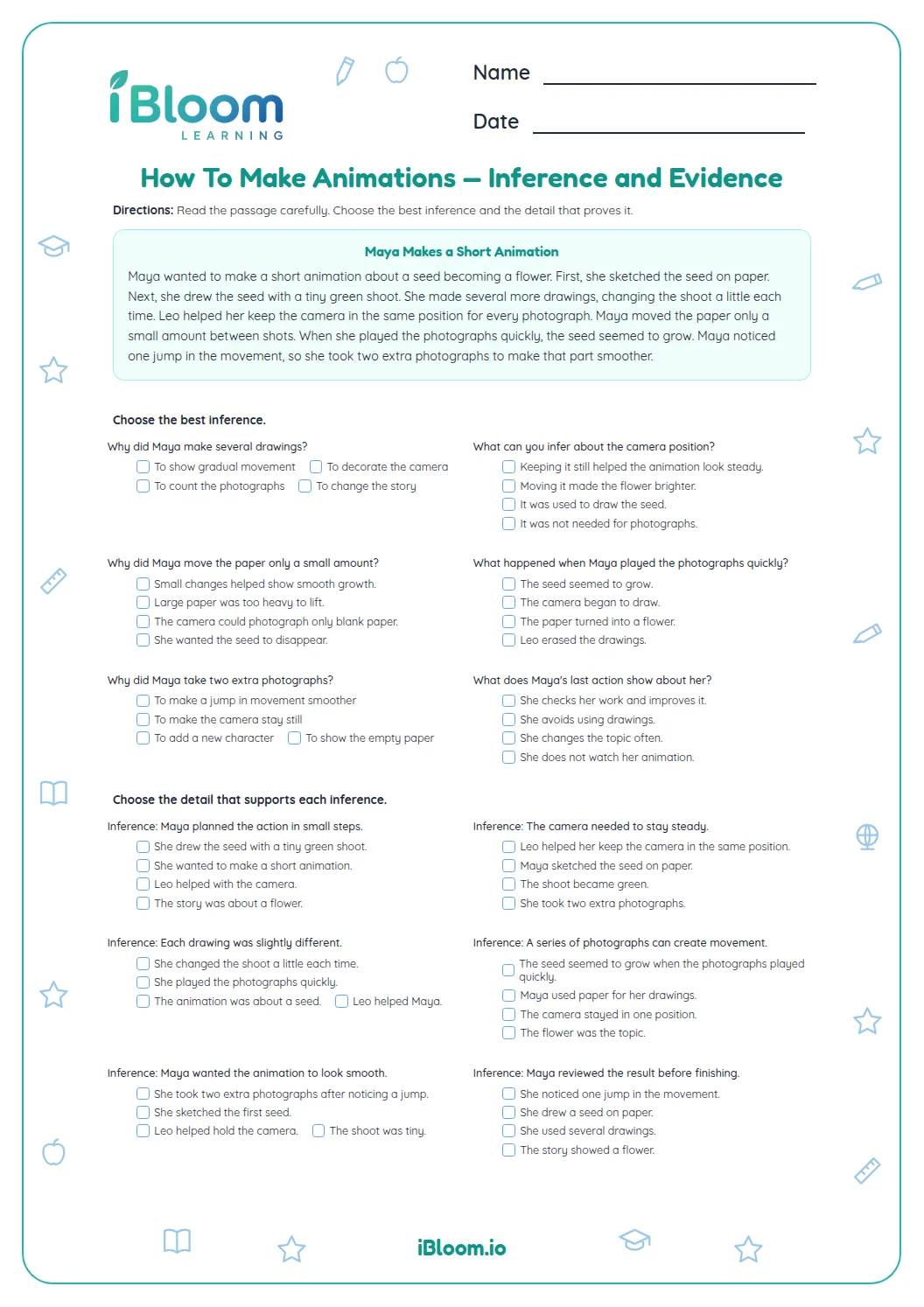
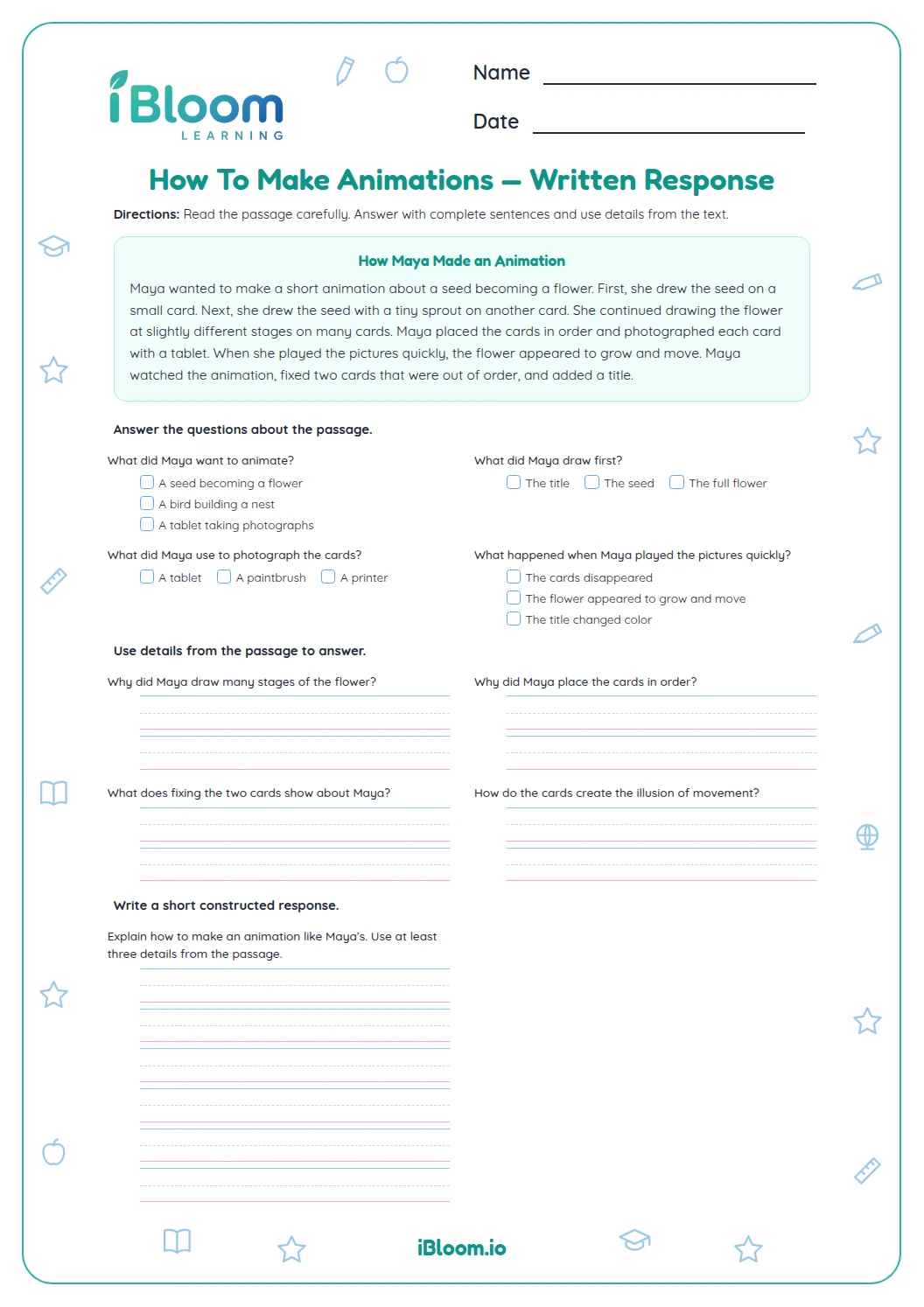
The passage is followed by questions about its main event, sequence, details, vocabulary, and supported inferences. Short written answers ask students to explain their thinking with information from the text.
- Part A: follow Nora’s process
- Part B: use context to understand animation words
- Part C: infer and cite details
How to use this worksheet
- 1Read the passage once for the sequence, then return to it for evidence.
- 2For written responses, include the detail that supports the answer.
Common mistakes and quick fixes
The mistake
Giving an inference without a text clue.
The fix
Name a specific action or detail that supports what you think.
The mistake
Choosing a familiar meaning of a word that does not fit the passage.
The fix
Read the sentence around the word and test which meaning makes sense there.
Common Core alignment
This page gives focused practice with the skill named in its title.
Quote accurately when explaining a text or inference.
On this sheet: Students answer with accurate passage details and make a supported inference.
Show the official wordingHide the official wording
Quote accurately from a text when explaining what the text says explicitly and when drawing inferences from the text.
Determine word meaning in context.
On this sheet: Students use context to interpret frames and illusion.
Show the official wordingHide the official wording
Determine the meaning of words and phrases as they are used in a text.
What to practice next
Make more practice
Further reading
Questions parents and teachers ask
What is a frame in an animation?
A frame is one still drawing or image in a sequence of images. Return to the sentence and nearby details before choosing, and point to the clue that supports the answer. This gives students a clear way to check their reasoning and make the next practice attempt more accurate.
Why did Nora redraw some pages?
The stem moved too far between drawings, so the motion looked jumpy. Return to the sentence and nearby details before choosing, and point to the clue that supports the answer. This gives students a clear way to check their reasoning and make the next practice attempt more accurate.
What is a flipbook animation?
A flipbook is a stack of pages with a drawing on each. The drawings change slightly in sequence. Flipping the stack quickly makes the sequence look like one moving image, as Nora discovers with her sunflower. Return to the sentence and nearby details before choosing, and point to the clue that supports the answer.
How can students support an inference?
An inference combines a clue from the text with what a reader already knows. For example, Nora redraws frames after noticing a jump. That detail supports the idea that she is patient and willing to improve her work. Return to the sentence and nearby details before choosing, and point to the clue that supports the answer.
How should a student answer a vocabulary question?
Read the whole sentence and nearby details, then test each possible meaning in context. In this passage, frames are individual drawings because Nora changes them one at a time to make the flower’s movement smoother. Return to the sentence and nearby details before choosing, and point to the clue that supports the answer.