





About this worksheet
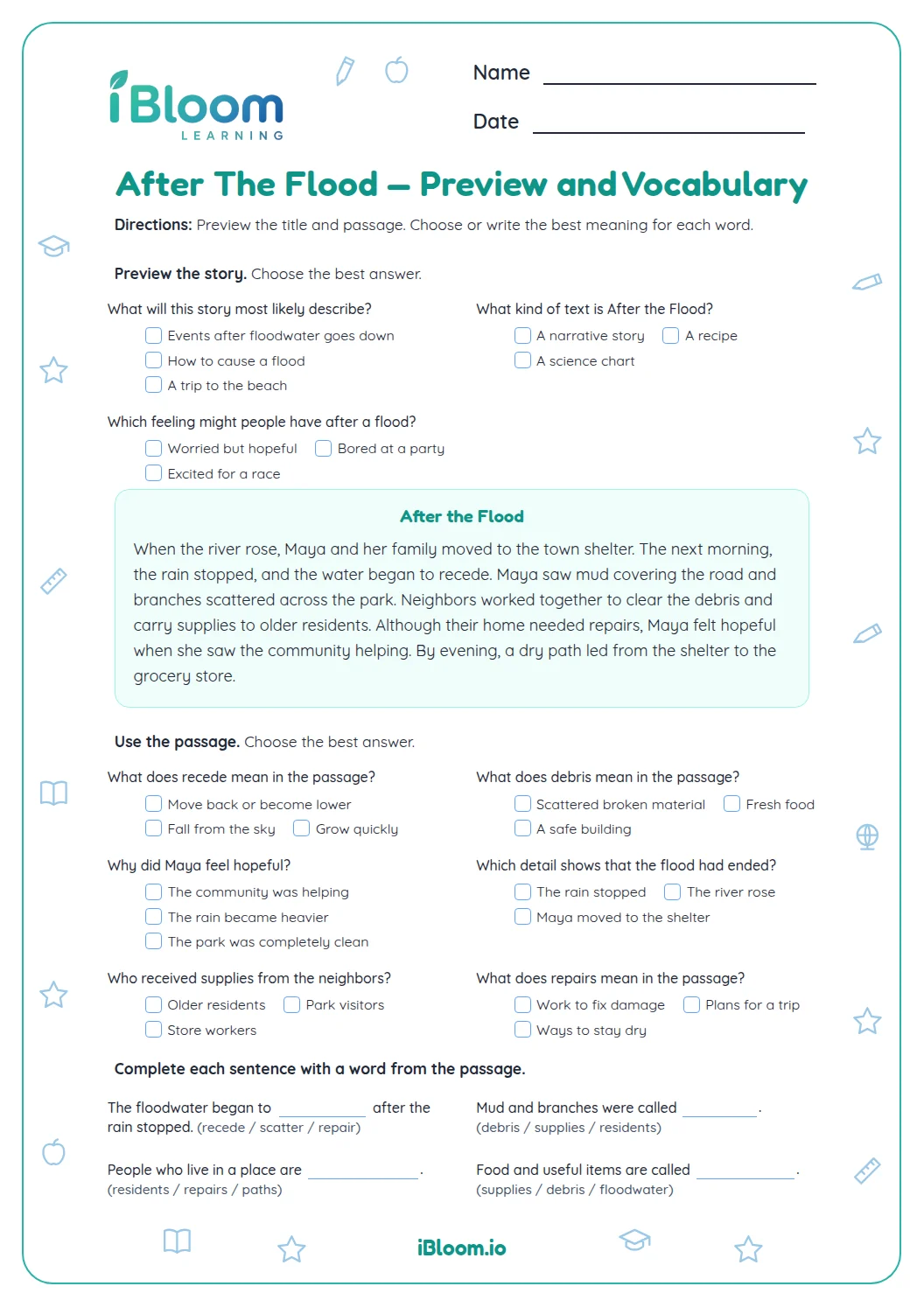
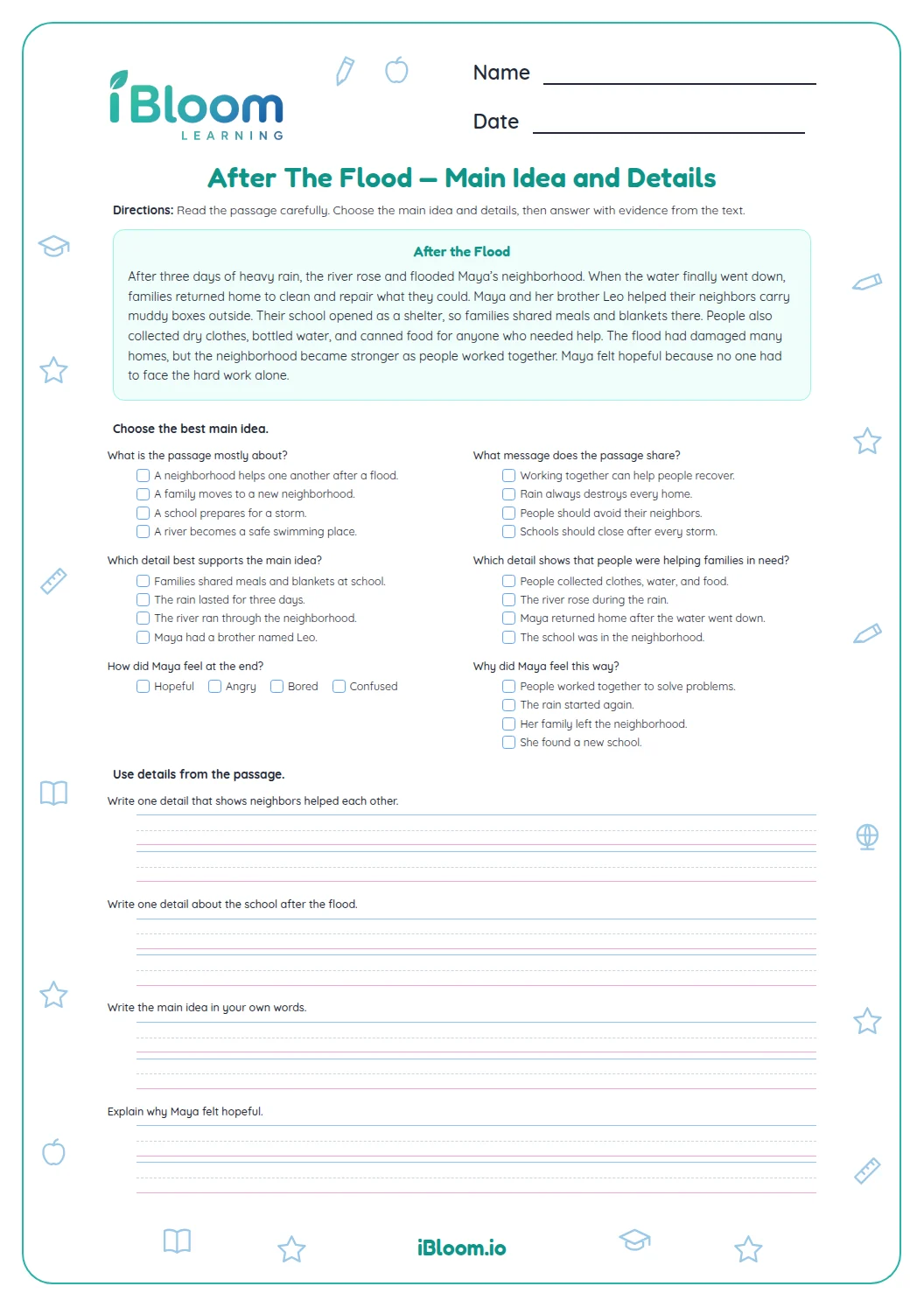
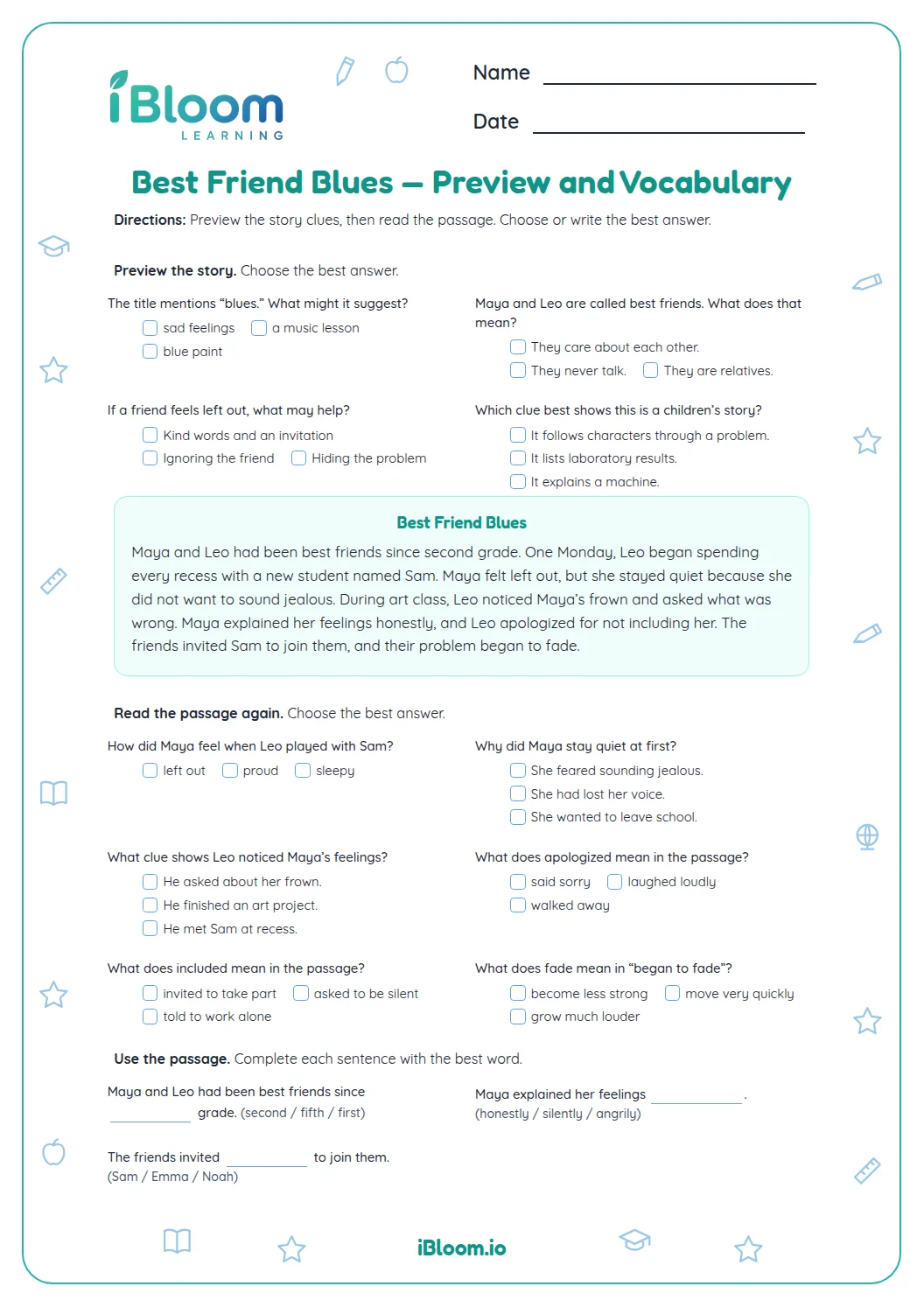
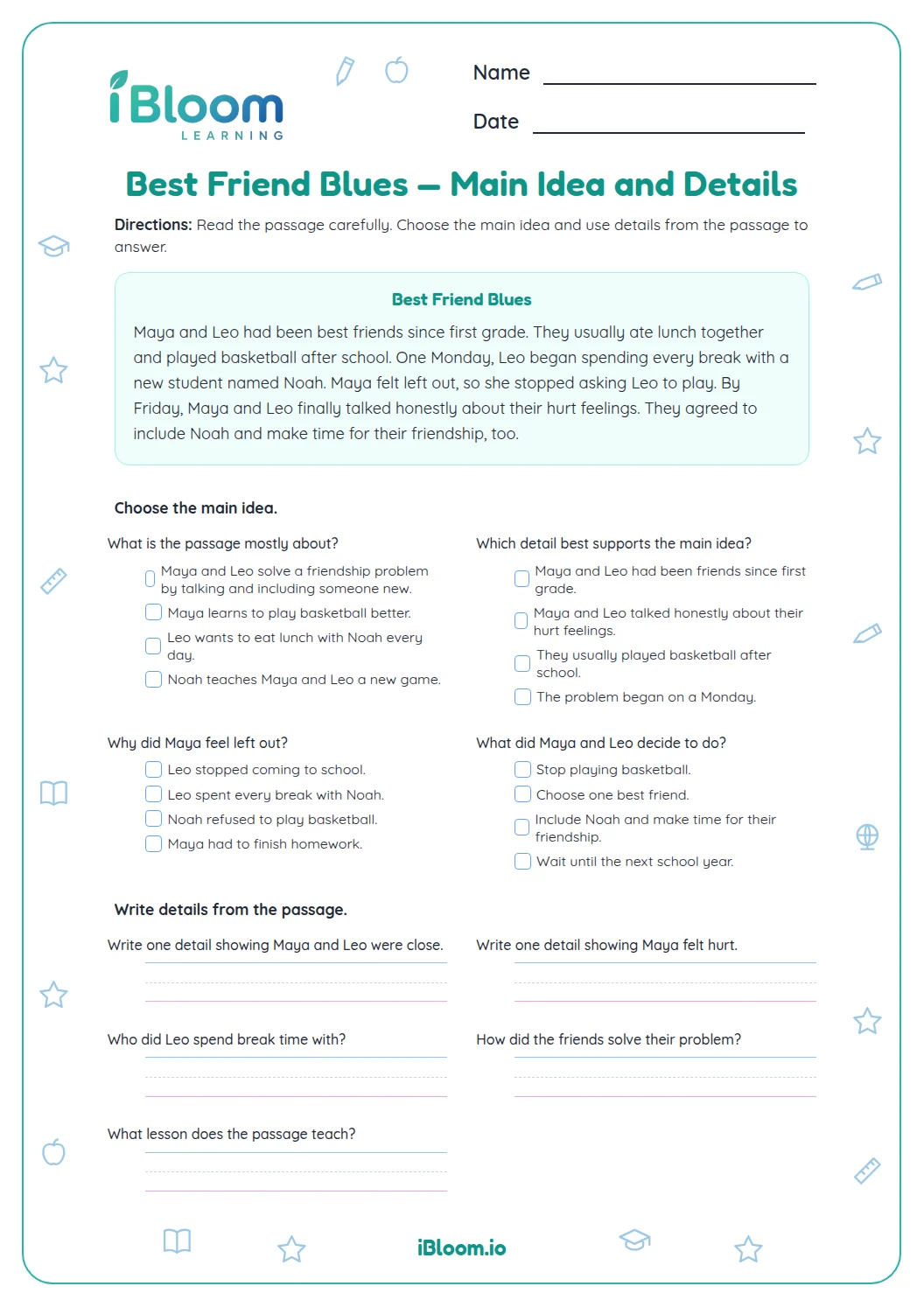
This Grade 5 reading worksheet uses the Jump Around story about Maya and Leo practicing a jumping course. Students choose the main idea, locate key details, and explain answers with evidence from the passage. The printable has 12 questions across multiple choice, short answer, and written response. It practices CCSS RL.5.2 by connecting story details with the central idea and CCSS RL.5.1 by answering with accurate textual evidence. A separate answer key gives concise answers and sample responses.
Aligned to RL.5.2 and RL.5.1
How is the main idea different from a detail?
A detail tells one event or fact. The main idea brings the important details together into one statement about the whole passage. For a story, consider what the character does and learns across the beginning, middle, and end.
- 1Question: What is the passage mostly about?
- 2Maya and Leo try jumps, make mistakes, and practice again.
- 3They improve and encourage others by the end.
- 4Main idea: Practice and teamwork help children improve.
Which details support an answer?
Look for an action, object, or event that directly answers the question. A strong explanation points to the passage rather than adding a guess. Mia’s notebook drawings, for example, show that she tracks the plant’s height over time.
What will students practice?
Part A asks about the passage as a whole and its supporting details. Part B checks specific events and reasons. Part C asks students to explain the central idea and use evidence in a complete response.
How to use this worksheet
- 1Read the passage once to understand what Mia is doing.
- 2Read it again and notice changes from planting to sprouting.
- 3For multiple choice, test each option against the whole story.
- 4For short answers, state one accurate detail in your own words.
- 5For written responses, connect the detail to the question and reread for evidence.
- 6Compare responses with the key; written answers may use different words and still be correct.
Common mistakes and quick fixes
The mistake
Choosing a vivid detail as the main idea.
The fix
Ask whether the sentence summarizes the beginning, middle, and end.
The mistake
Using a guess that the passage never says.
The fix
Point to a sentence or event that supports each answer.
The mistake
Repeating a detail without explaining it.
The fix
Add a phrase that tells how the detail answers the question.
Common Core alignment
Use story details and a character’s response to explain a theme or central message.
On this sheet: Children identify the whole-story idea and explain how Mia’s observations and records support it.
Show the official wordingHide the official wording
Determine a theme of a story, drama, or poem from details in the text, including how characters in a story or drama respond to challenges or how the speaker in a poem reflects upon a topic; summarize the text.
Answer questions with accurate details from the story.
On this sheet: The detail and written-response questions require evidence from the passage.
Show the official wordingHide the official wording
Quote accurately from a text when explaining what the text says explicitly and when drawing inferences from the text.
What to practice next
Make more practice
Further reading
Questions parents and teachers ask
How long is the passage?
The passage is one paragraph about Maya and Leo at a Saturday jumping activity. It describes the course, their early mistakes, and how practice helps them move more carefully and encourage other students. The passage keeps the focus on one activity from start to finish.
What does the worksheet mean by main idea?
The main idea is the point that connects the important events across the whole story. Here, Maya and Leo improve by slowing down, watching a demonstration, practicing, and encouraging one another. Students can support that statement with events from the beginning and ending.
How many questions are included?
There are 12 questions: six multiple-choice questions, four short-answer questions, and two written responses. They cover the main idea, specific details, and explanations supported by the passage. The questions use the story in three different ways, including details, explanation, and a summary.
Can students write different answers from the key?
Yes. The key gives sample wording for open responses, not the only acceptable wording. An answer is strong when it addresses the question and uses accurate details from the story. A correct detail stated in a child’s own words is acceptable.
What evidence should a student use?
Students can refer to Leo knocking over a foam bar, Maya landing outside the floor spots, or both children slowing down to watch the coach. The best detail depends on the question being answered. The response should connect the event to the question.