




About this worksheet
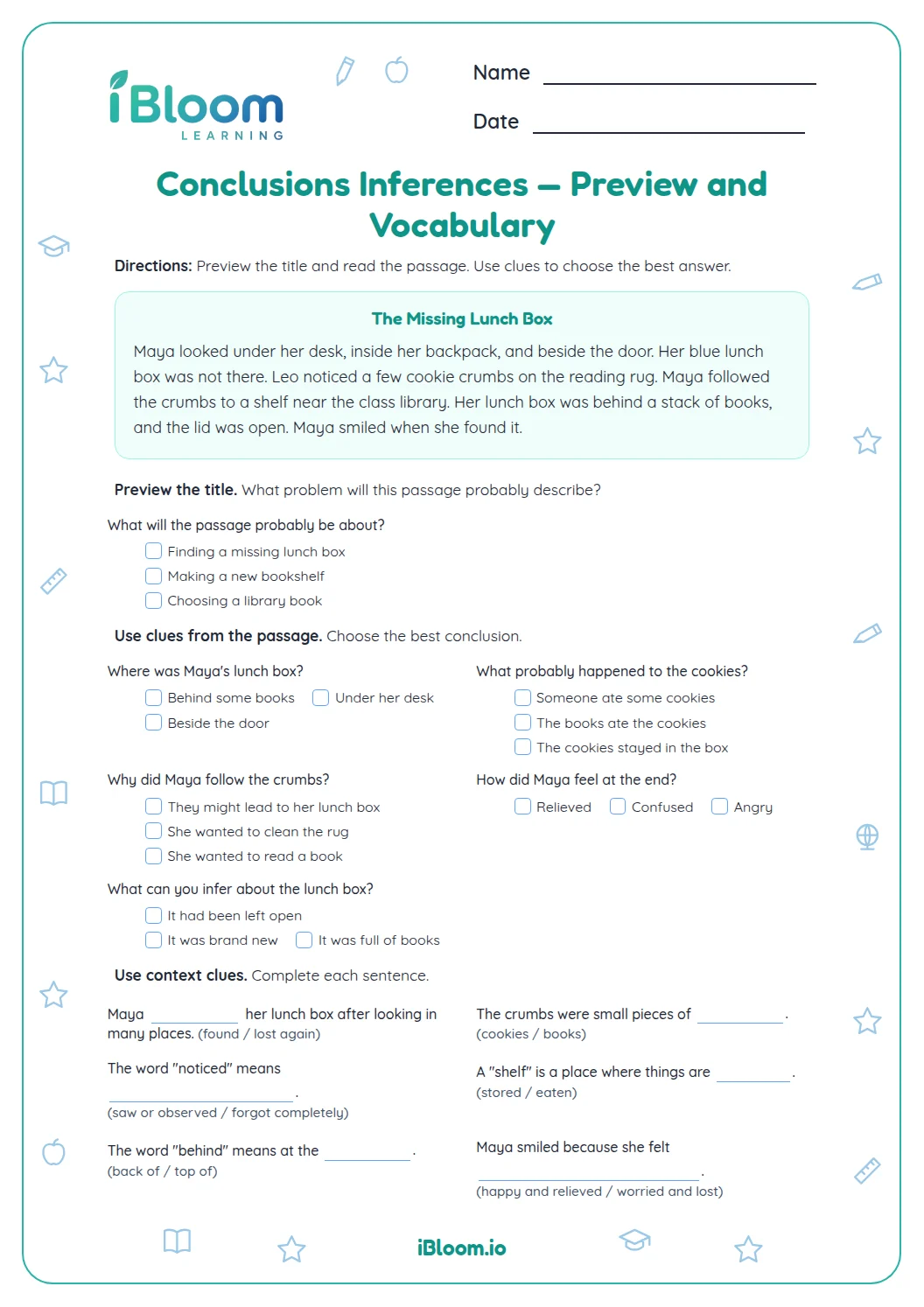
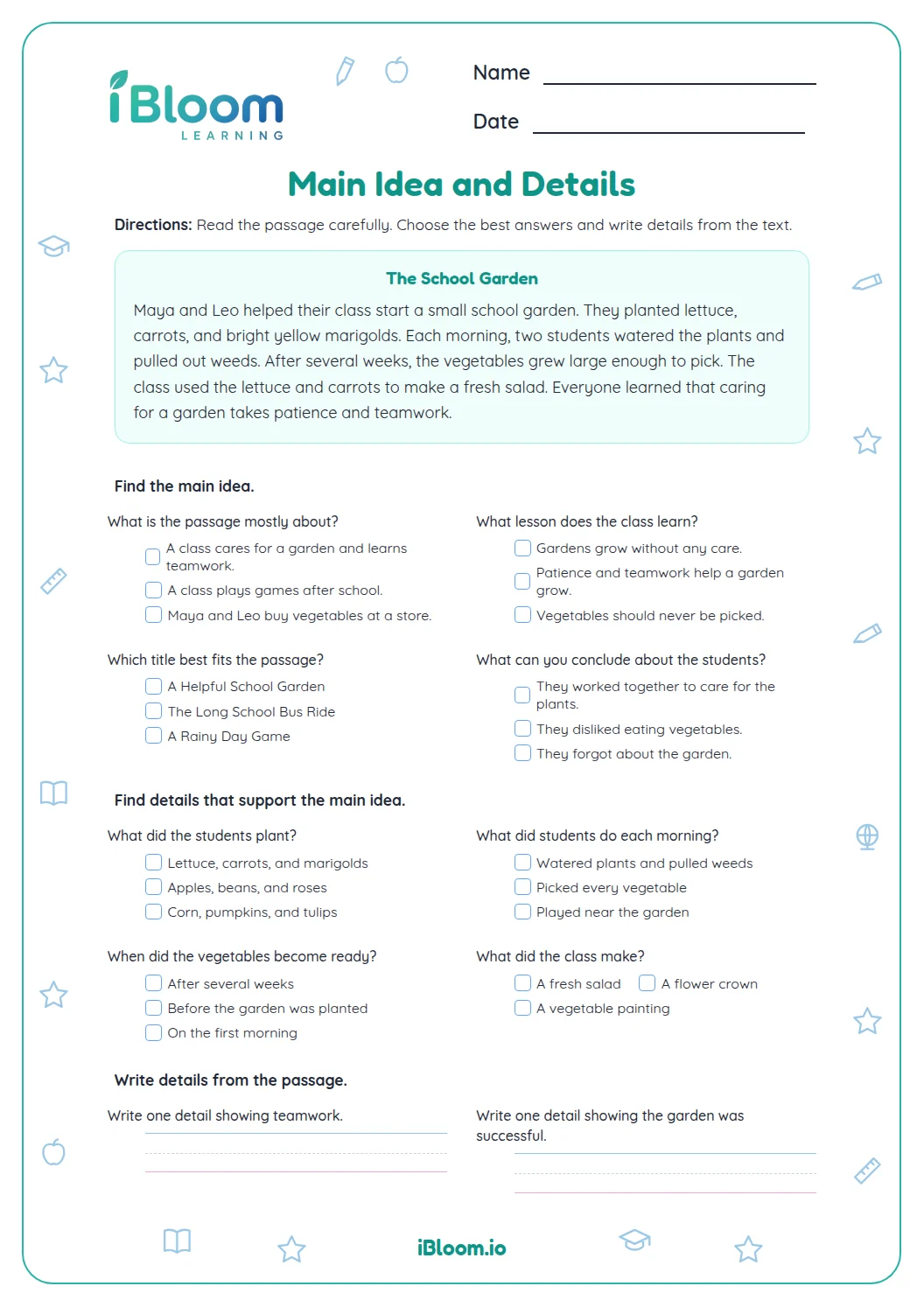
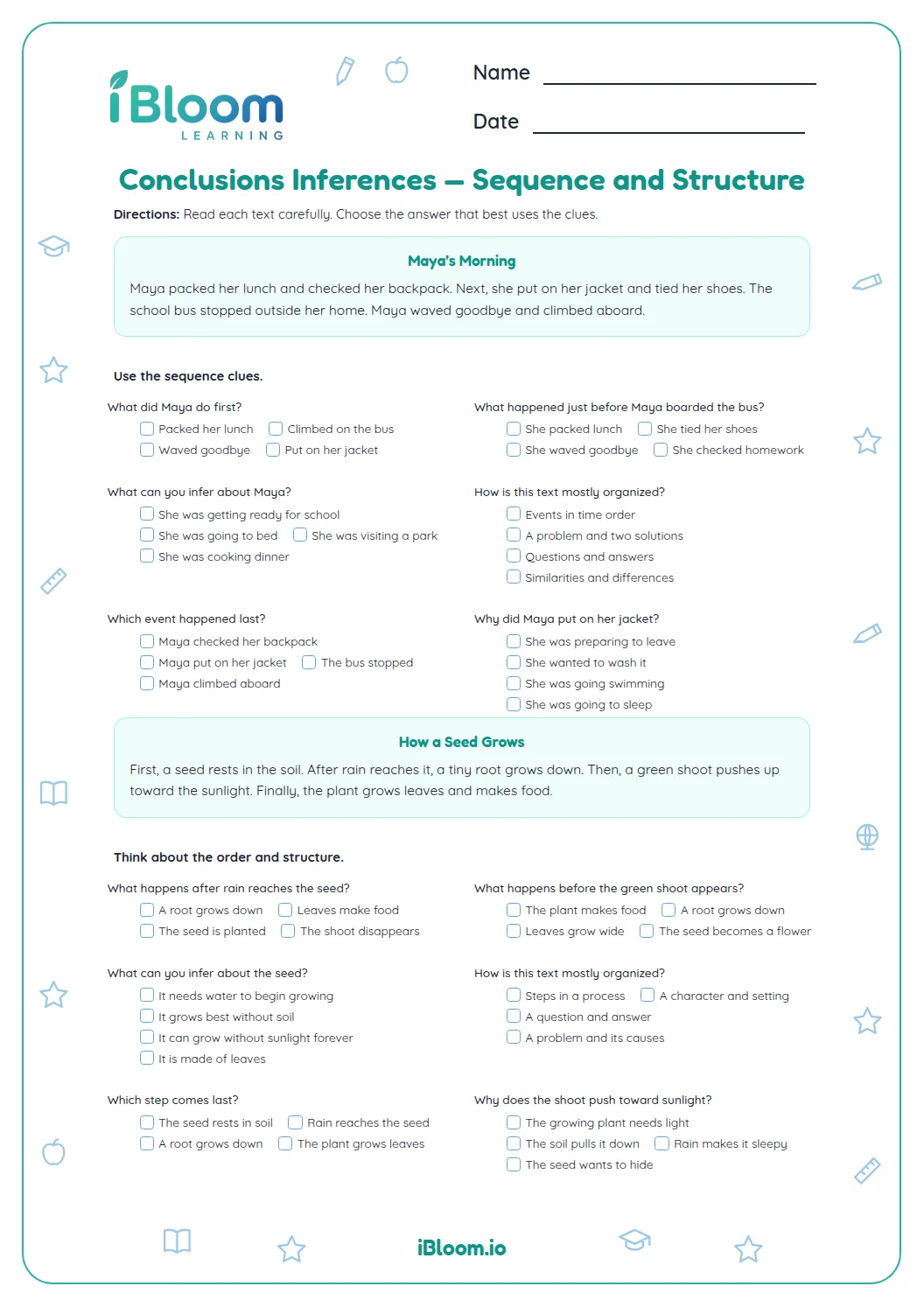
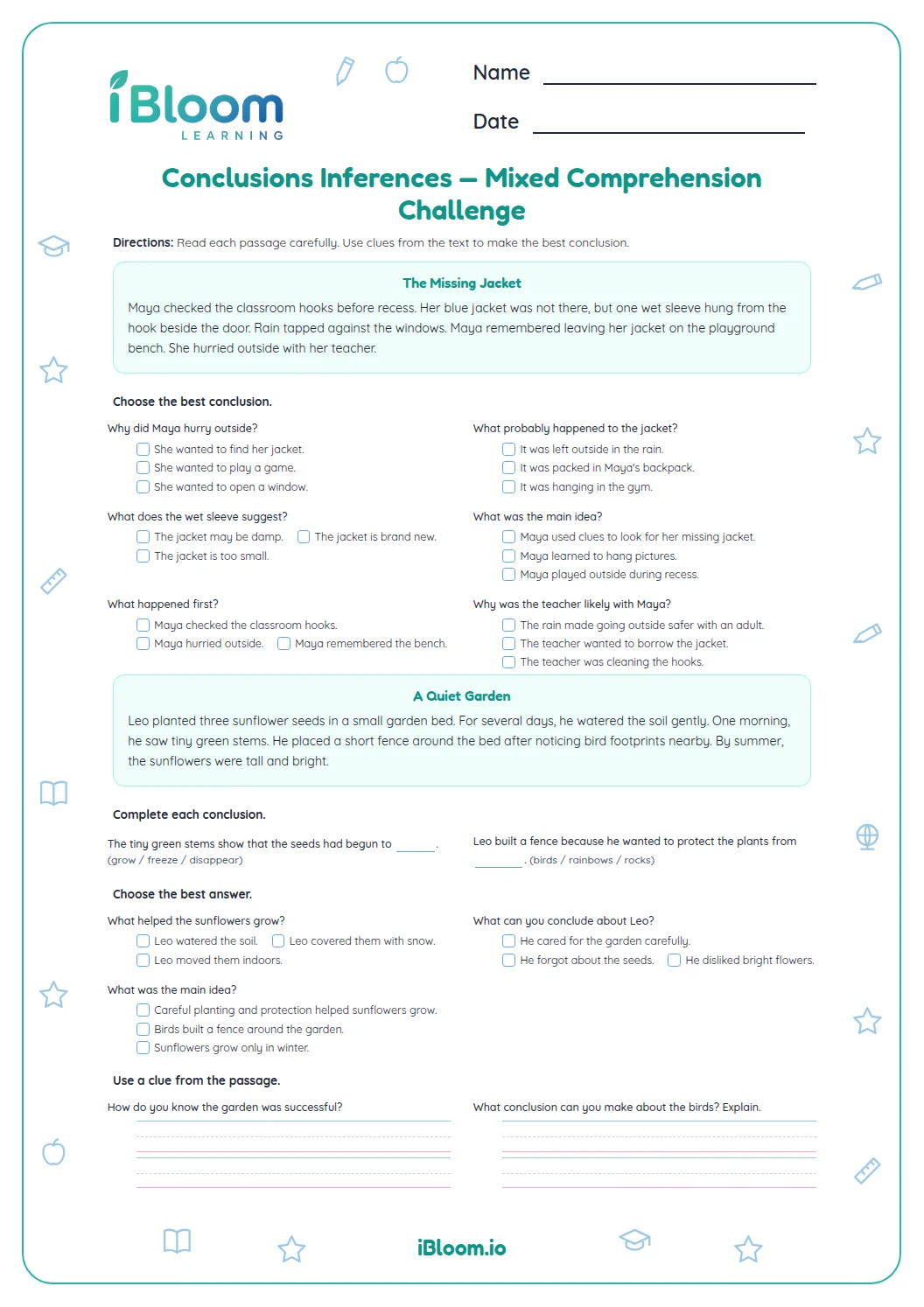
This free Grade 3 printable uses an original school-garden story to practice drawing inferences and supporting conclusions with text details. Readers answer 13 questions about clues, causes, feelings, and character choices, then write a short response naming a clue. The separate key includes the correct choices and a sample evidence-based answer. The questions ask readers to return to the passage and use its details, in line with CCSS RL.3.1.
Aligned to CCSS.ELA-Literacy.RL.3.1
What is an inference?
An inference is a conclusion that combines a clue in the text with what a reader already knows. The passage does not directly say that rain fell. It gives damp soil as a clue, so the reader can infer that rain fell recently.
Question 3 asks what the damp soil suggests about the weather. Question 4 asks which detail supports that inference.
- 1Question: What can the reader infer about the weather?
- 2Clue: “A trail of damp soil crossed the path.”
- 3Known idea: Rain can make soil damp.
- 4Inference: It had rained recently.
How do clues support a conclusion?
Look for actions, descriptions, and changes across the passage. A closed gate the next morning suggests the loose board was fixed; the rabbit drinking outside the fence suggests the dish was useful. One clue should fit the question better than the other choices.
What will the reader practice?
The 14 questions include 13 multiple-choice items and one short written response. They ask readers to connect passage details with reasonable conclusions about the garden, its visitors, and Nia’s choices.
How to use this worksheet
- 1Read the story once to follow what happens in the garden.
- 2For each question, return to the sentence that may hold a clue.
- 3Choose the answer that fits both the clue and the question.
- 4For question 14, state an inference and name one detail that supports it.
- 5Use the key to review the choices and discuss a reasonable written answer.
Common mistakes and quick fixes
The mistake
Treating a guess as an inference without a clue.
The fix
Ask the reader to point to the story detail that made the idea reasonable.
The mistake
Choosing a true detail that does not answer the question.
The fix
Reread the question first, then select the clue connected to that exact idea.
The mistake
Repeating a clue without explaining the conclusion.
The fix
Add a short “This suggests…” sentence that connects the detail to the inference.
Common Core alignment
This worksheet practices the standard below through its specific reading tasks.
Answer questions about a story and point to details that support each answer.
On this sheet: Each choice and the final written response use details in the story as evidence.
Show the official wordingHide the official wording
Ask and answer questions to demonstrate understanding of a text, referring explicitly to the text as the basis for the answers.
What to practice next
Make more practice
Further reading
Questions parents and teachers ask
What does it mean to make an inference?
An inference is a conclusion supported by a text clue and what a reader already knows. In this passage, damp soil is a clue that it may have rained. The questions ask readers to connect clues with ideas about the garden, its visitors, and Nia’s choices.
How many questions are on the worksheet?
There are 14 questions: 13 multiple-choice questions and one written response. The first 13 ask readers to choose an answer supported by the garden story. The last asks for an inference about the rabbit and a detail from the passage.
What grade is this inference worksheet for?
The page is written for Grade 3 readers. An adult can read the passage aloud if needed, then invite the child to find the sentence that supports each answer. The questions use a short original story about a school garden, a loose board, and a rabbit.
What is the answer key useful for?
The separate key gives the correct answer for each selected-response item and a sample for the written response. A child’s wording can differ from the sample if the inference is reasonable and the passage detail supports it. The key also helps an adult check that a child’s clue fits the story.
How should a child answer the final question?
Name an idea about the rabbit and connect it to a detail from the passage. For example, the rabbit can visit safely outside the fence because Nia sees it drinking there. The response should use a clue rather than an unsupported guess.