Free printable practice
Recycling Practice Activities
Grade 1 recycling worksheets help children sort everyday items, understand why recycling matters, and build simple environment vocabulary.
Free printable worksheet PDFs
Preview every available page, then download the free worksheet PDF for home, homeschool, tutoring, or classroom practice.
Preview the exact activity before downloading it.
 Recycling — Sort and ClassifyGrade 1 recycling worksheets help children sort everyday items, understand why recycling matters, and build simple environment vocabulary. This sort and classify worksheet provides a distinct, age-appropriate way to practise the same lesson.Grade 1Free PDF preview
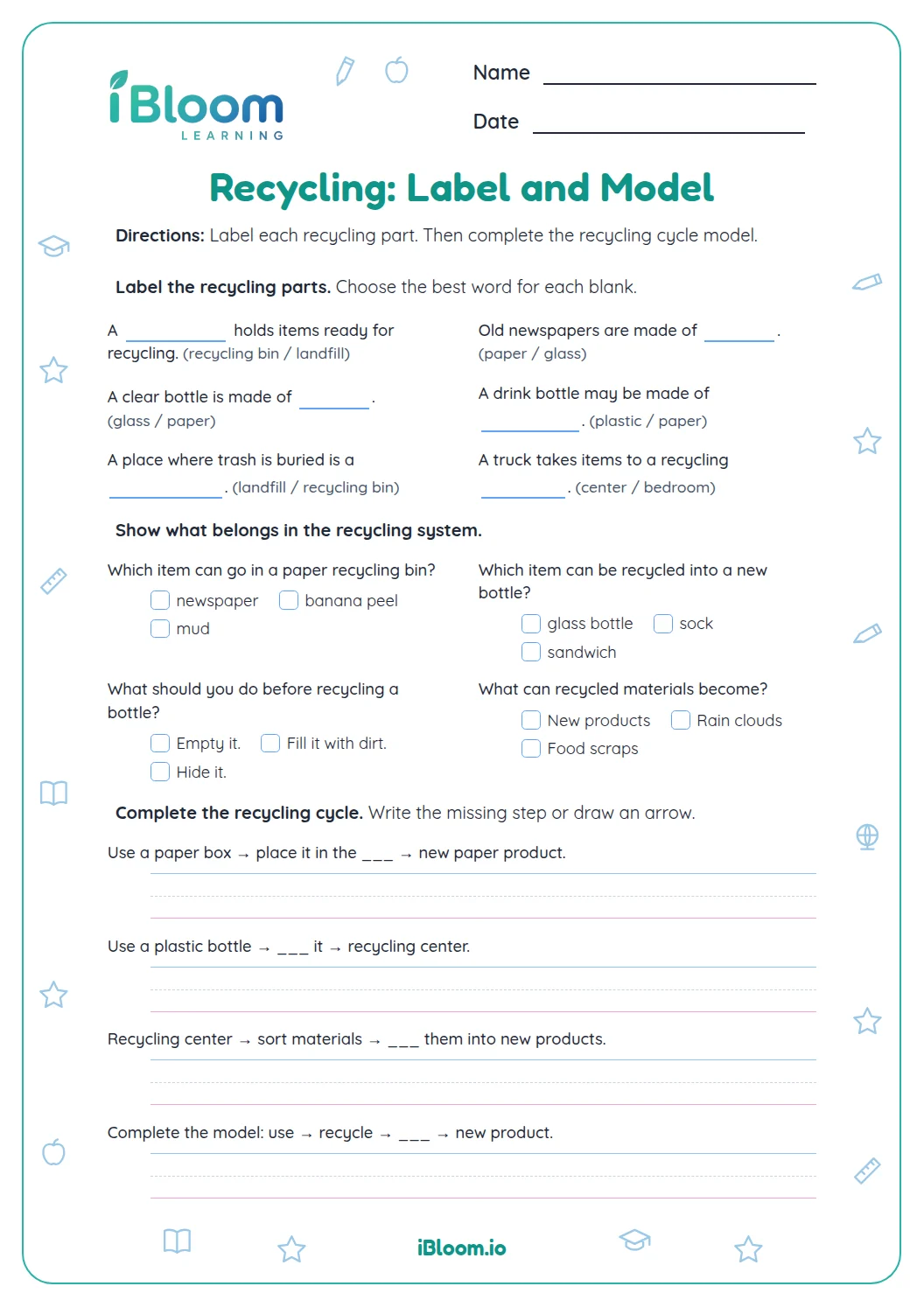 Recycling — Label and ModelGrade 1 recycling worksheets help children sort everyday items, understand why recycling matters, and build simple environment vocabulary. This label and model worksheet provides a distinct, age-appropriate way to practise the same lesson.Grade 1Free PDF preview
 Recycling — Explain Cause and EffectGrade 1 recycling worksheets help children sort everyday items, understand why recycling matters, and build simple environment vocabulary. This explain cause and effect worksheet provides a distinct, age-appropriate way to practise the same lesson.Grade 1Free PDF preview
 Recycling — Apply Science IdeasGrade 1 recycling worksheets help children sort everyday items, understand why recycling matters, and build simple environment vocabulary. This apply science ideas worksheet provides a distinct, age-appropriate way to practise the same lesson.Grade 1Free PDF preview
 Recycling — Science Reasoning ReviewGrade 1 recycling worksheets help children sort everyday items, understand why recycling matters, and build simple environment vocabulary. This science reasoning review worksheet provides a distinct, age-appropriate way to practise the same lesson.Grade 1Free PDF preview
Practice that builds confidence
What first graders learn
These Grade 1 science worksheets help children understand recycling as one way people care for the environment. Students practise identifying materials such as paper, plastic, glass, and metal, then decide which everyday items can be recycled.
The printable activities include picture sorting, labeling, matching, simple writing prompts, and observation-based tasks. They support early science vocabulary while encouraging children to notice recycling choices at home, at school, and in their community.
Recycling is introduced as a practical environmental habit: using certain materials again instead of throwing everything away. Children connect familiar objects—newspapers, cans, bottles, boxes, and containers—to the idea that waste can be sorted. The focus is not on complex recycling rules, but on careful observation, responsible choices, and words such as recycle, waste, trash, material, paper, plastic, metal, and glass.

How the worksheets progress
Activities move from recognition to decision-making. A child may first circle recyclable items, then sort pictures into recycle and trash groups, and later explain a simple choice in a sentence. Matching tasks strengthen vocabulary, while cut-and-paste or draw-and-label pages make the science idea more concrete. This progression helps students go beyond memorizing a symbol and begin thinking about what an object is made of.
A simple parent routine
At home, choose three clean items after a snack or meal, such as a cardboard box, a plastic bottle, and a food wrapper. Ask, “What is it made of?” and “Where should it go?” Let your child say the material before deciding. Then use one worksheet page to reinforce the same thinking with pictures. Keep the routine conversational so children learn that recycling is a real-life habit, not only a school topic.

Classroom uses for teachers
Teachers can use these pages during Grade 1 environment lessons, science centers, morning work, or after a class discussion about caring for the Earth. Sorting pages work well in small groups because students can explain their choices to a partner. Writing prompts can become a quick science journal entry, and picture activities are useful for checking whether children understand the difference between an object and the material it is made from.

Common mix-ups to watch for
Some children think every container is recyclable or that anything with a recycling symbol always goes in the same bin. Others sort by color or shape instead of material. Encourage students to slow down and ask, “Is it paper, plastic, glass, or metal?” Also remind them that dirty or food-filled items may not belong with clean recyclables, depending on local rules.
Free printable PDF download
Use this Grade 1 recycling worksheet page to preview the activity, print it, or download it as a PDF for quick practice. It works well for homework, homeschool lessons, tutoring, morning work, revision, and classroom centers.
Answers and answer key support
After the child completes the worksheet independently, parents and teachers can use the answer support or answer key information to check the work, review mistakes, and choose the next practice step.
Why iBloom worksheets help
The pages use clear pictures, simple directions, and age-appropriate choices so first graders can focus on the science concept. A helpful child-friendly strategy is: “Look, name the material, then choose the place.” This gives children a repeatable process they can use on worksheets and in everyday recycling moments.
Helpful answers
Frequently asked questions
What do Grade 1 students practise in these recycling worksheets?
They practise identifying recyclable items, sorting objects by material, using recycling vocabulary, and explaining simple choices about waste and the environment.
Do children need to know local recycling rules before using these pages?
No. The worksheets focus on broad first-grade concepts such as paper, plastic, glass, and metal. You can add local rules during discussion if your area has special recycling guidelines.
How can I make recycling practice more hands-on at home?
Use clean household items such as boxes, bottles, cans, and wrappers. Ask your child to name the material, decide whether it may be recyclable, and then complete a related worksheet.
Are these worksheets useful for a science center?
Yes. Sorting, matching, and labeling pages are well suited for independent or partner work in a Grade 1 science center about the environment.
What mistakes should I look for when my child sorts recycling pictures?
Watch for sorting by color, size, or shape instead of material. Encourage your child to ask what the object is made of before choosing recycle or trash.
Is this Grade 1 recycling worksheet free?
Yes. You can preview it for free and use the printable worksheet for home or classroom practice.
Can I download this Grade 1 recycling worksheet as a PDF?
Yes. Use the worksheet download option to save a printable PDF, or print the worksheet directly from the page.
Does this Grade 1 recycling worksheet include answers or an answer key?
When the activity has fixed answers, iBloom includes answer support so parents and teachers can check the completed worksheet.