


About this worksheet
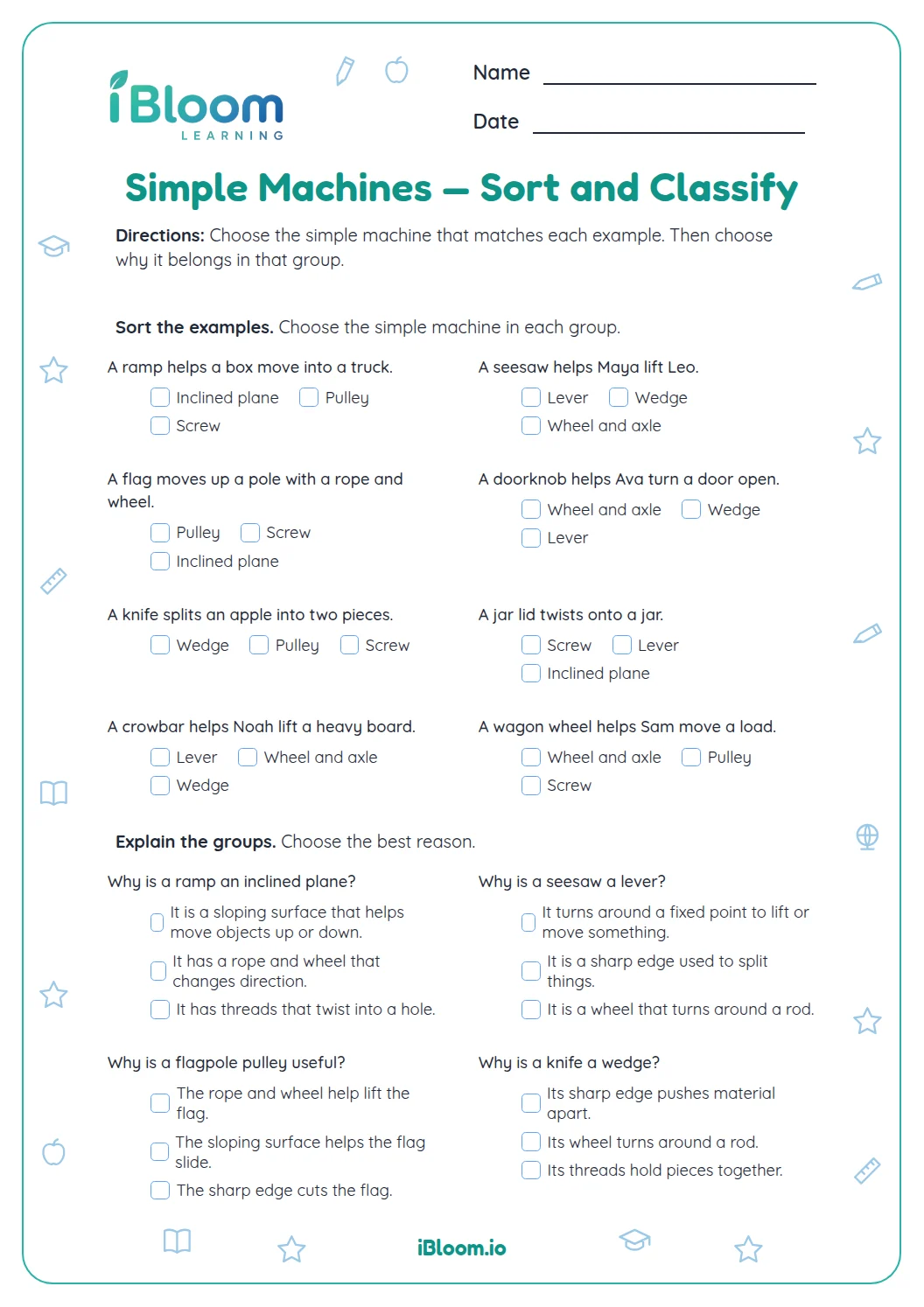
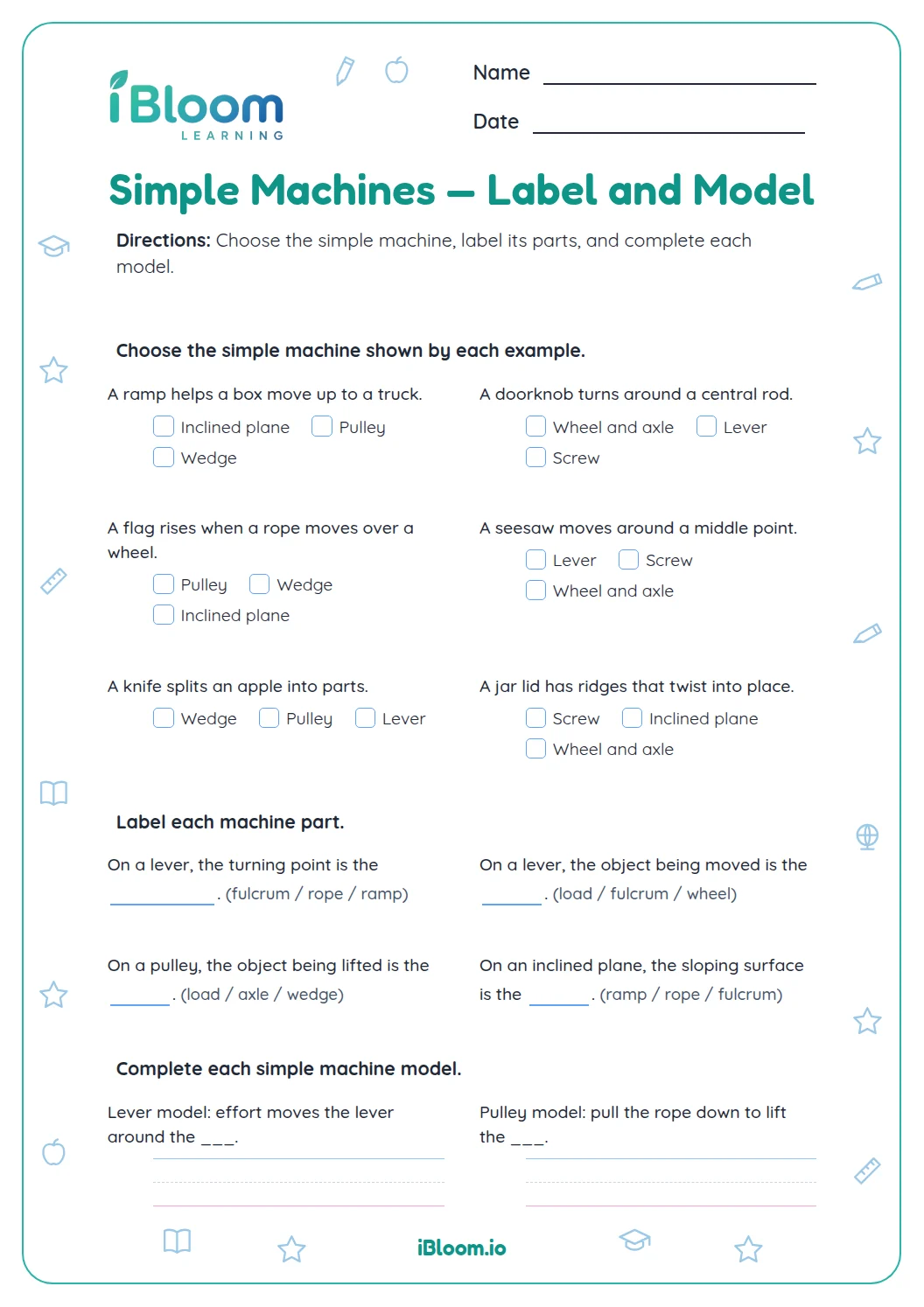
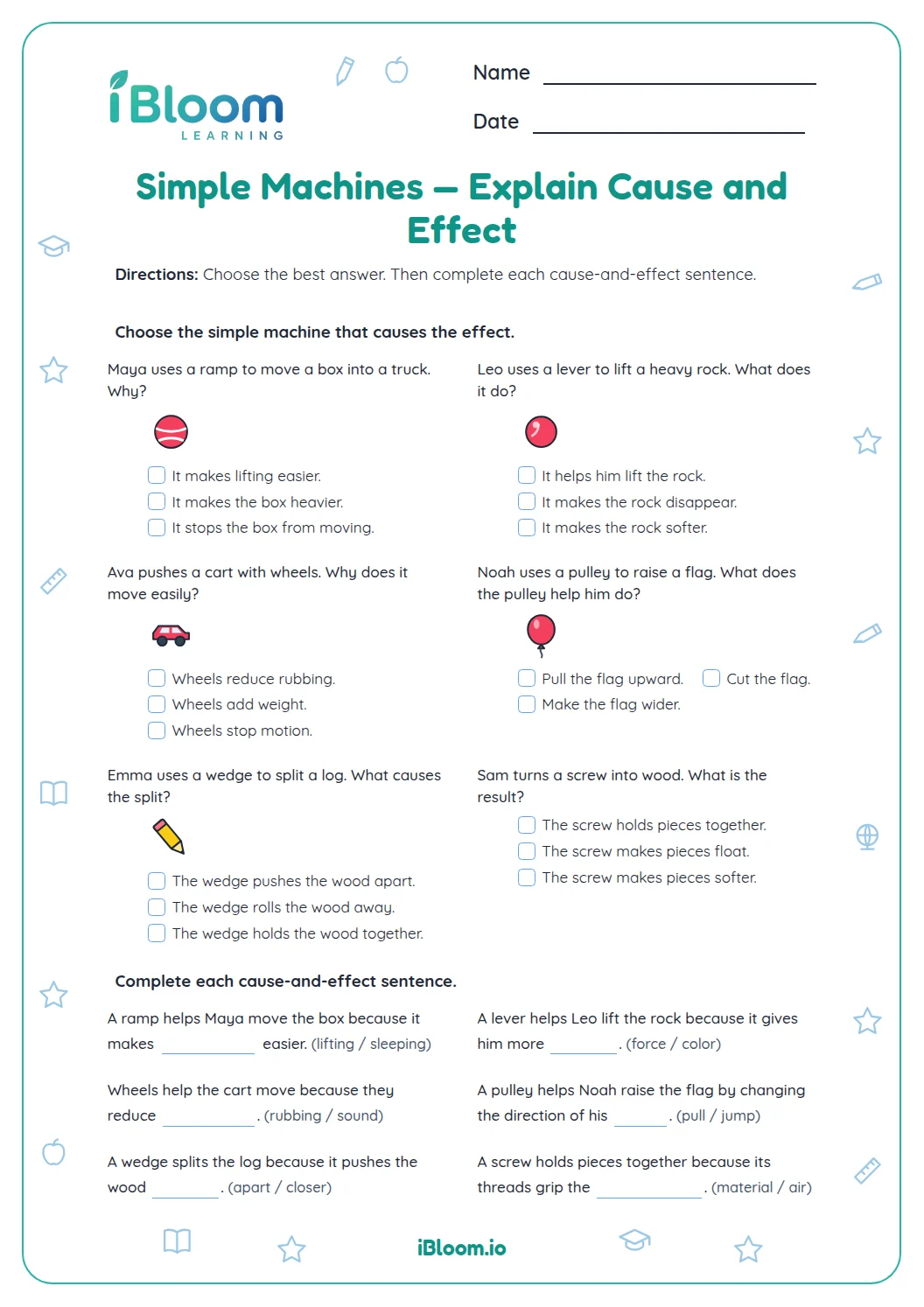
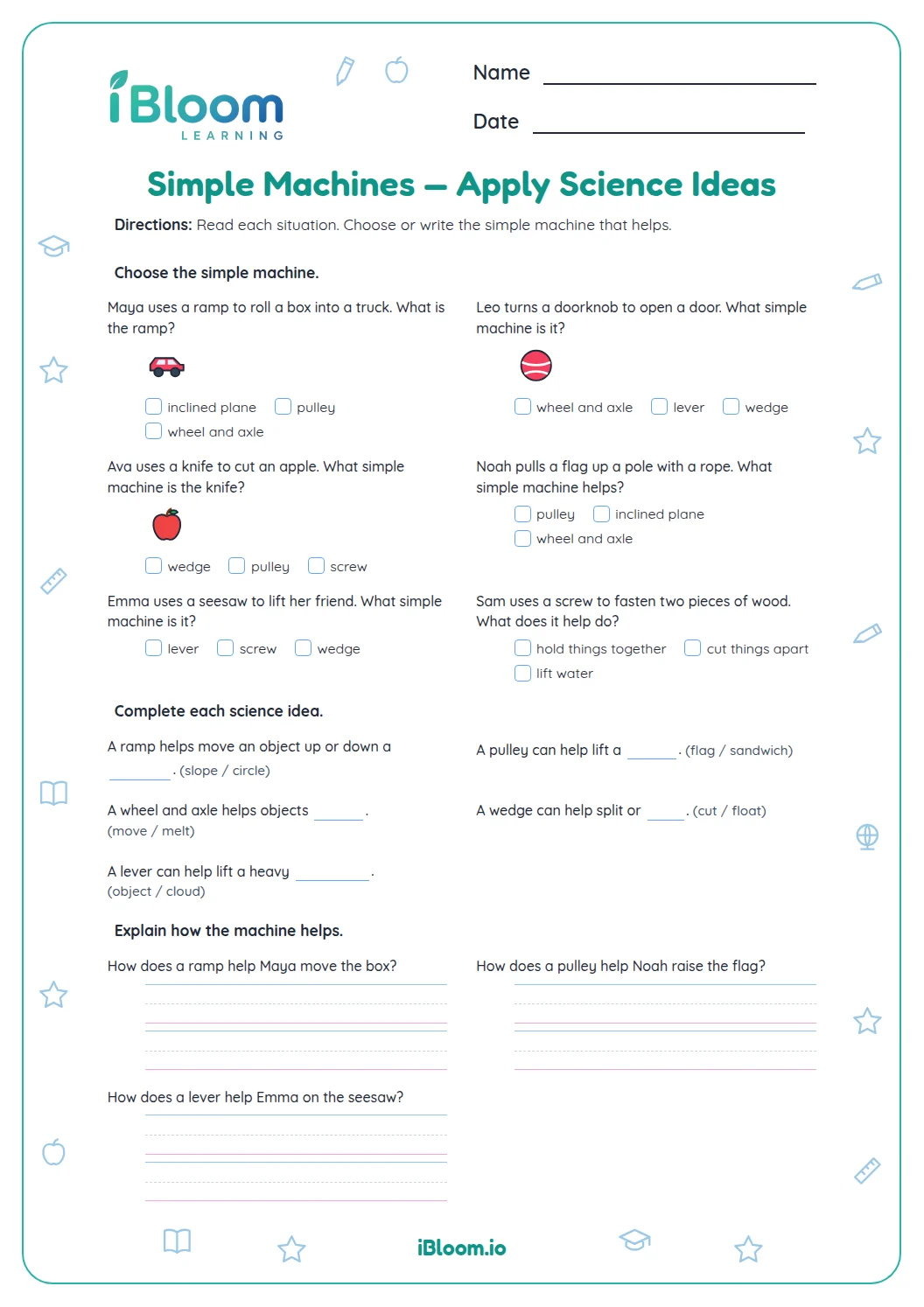
This printable Grade 2 science review helps children connect simple machine names to everyday tools and actions. Fourteen multiple-choice questions ask students to identify levers, pulleys, wedges, screws, inclined planes, and wheel-and-axle systems, then explain how ramps and other tools help with a task. The answer key is included on a separate page.
How can you identify a simple machine?
Look at the way a tool is shaped or moves. A seesaw pivots around a support, so it works as a lever. A ramp is an inclined plane. A rope passing over a wheel is a pulley.
Question 1 asks which tool is a lever. A seesaw turns around a middle support, so the answer is seesaw.
- 1Tool: seesaw
- 2It turns around a support
- 3Machine: lever
How does a simple machine help?
A simple machine changes how a push or pull is used. A ramp gives a longer, less steep path for moving a box upward. A pulley changes the direction of a pull, such as when raising a flag. The tool helps with a task; it does not make the work disappear.
Which machines should children recognize?
This review uses the six familiar simple machines: lever, inclined plane, pulley, wedge, screw, and wheel and axle. Some tools combine machines, but these questions focus on identifying one useful part or action at a time.
What does the review ask?
The first questions connect everyday tools with machine names. Later questions ask what parts are called and how a ramp, wheel, or lever helps. Students choose the best explanation from three options.
How to use this worksheet
- 1Name tools children have seen, such as a ramp, seesaw, jar lid, and doorknob.
- 2For each question, notice whether the tool pivots, rolls, splits, twists, or uses a rope.
- 3Match that action to one of the six machine types.
- 4For explanation questions, choose what the machine changes about a push or pull.
- 5Review missed answers and ask the child to name the clue in the tool.
Mistakes to watch for
The mistake
Calling every moving part a wheel
The fix
Look for a wheel joined to a central axle, as in a doorknob or wagon.
The mistake
Thinking a ramp removes the force
The fix
A ramp changes the path: it is longer and less steep, while the object still needs a push.
The mistake
Mixing up lever and inclined plane
The fix
A lever pivots around a support; an inclined plane is a sloped surface.
What to practice next
Make more practice
Questions parents and teachers ask
What are the six simple machines?
The six are the lever, inclined plane, pulley, wedge, screw, and wheel and axle. A seesaw is a lever, a ramp is an inclined plane, and a flagpole rope may use a pulley. This worksheet asks children to identify familiar examples.
How does a ramp help move a heavy object?
A ramp provides a longer, less steep path upward. The person still pushes the object, but the path changes how the force is applied. Several questions use this idea to distinguish a ramp from other tools. Ask which shape or moving part gives the clue, such as a slope, pivot, wheel, or thread.
What is the fulcrum on a lever?
The fulcrum is the support or pivot that a lever turns around. A seesaw turns around its middle support. Students use this word in question 8 to connect the part with the lever’s motion. Ask which shape or moving part gives the clue, such as a slope, pivot, wheel, or thread.
Are simple machines only found in machines with motors?
No. A simple machine can be part of a tool without a motor. A seesaw, knife edge, ramp, jar lid, and doorknob all show simple machine ideas through their shape or movement. Ask which shape or moving part gives the clue, such as a slope, pivot, wheel, or thread.
How many questions are included?
There are 14 multiple-choice questions. They cover the six simple machine types, tool parts such as a fulcrum and axle, and ways a ramp or other tool changes how a force is used. Ask which shape or moving part gives the clue, such as a slope, pivot, wheel, or thread.
Is an answer key included?
Yes. The separate answer key lists the correct choice for every question. Ask students to explain the clue, such as a pivot, slope, rope and wheel, or twisting thread, as they check. Ask which shape or moving part gives the clue, such as a slope, pivot, wheel, or thread.