






About this worksheet
This free Grade 3 spelling worksheet helps students notice common spelling patterns in familiar words. Part A matches words to long-vowel teams, r-controlled vowels and consonant endings such as -tch and -dge. Part B asks students to complete eight words from a short clue by writing the missing letters. The two tasks move from recognizing a pattern to recalling the letters that spell it. It practices CCSS.ELA-Literacy.L.3.2.f and includes a separate answer key.
Aligned to L.3.2.f
How can a spelling pattern help you match a word?
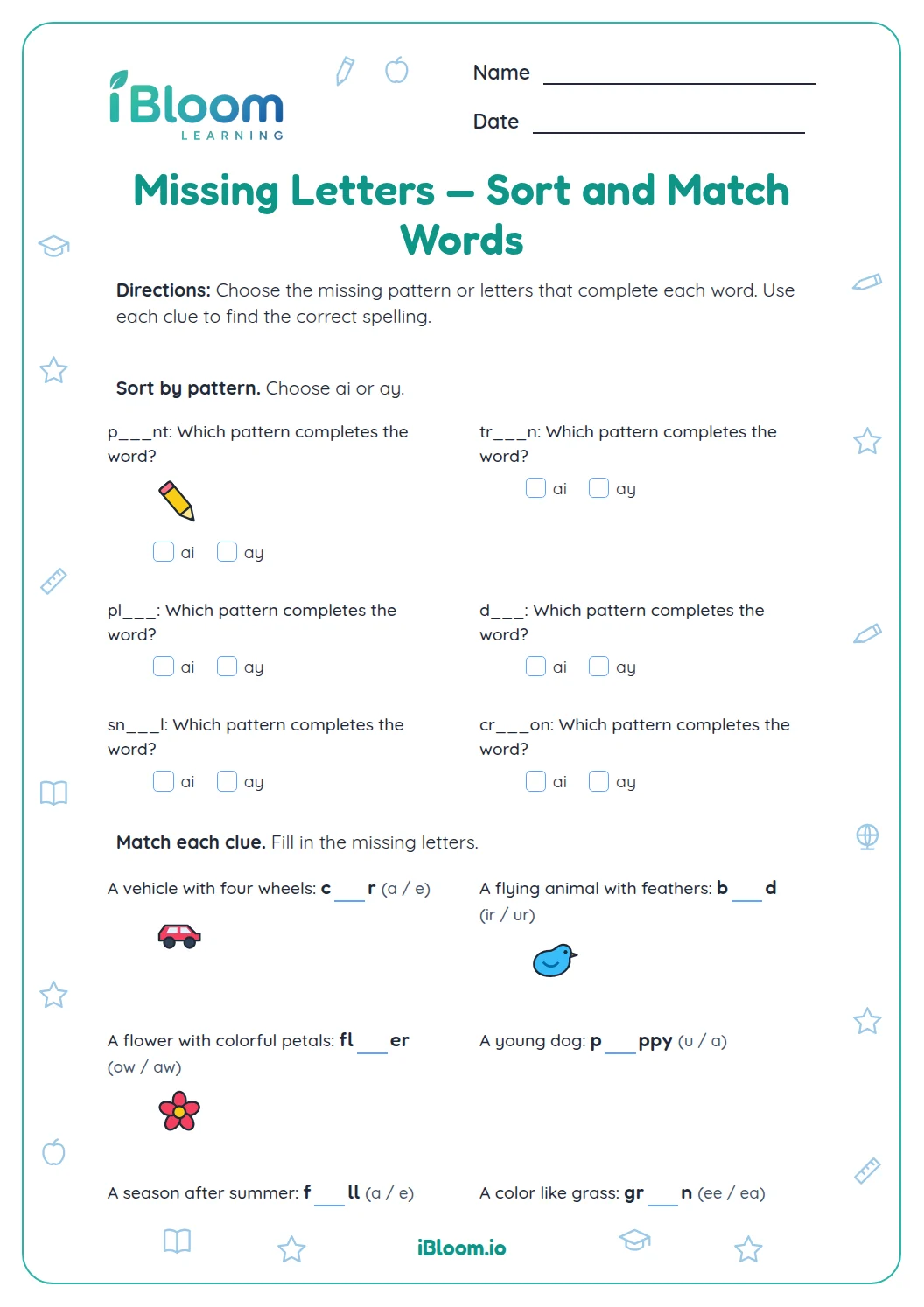
A spelling pattern is a group of letters that often represents a sound or appears at the end of a word. The pattern can help narrow down a match. In question 1, train has the long-a pattern ai. Tray also has a long-a sound, but its spelling uses ay, so train is the word that matches the pattern named in the question.
Read the whole pattern, not just the sound. In question 6, scratch ends in tch. The other choices begin similarly, but they do not have the requested ending.
- 1Pattern named: long a spelled ai
- 2train → ai spells the long-a sound
- 3tray → ay, not ai
- 4Answer: train
How do you fill in the missing letters?
Use the clue to think of the whole word first. Then compare its spelling with the letters already printed. For question 9, the clue is a vehicle that runs on tracks: train. The prompt shows tr___n, so the missing letters are ai.
What is in the two worksheet parts?
Part A focuses on matching a pattern to one word from three choices. Part B gives a meaning clue and a partly written word. The second part checks whether students can recall the actual letters in a familiar word, rather than only recognize it.
- Part A: eight spelling-pattern matches
- Part B: eight words to complete from clues
- Answer key: the correct word choice and missing letters
How can a student use the spelling clues?
- 1Read the target pattern in the question before scanning the options.
- 2Say each choice and look at the letters that spell the target sound.
- 3For a word ending, inspect the final letters rather than the first sound.
- 4In Part B, solve the meaning clue aloud before filling any blanks.
- 5Write only the letters missing from the printed word.
- 6Check the finished word against the answer key and reread its clue.
Common spelling-pattern mix-ups
The mistake
Choosing tray for a question that asks for ai because tray has the same long-a sound.
The fix
Match the letters named in the question as well as the sound: train uses ai; tray uses ay.
The mistake
Writing one letter when two letters are missing, as in completing scratch.
The fix
Say the full word and compare each letter to the printed start and end; scratch needs at.
The mistake
Confusing endings that sound alike, such as -tch and a single ch.
The fix
Look closely at the word ending and remember the complete pattern requested, not only its sound.
Common Core alignment
This worksheet practices the skill described in the standard below.
Students use spelling patterns to identify and write the words on the sheet.
On this sheet: Students match vowel and consonant patterns and apply them when completing words.
Show the official wordingHide the official wording
Use spelling patterns and generalizations (e.g., word families, position-based spellings, syllable patterns, ending rules, meaningful word parts) in writing words.
What to practice next
Make more practice
Further reading
Questions parents and teachers ask
Which spelling patterns are included?
The matching section includes long-vowel spellings ai, ee, oa, igh and ea, the r-controlled pattern ar, and the endings -tch and -dge. Each item names a pattern and asks students to select the word that uses it, so both letters and sound matter.
What does “complete the words” mean here?
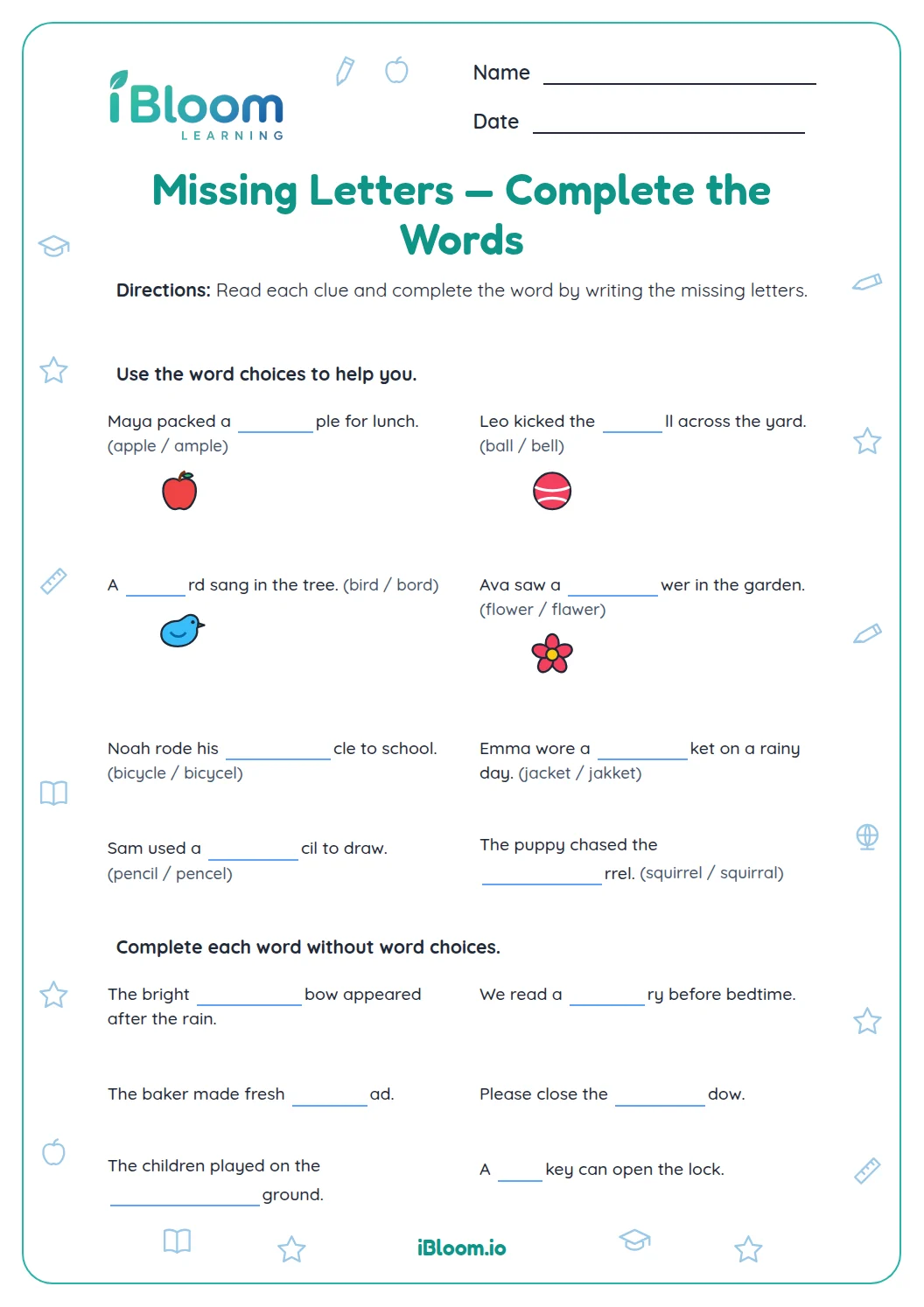
Students read a short meaning clue and write the missing letters in a partly printed word. For example, the clue about a vehicle on tracks points to train, and the printed form tr___n leaves ai to fill in. The completed word should match the clue.
How many questions does the page have?
There are 16 questions: eight word choices in Part A and eight missing-letter prompts in Part B. The tasks move from recognizing spelling patterns to supplying the letters in a word. Students can say the whole word before choosing or writing.
Should students write the whole word or only the missing letters?
Part B asks for the missing letters only. Students can still say or write the whole word on scrap paper first to confirm that the clue and spelling fit. Then they should compare the completed word with the visible letters in the prompt.
Is the answer key included?
Yes. The separate answer key shows the correct word for each pattern choice and the letter group needed to complete each word. It can be used after students finish both parts to check the spelling and revisit any confusing pattern.