


About this worksheet
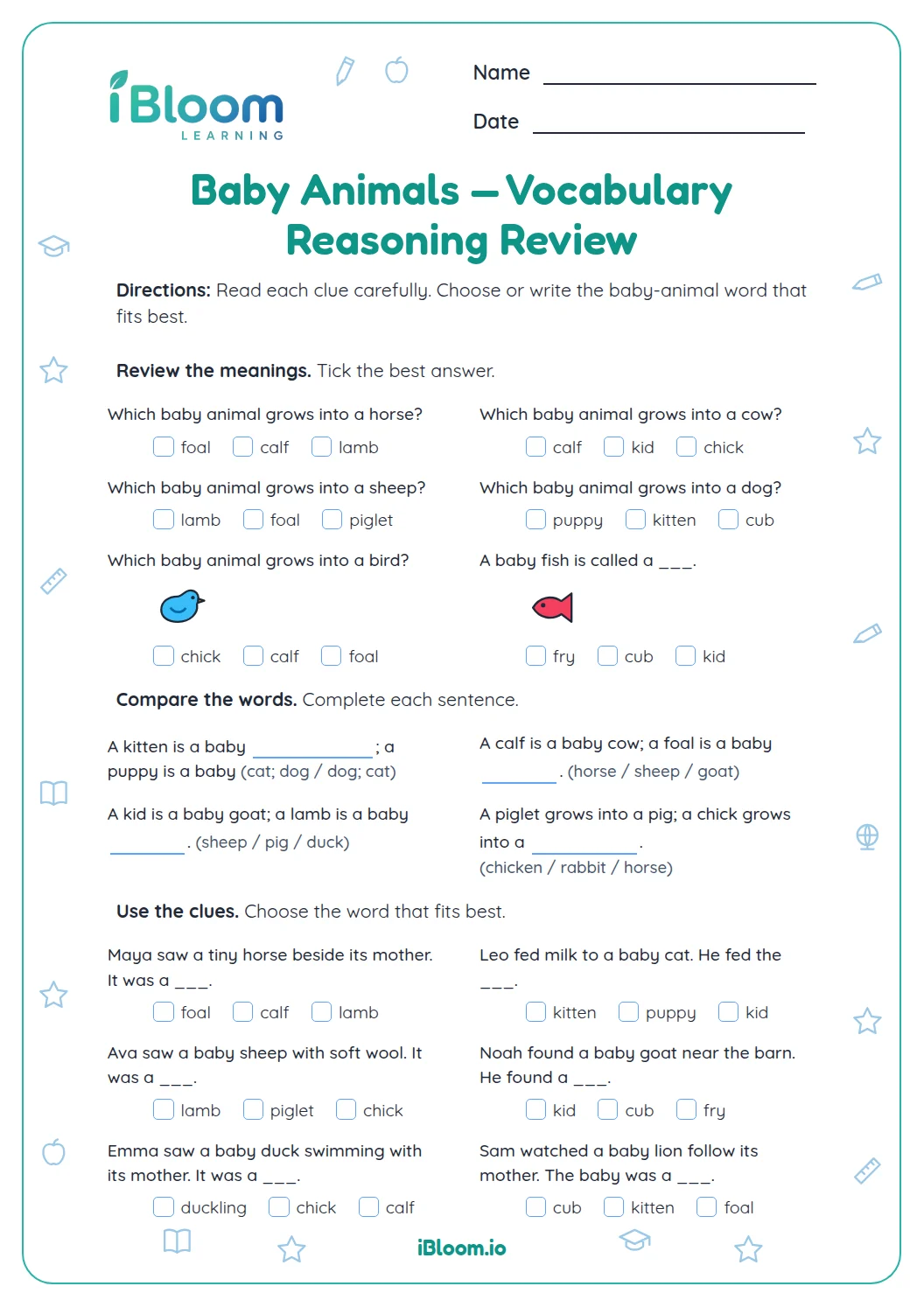
This free Grade 1 worksheet pairs a 12-word baby-animal word search with questions about what each name means. Children find puppy, kitten, calf, foal, lamb, kid, duckling, chick, cub, piglet, gosling and joey, then connect several names to adult animals or sentence clues. The answer key lists the search words and responses. The practice supports CCSS L.1.5.a by connecting words in a category.
Aligned to L.1.5.a
Which baby-animal words are in the puzzle?
The grid contains twelve names placed horizontally across five rows. Some rows contain two or three names. Students circle each word from the list, then match names such as lamb and gosling to adult animals.
A baby goat is a kid, and a baby kangaroo is a joey. These familiar words give the search a vocabulary purpose beyond spotting letters.
How can children use the word meanings?
Read the whole clue before answering. “A baby chicken” points to chick, while “a baby duck” points to duckling. The word search and sentence clues use the same word family.
How does a word clue work?
For “A baby sheep is a ___,” connect sheep with its young. The matching word is lamb. Students can use the word list as a reminder while they complete the clues.
Find and use the words
- 1Scan the word list before searching the rows.
- 2Circle each word as you find it; the names run left to right, with several in some rows.
- 3Read each adult-animal choice and match it to the baby name.
- 4Use the sentence clue to complete the remaining questions.
- 5Check the word list and key when finished.
Common Core alignment
This page supports Grade 1 vocabulary learning by connecting related animal words and their meanings.
Sort words into categories.
On this sheet: Students group animal names by the relationship between a young animal and its adult.
Show the official wordingHide the official wording
Sort words into categories (e.g., colors, clothing) to gain a sense of the concepts the categories represent.
What to practice next
Make more practice
Further reading
Questions parents and teachers ask
Which way do the hidden words run?
Each of the twelve words runs horizontally from left to right. Some rows contain more than one name, so check the full row before moving to the next one. The first row includes puppy and kitten. Students can cross each found name off the list as they go.
What does “kid” mean on this page?
Kid means a young goat in this word set. It names an animal here, and the clue “A baby goat is a ___” helps children connect the word to its meaning. For example, use the word puppy and name the adult animal it belongs with.
What is a joey?
A joey is a young kangaroo. The matching question asks students to connect joey with kangaroo rather than with the other adult animals listed. It is one of twelve names hidden in the grid. For example, use the word puppy and name the adult animal it belongs with.
Can a student use the word list while answering?
Yes. Finding the words first gives students a reference for the meaning questions. They still need to connect each baby name with the correct animal or sentence clue, then select the matching word. For example, use the word puppy and name the adult animal it belongs with.
How long does the activity take?
About 15 minutes is a reasonable estimate for finding the twelve words and answering the meaning questions. The time can vary with how quickly a student spots words and makes each animal connection. For example, use the word puppy and name the adult animal it belongs with.