




About this worksheet
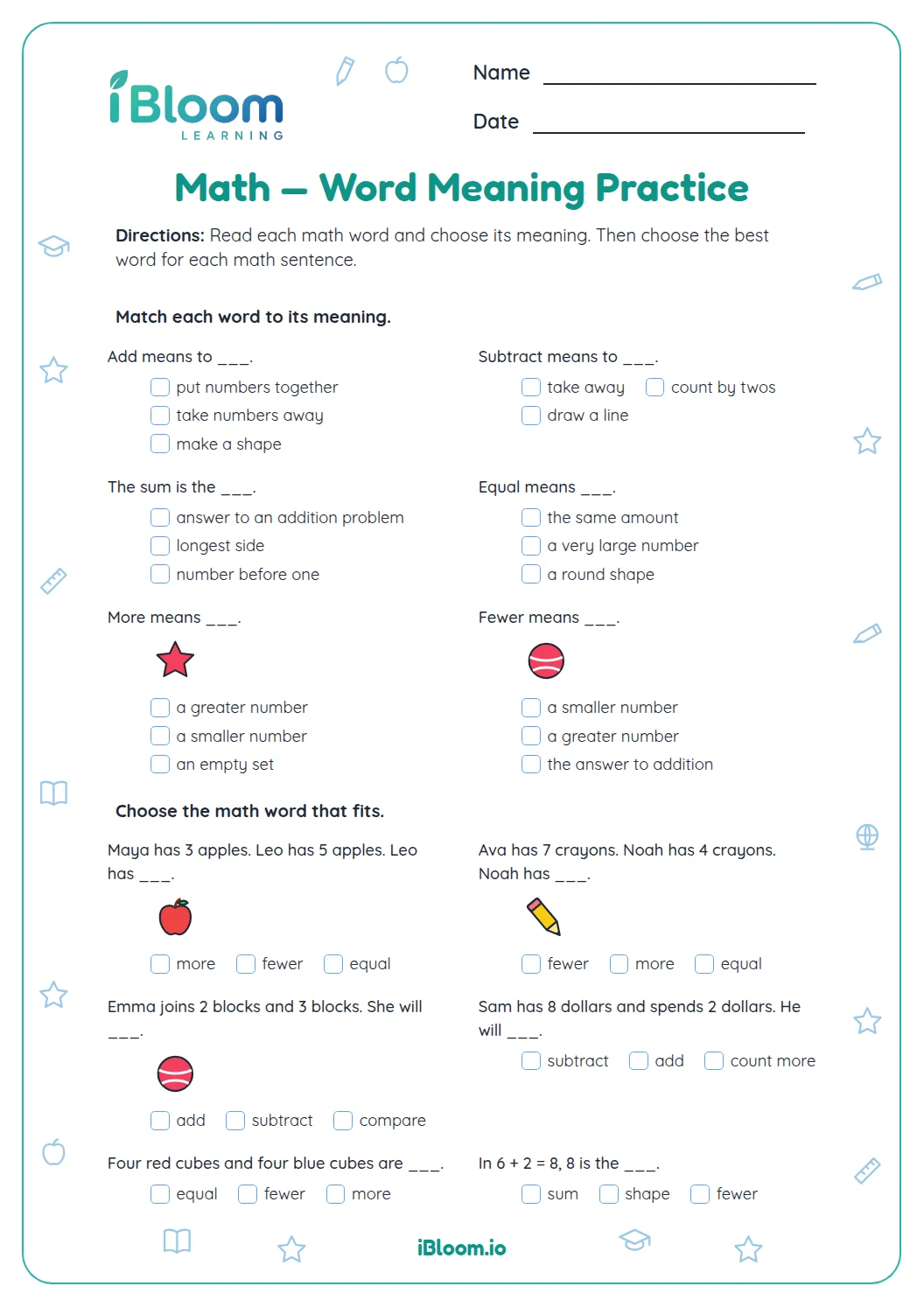
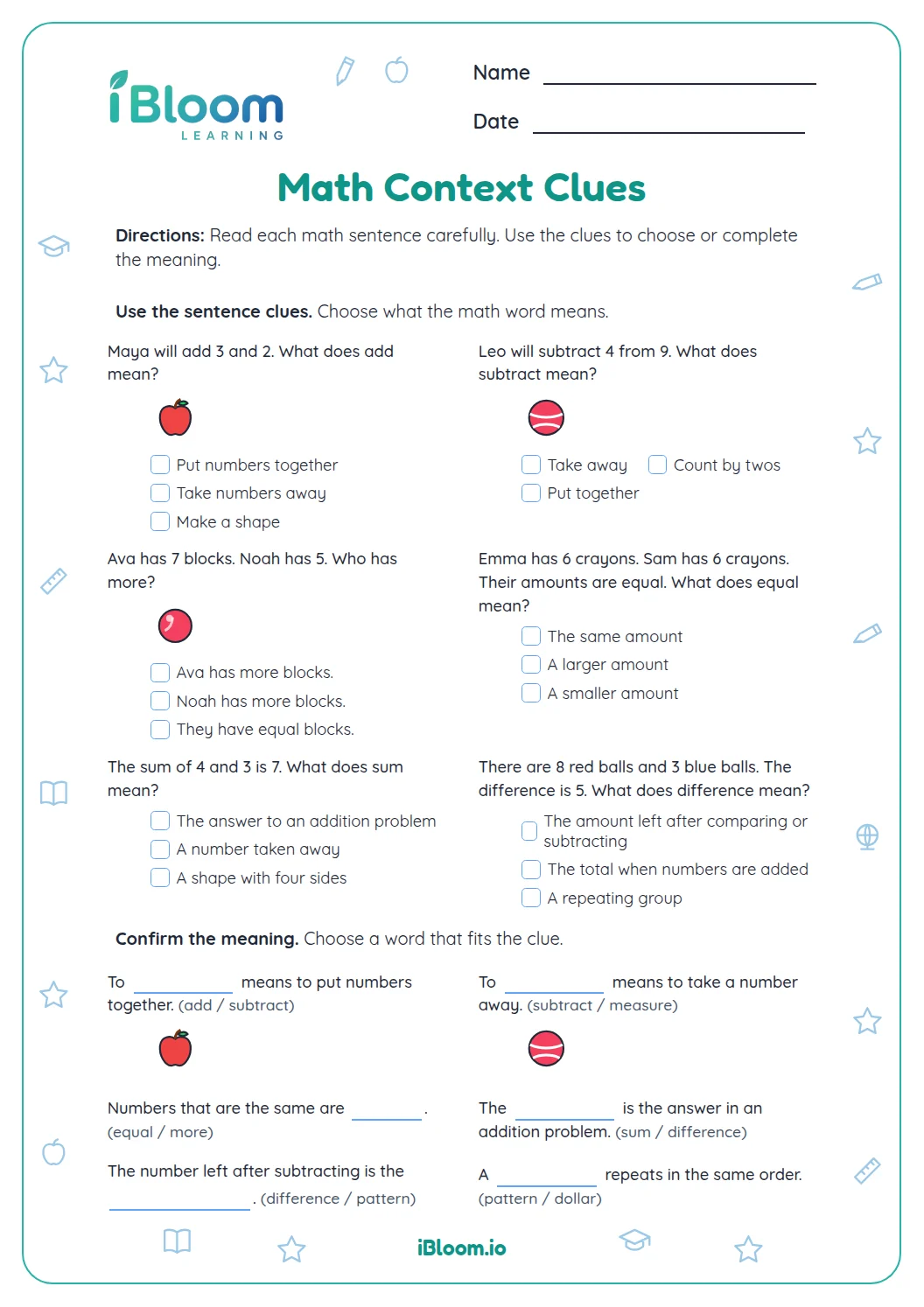
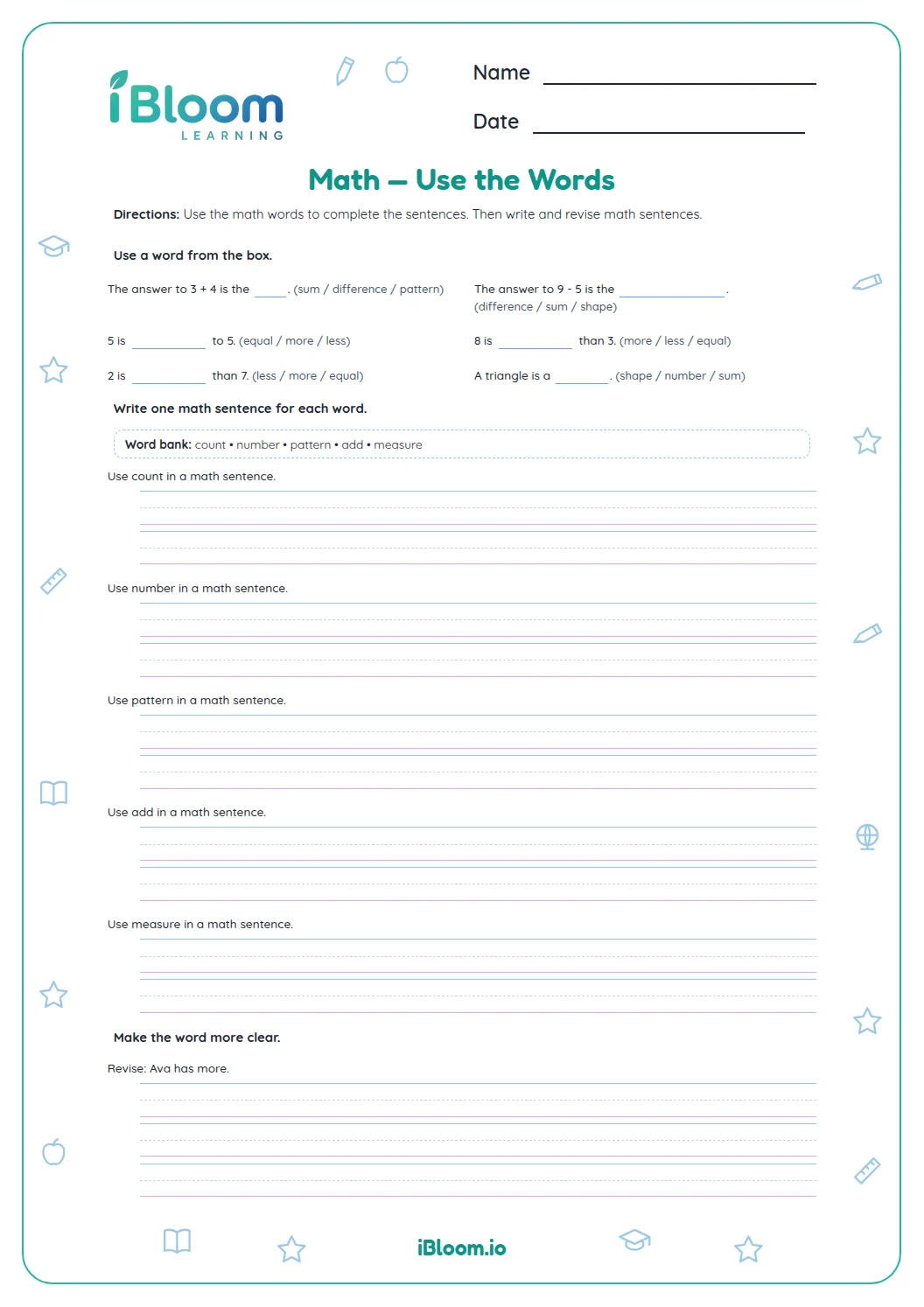
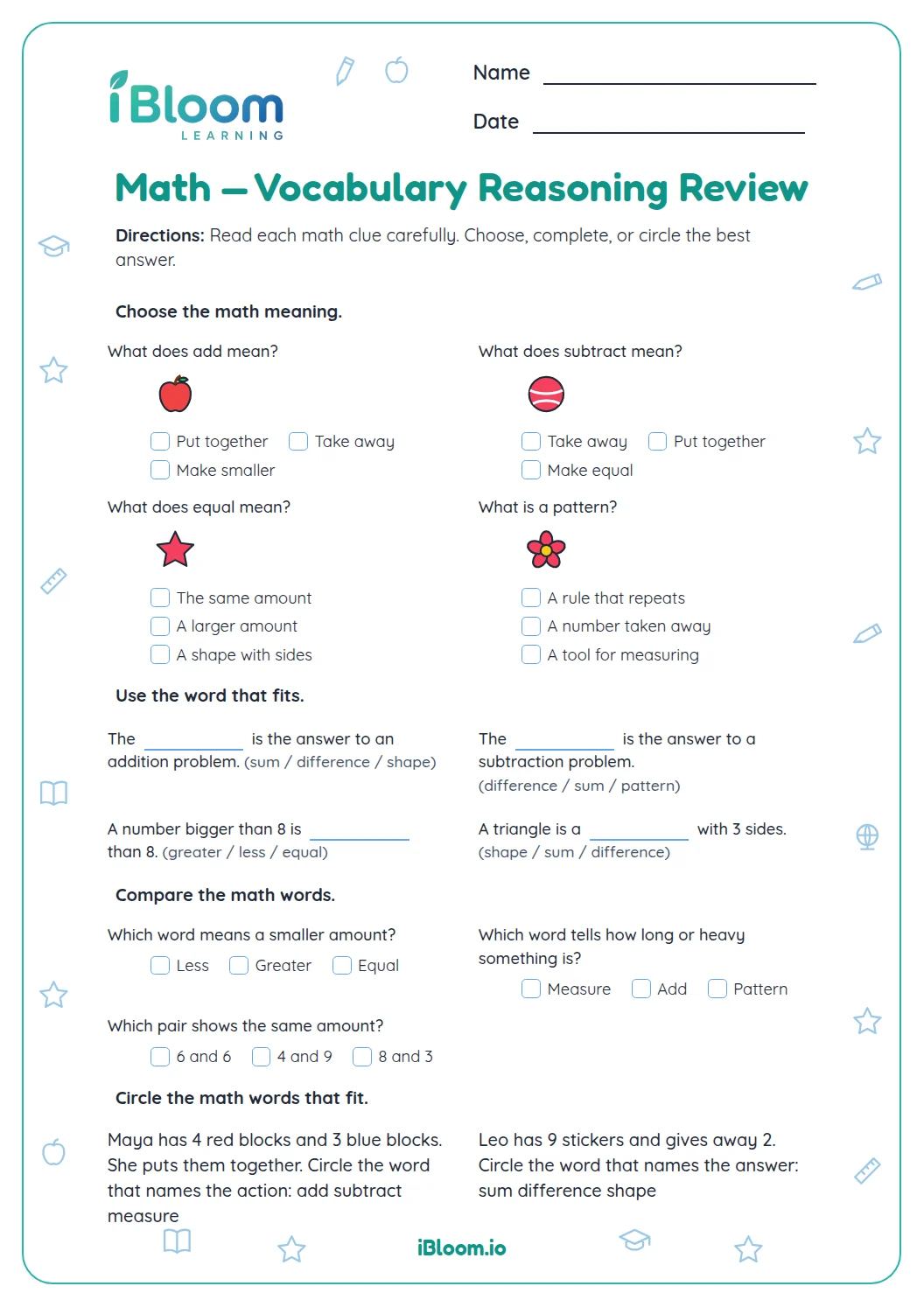
This free Grade 1 vocabulary worksheet helps children connect math words with their meanings. Part A has six questions about groups such as shapes, money, length, and time. Part B has four short sentences that supply clues for words such as add, less, and sum. Part C has two questions with shape drawings to connect sides and corners to something children can see. All twelve questions are multiple choice. The sheet practices CCSS L.1.5a and L.1.4a, and the separate answer key marks one correct choice for each question.
Aligned to L.1.5a and L.1.4a
How does sorting words help with math language?
A category groups words that share a meaning or use. Circle belongs with shape words, penny belongs with money words, and inch belongs with length units. Ask the child to name the group before looking at the answer choices.
Part A begins with single words, then includes pairs and a three-word group. The child must check every word in a group, rather than choosing it because just one word sounds familiar.
How do sentence clues explain a math word?
Part B connects a word to an action or quantity. Adding joins groups. Less names a smaller amount. Sum means the total found by adding. The sentence provides information that helps the child select a meaning.
- 1Jo has 3 cups of sand. Kim has 5. Jo has LESS sand.
- 2Compare the amounts: 3 is smaller than 5.
- 3Less means a smaller amount.
How should children use the shape drawings?
The final two questions show a square and rectangle, then a triangle. Children can trace a straight edge with a finger while saying side, then touch the places where two sides meet while saying corner.
These drawings attach the vocabulary to a visible feature. After checking the choices, ask the child to point to another side or corner on the same drawing and use the word aloud.
Use the sheet step by step
- 1Read the category in question 1 and ask for another shape word aloud.
- 2Complete Part A, checking every word in a pair or group.
- 3Read each Part B sentence before reading the answer choices.
- 4Point to the clue that explains add, less, sum, or length.
- 5Touch the sides and corners in Part C, then review the marked choices on the key.
Mistakes to watch for
The mistake
Choosing hour as a length unit because both hours and inches measure something.
The fix
Name what is measured: inches describe length, while hours describe time.
The mistake
Thinking less means a larger amount in the sand sentence.
The fix
Compare 3 cups with 5 cups and say that Jo has less sand.
The mistake
Calling the straight edges corners.
The fix
Run a finger along an edge for side; stop where two edges meet for corner.
Common Core alignment
Group math words into categories such as shapes, money, length, and time.
On this sheet: Part A asks children to choose words that belong in named categories.
Show the official wordingHide the official wording
Sort words into categories (e.g., colors, clothing) to gain a sense of the concepts the categories represent.
Use short sentences to identify the meanings of math words.
On this sheet: Parts B and C provide clues for add, less, sum, length, sides, and corners.
Show the official wordingHide the official wording
Use sentence-level context as a clue to the meaning of a word or phrase.
What to practice next
Make more practice
Further reading
Questions parents and teachers ask
Which math words does this sheet practice?
The sheet uses shape, money, length, time, and position words before moving to add, less, sum, length, sides, and corners. Examples include circle, penny, inch, hour, minute, and first. Children choose category members, read sentence clues, and connect the last two vocabulary answers to drawings.
Does my child need to read every word independently?
No. You can read the questions and choices aloud while your child decides which meaning fits. Pause after the category or sentence clue, then read the choices. Ask the child to explain one selection in their own words so that the activity checks understanding as well as word recognition.
How do we explain the word sum?
A sum is the total found by adding. Question 9 uses 2 + 3 = 5 and names five as the sum. You can put two cubes beside three cubes, join the groups, and count all five together. Then repeat the sentence: the sum is five.
Why are there shape drawings at the end?
The drawings let children connect the words sides and corners to visible parts of shapes. In question 11, the straight edges are sides. In question 12, the three meeting points are corners. Ask your child to point while saying each word, then select the matching answer.
How should we review a wrong category answer?
Return to the category name and test the chosen word against it. If a child selects hour for length, ask what an hour measures and what an inch measures. Then choose again. The answer key marks each correct choice, but the spoken explanation helps reveal how the child grouped the words.