



About this worksheet
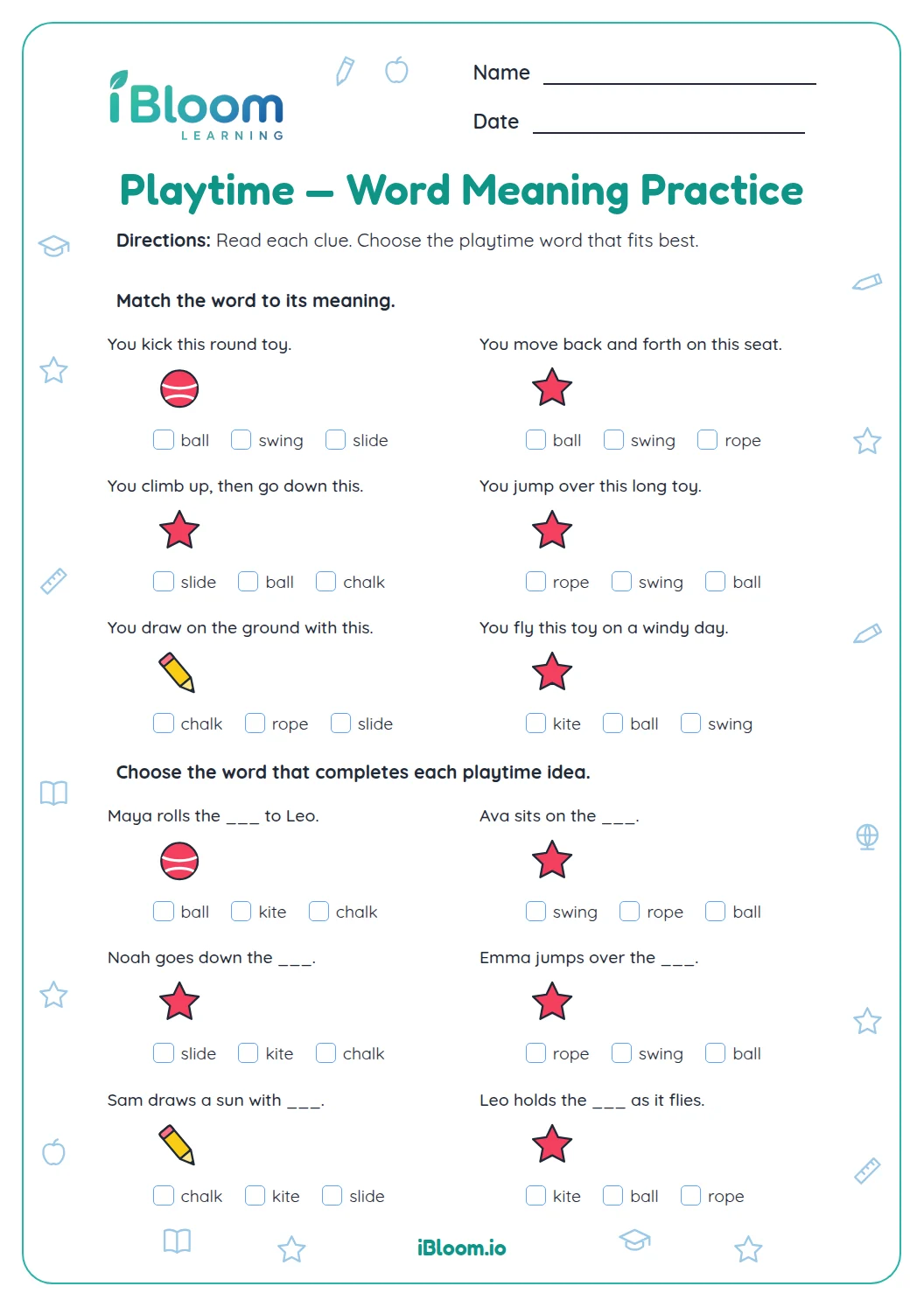
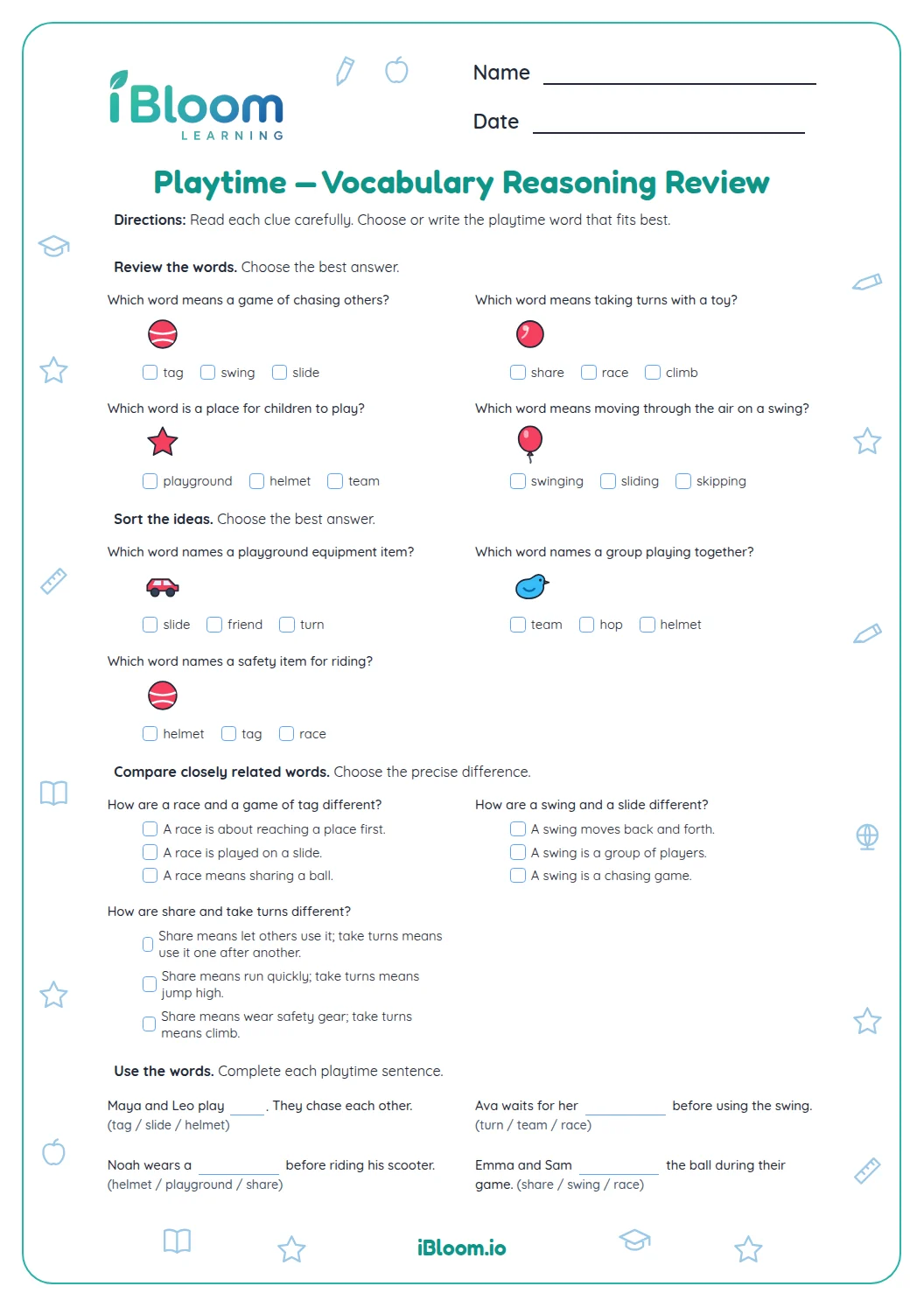
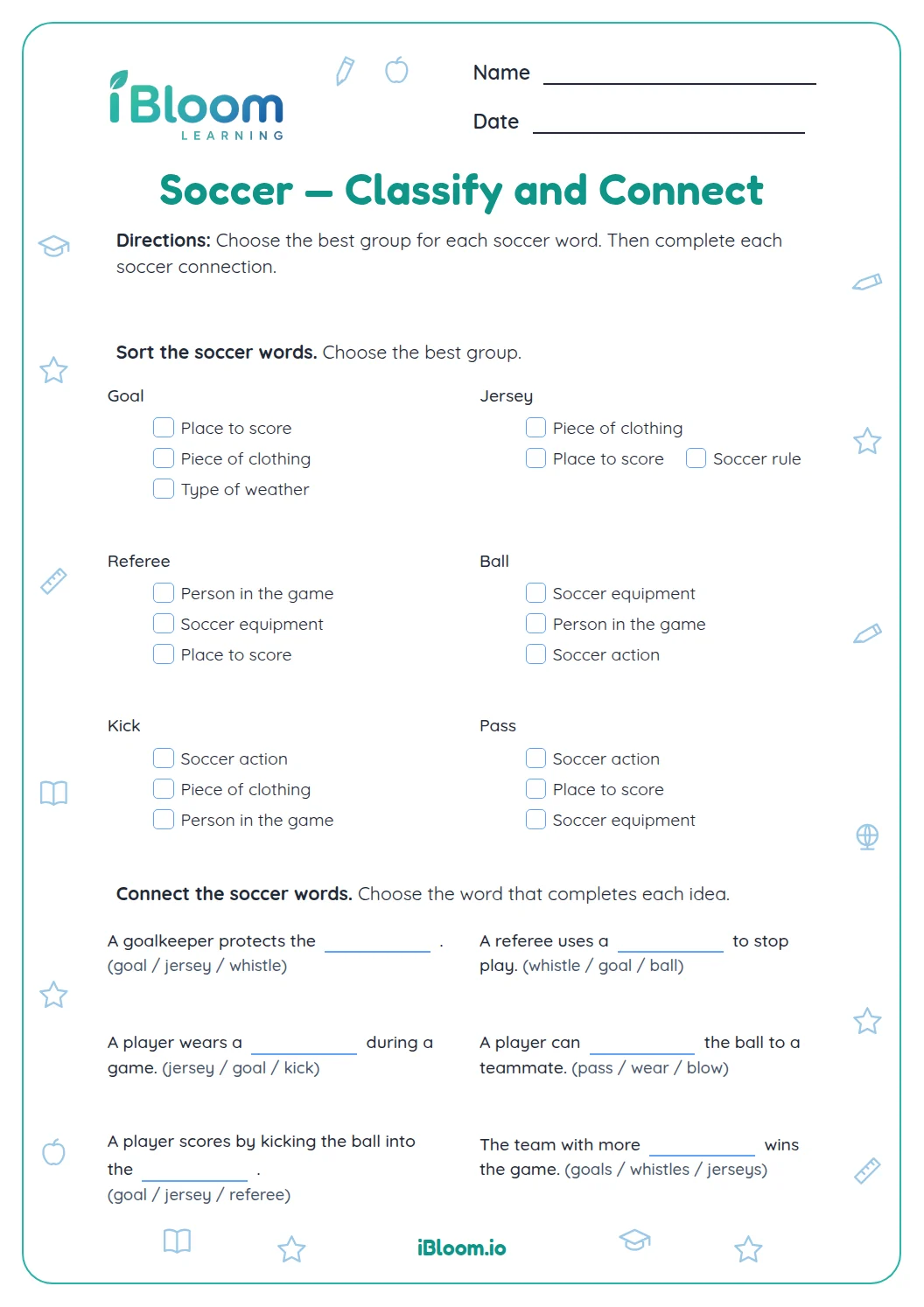
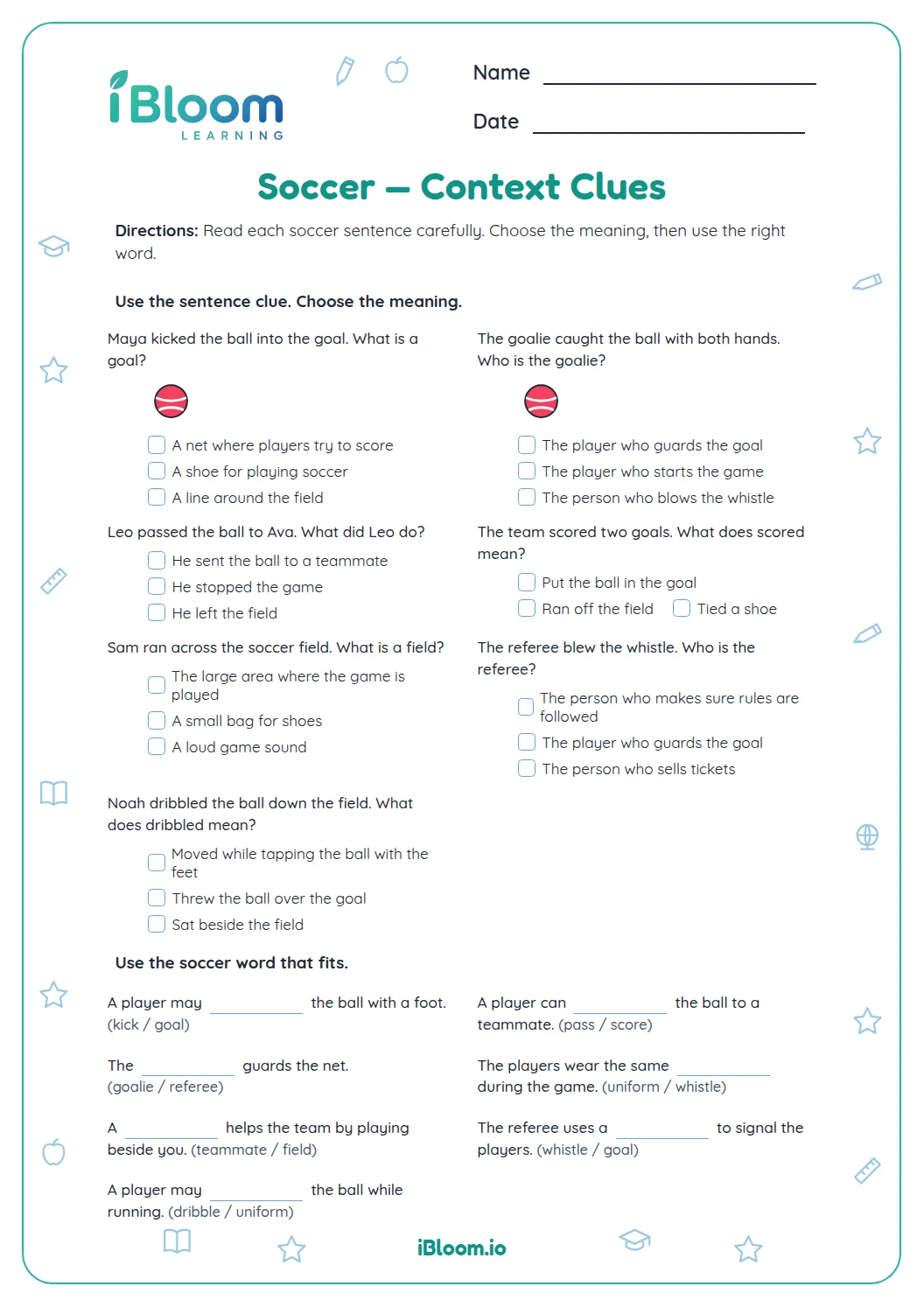
This Grade 1 vocabulary worksheet practices playtime words through short sentence clues and a word-search activity. Across 18 questions, children infer what a word means from its sentence, find eight target words in a letter grid, and use a playtime word to complete a sentence. The context-clue questions align with CCSS L.1.4a. A separate answer key is included.
Aligned to L.1.4a
What is a context clue?
A context clue is a hint in the words around an unfamiliar word. In “Lena goes down the slide at the park,” the action and setting help explain what slide means. Reading the whole sentence gives more information than looking at one word alone.
How can a child use a sentence clue?
Ask what the sentence tells the person or object to do. If Sam kicks a round ball to a friend, the action helps show that ball is something used for play. Then try the meaning in the sentence and see whether it makes sense.
- 1Sam kicks the round ball to a friend.
- 2Clue: kicks it to a friend
- 3Try the meaning: a toy to kick or throw
- 4Answer: a toy to kick or throw
What does the word search add?
The grid includes ball, game, jump, play, run, slide, swing, and tag. Finding each spelling gives children another look at the words used in the sentence questions. Meaning work comes from reading the surrounding clues, not from the grid alone.
How to use this worksheet
- 1Read each sentence aloud once from beginning to end.
- 2Look for an action or detail that explains the playtime word.
- 3Try the answer choice in place of the target word.
- 4Find the eight listed spellings in the grid and mark each one.
- 5Finish the last sentence choices, then check the key.
Common mistakes and quick fixes
The mistake
Choosing a word by topic alone.
The fix
Use the action or detail in the sentence to decide what the word means.
The mistake
Reading only the target word.
The fix
Read the full sentence because the clue may come before or after it.
The mistake
Finding a similar-looking word in the grid.
The fix
Match every letter in the listed word in order before marking it.
Curriculum alignment
Read the whole sentence to find the clue that points to a word meaning.
Use sentence clues to figure out a playtime word.
On this sheet: Children use the sentence around a playtime word to choose its meaning.
Show the official wordingHide the official wording
Use sentence-level context as a clue to the meaning of a word or phrase.
What to practice next
Make more practice
Further reading
Questions parents and teachers ask
What are context clues?
Context clues are hints in a sentence that help explain a word. In “Sam kicks the round ball to a friend,” kicking it to a friend helps show that a ball is used for play. The worksheet asks children to use this kind of sentence detail.
How many words are in the word search?
There are eight target words: ball, game, jump, play, run, slide, swing, and tag. They are placed horizontally in the grid. Children can cross off each word from the list after finding and marking its letters, then check that none are left.
Should a child look at the choices before reading?
It helps to read the whole sentence first. That way the child notices the clue before the answer choices influence the guess. After reading, compare each choice with the sentence and use the one that makes sense in context.
Can I read the questions aloud?
Yes. Reading a short sentence aloud can help a child focus on the meaning and clue words. Ask the child to point out the detail that helped, then choose a meaning. The word search can be completed independently or together.
Is an answer key included?
Yes. The key lists the intended answer for each question and notes that all eight word-search words are present. Use it to check both the context-clue choices and the completed grid. The grid answer is a reminder that every listed playtime word appears.