Free printable practice
Clumsy Practice Activities
Grade 2 children build understanding of the word clumsy through printable word-search activities with spelling, meaning, and context practice.
Free printable worksheet PDFs
Preview every available page, then download the free worksheet PDF for home, homeschool, tutoring, or classroom practice.
Preview the exact activity before downloading it.
 Clumsy — Word Meaning PracticeGrade 2 children build understanding of the word clumsy through printable word-search activities with spelling, meaning, and context practice. This word meaning practice worksheet provides a distinct, age-appropriate way to practise the same lesson.Grade 2Free PDF preview
 Clumsy — Classify and ConnectGrade 2 children build understanding of the word clumsy through printable word-search activities with spelling, meaning, and context practice. This classify and connect worksheet provides a distinct, age-appropriate way to practise the same lesson.Grade 2Free PDF preview
 Clumsy — Context CluesGrade 2 children build understanding of the word clumsy through printable word-search activities with spelling, meaning, and context practice. This context clues worksheet provides a distinct, age-appropriate way to practise the same lesson.Grade 2Free PDF preview
 Clumsy — Use the WordsGrade 2 children build understanding of the word clumsy through printable word-search activities with spelling, meaning, and context practice. This use the words worksheet provides a distinct, age-appropriate way to practise the same lesson.Grade 2Free PDF preview
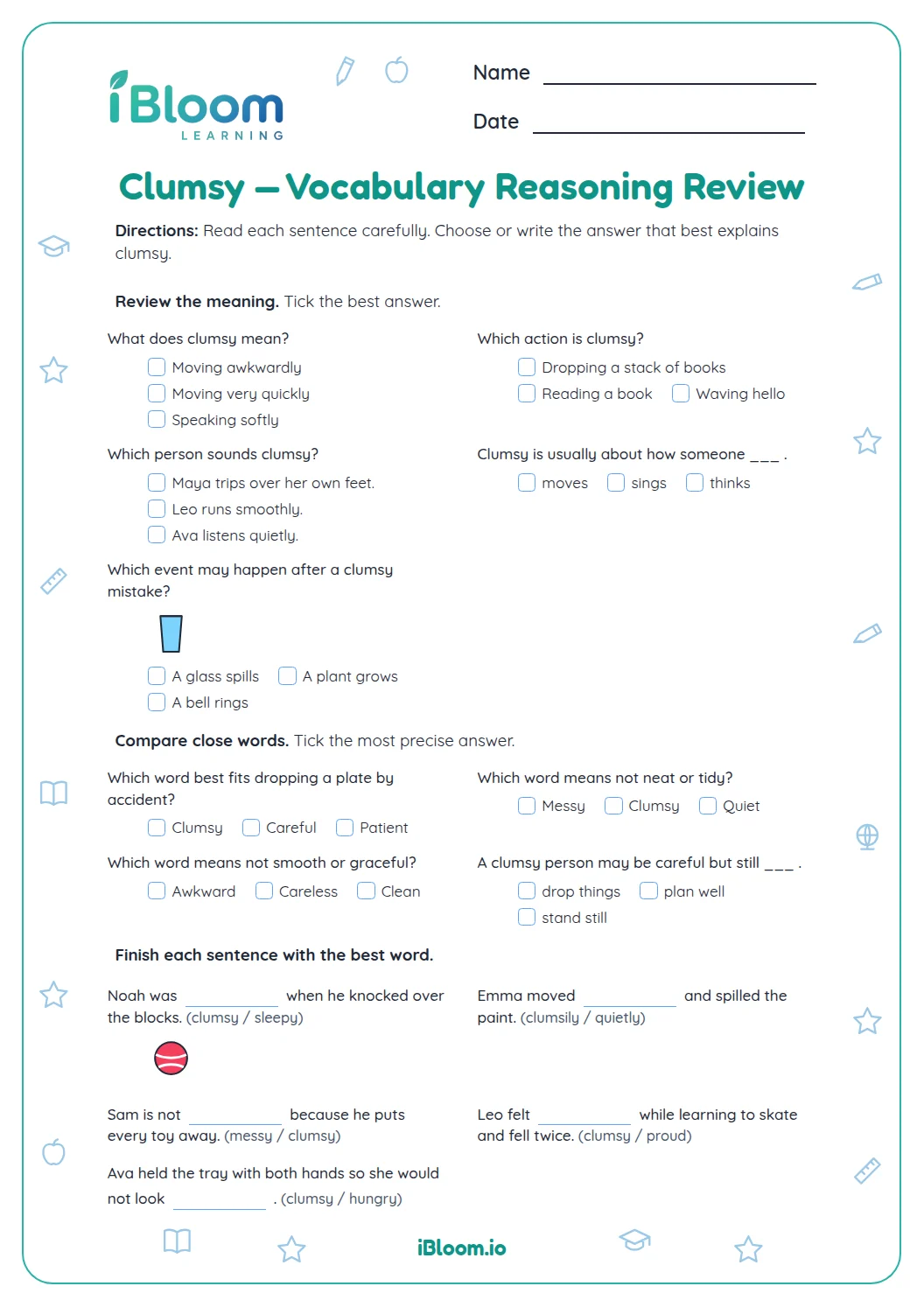 Clumsy — Vocabulary Reasoning ReviewGrade 2 children build understanding of the word clumsy through printable word-search activities with spelling, meaning, and context practice. This vocabulary reasoning review worksheet provides a distinct, age-appropriate way to practise the same lesson.Grade 2Free PDF preview
Practice that builds confidence
Understanding the Word Clumsy
These Grade 2 vocabulary worksheets help children practise the word clumsy by finding it in word-search grids and connecting it to meaning. Children look closely at letter order, notice the spelling pattern, and think about situations where someone might be awkward, careless, or unsteady.
The printable activities include word-search practice, simple vocabulary prompts, and short follow-up tasks that help children use clumsy in context. They are designed for independent work, homework, literacy centers, or a quick vocabulary review.
In Grade 2, children are ready to move beyond simply recognizing a word and begin explaining what it means. Clumsy describes someone or something that moves awkwardly, drops things, bumps into objects, or handles something without much control. A child might say, The clumsy puppy knocked over the bowl, or I felt clumsy when I tried to skate.

Word Search Skills Children Practise
These worksheets use the familiar word-search format to strengthen vocabulary, spelling, and visual scanning. Children search for clumsy across the grid, check each letter in order, and compare the word with the word bank or clue. This supports careful reading because the word has a less common letter pattern and ends with -sy, which children may not see often in everyday spelling.
Building Meaning Through Context
After finding the word, children can complete short prompts such as choosing whether a sentence shows a clumsy action or writing their own sentence with the word. This helps them understand that clumsy is not just about making a mistake; it often describes awkward movement or poor coordination. Encourage children to connect the word to safe, everyday examples, such as spilling juice, tripping on a shoelace, or knocking over blocks.
Parent Routine for Home Practice
Start by reading the word aloud together: clum-sy. Ask your child to trace the letters with a finger, then find the word in the puzzle. After the search, ask two quick questions: What happened that was clumsy? How could the person be more careful next time? Finish by having your child say or write one original sentence using clumsy correctly.

Classroom Uses for Teachers
Teachers can use these pages during vocabulary warm-ups, small-group reading, morning work, or literacy centers. Pair the worksheet with a read-aloud moment: when a character drops, bumps, or stumbles, pause and ask whether clumsy fits. Students can also share sentences orally before writing, which supports children who know the meaning but need help forming a complete sentence.

Free printable PDF download
Use this grade 2 clumsy word search worksheet page to preview the activity, print it, or download it as a PDF for quick practice. It works well for homework, homeschool lessons, tutoring, morning work, revision, and classroom centers.
Answers and answer key support
After the child completes the worksheet independently, parents and teachers can use the answer support or answer key information to check the work, review mistakes, and choose the next practice step.
Why iBloom Worksheets Help
The activities keep the focus narrow, so children practise one useful adjective deeply instead of rushing through a long list. The puzzle builds attention to spelling, while the follow-up language tasks build meaning and usage. Watch for common errors such as reading clumsy as only silly, using it to insult a person, or misspelling it as clumsey. A child-friendly strategy is: find it, say it, picture it, use it in a sentence.
Helpful answers
Frequently asked questions
What does clumsy mean for a Grade 2 student?
Clumsy means awkward, unsteady, or not careful with movement. A Grade 2 child might understand it through examples like dropping a cup, bumping into a chair, or tripping over a toy.
How does a word search help children learn the word clumsy?
A word search makes children look closely at each letter in order. This strengthens recognition and spelling while keeping the vocabulary word active in the child’s attention.
What spelling mistake should children watch for with clumsy?
Children may try to spell it as clumsey because many words have an ey sound at the end. Point out that clumsy ends with sy: c-l-u-m-s-y.
Can these worksheets be used in literacy centers?
Yes. They work well as a quiet vocabulary center because students can search for the word, check the spelling, and then write or share a sentence using clumsy.
How can I help my child use clumsy in a sentence?
Ask your child to picture a small accident or awkward movement, then build a sentence around it, such as The clumsy kitten knocked over the basket.
Is this grade 2 clumsy word search worksheet free?
Yes. You can preview it for free and use the printable worksheet for home or classroom practice.
Can I download this grade 2 clumsy word search worksheet as a PDF?
Yes. Use the worksheet download option to save a printable PDF, or print the worksheet directly from the page.
Does this grade 2 clumsy word search worksheet include answers or an answer key?
When the activity has fixed answers, iBloom includes answer support so parents and teachers can check the completed worksheet.