


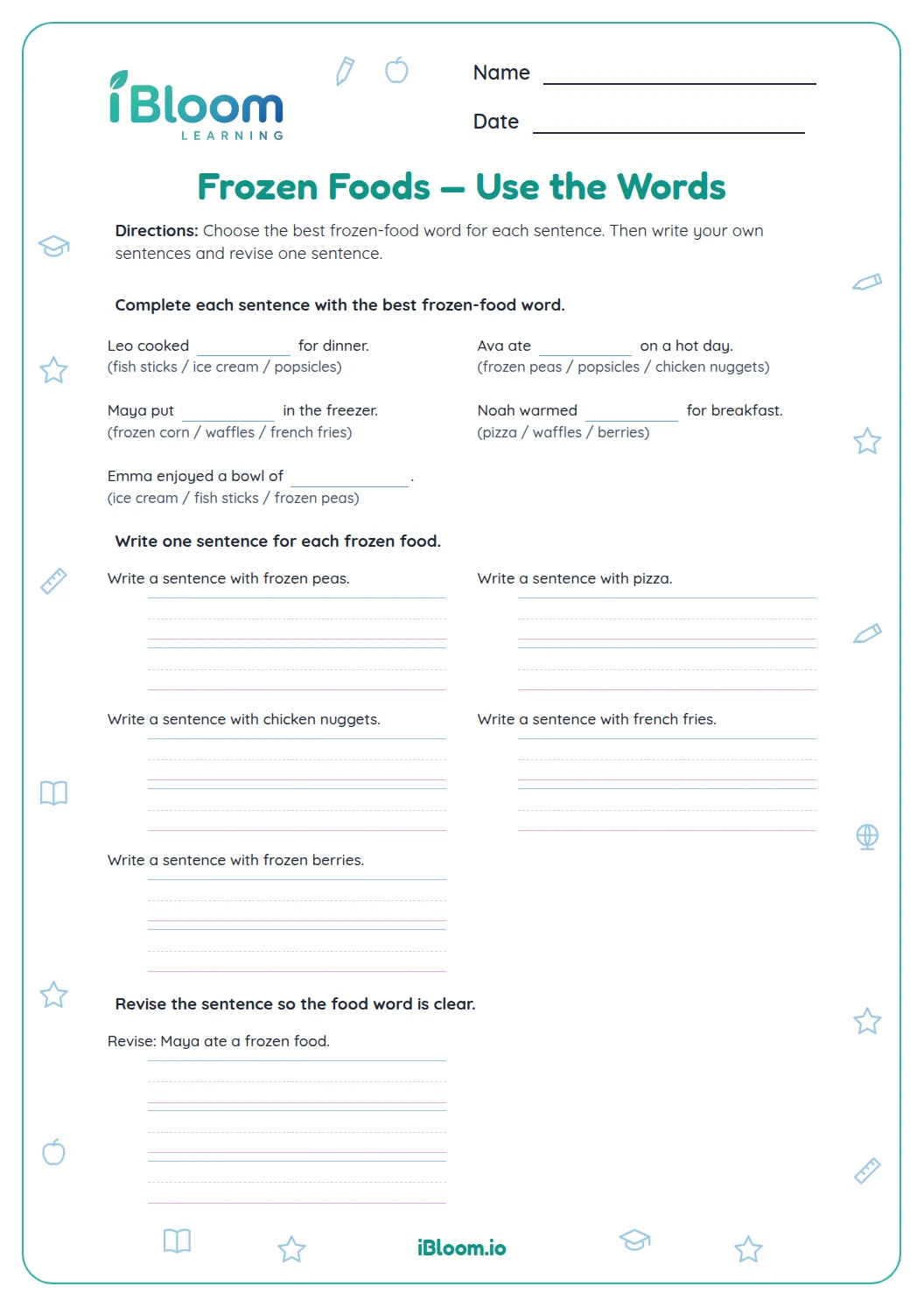
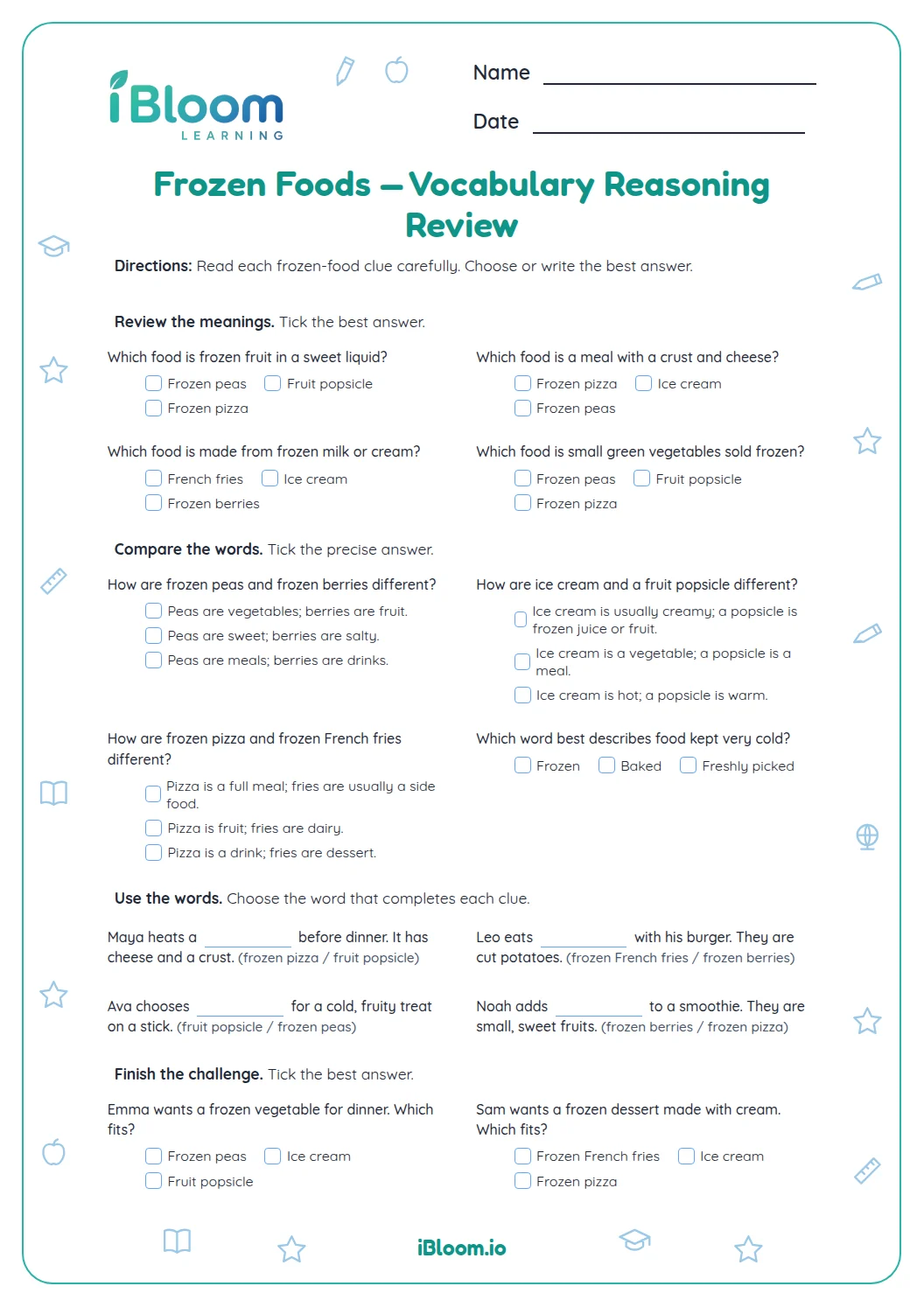


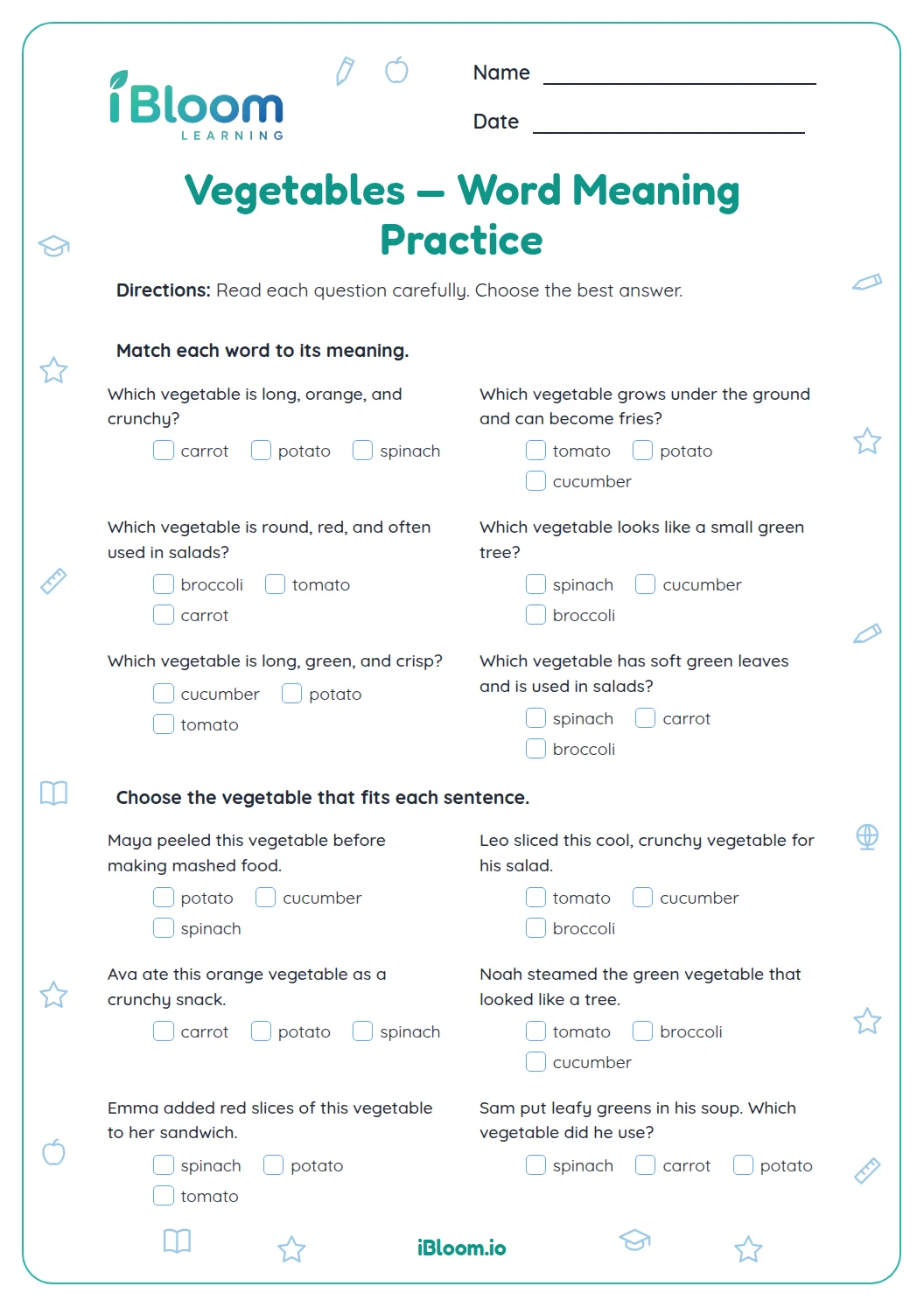


About this worksheet
This Grade 2 printable pairs a frozen-food word search with short sentence questions about chilly, melt, solid, freezer, and related words. Children first locate eight topic words in the grid, then use each sentence to select a word that makes sense. The practice focuses on using sentence context to clarify word meaning, aligned with Common Core L.2.4a. The separate answer key makes it easy to review the choices together.
Aligned to L.2.4a
What vocabulary does the sheet practice?
The word search includes frozen, chilly, melt, solid, store, freezer, cool, and thaw. The second part uses familiar sentences about frozen food and temperature to make those words meaningful.
Some questions ask for a word that describes a cold feeling; others ask what happens as ice or frozen food warms. Children can use the other words in a sentence as clues.
How should a child use the word search?
Scan one row at a time and mark each target word in the grid. The words run across rows, so the child can focus on matching letters in order before moving to the meaning questions.
For question 3, “Water turns to liquid when it ___,” the words water and liquid point to melts. The answer is not freeze, which describes the opposite change.
- 1Water turns to liquid when it ___.
- 2Clue: liquid
- 3Answer: melts
How do the sentence clues help?
Have the child read the complete sentence, then try each choice in the blank. A choice should make sense with every word in the sentence. If two words seem possible, talk about what each one means before choosing.
The word-search activity is paired with sentence choices so children practice recognizing a word and understanding how it works in context.
How to use this worksheet
- 1Look across each row and find the eight words in the word search.
- 2Read the sentence and all three choices.
- 3Say each choice in the blank to see whether the sentence makes sense.
- 4Use cold or warm clues to reason about melt, freeze, and thaw.
- 5Check the answer key and explain one choice aloud.
Common mistakes and quick fixes
The mistake
Choosing freeze for a sentence about warming ice.
The fix
Notice whether the sentence describes warming or cooling; warming ice melts.
The mistake
Mixing up solid and liquid.
The fix
Use the clue “hard” for solid and “flows” for liquid.
The mistake
Selecting a related word that does not fit the sentence.
The fix
Read the full sentence again with the choice in the blank.
Common Core alignment
This practice connects Grade 2 word meaning to familiar sentences about frozen food.
Use sentence clues to work out a word’s meaning.
On this sheet: The sentence questions use context to select words about cold, freezing, and melting.
Show the official wordingHide the official wording
Use sentence-level context as a clue to the meaning of a word or phrase.
What to practice next
Make more practice
Questions parents and teachers ask
What words are in the frozen-food word search?
The grid includes frozen, chilly, melt, solid, store, freezer, cool, and thaw. Every word runs across a row. The answer key marks all eight words and gives the answers to the sentence questions. Then children meet several of the same words again in context.
What is the difference between melt and thaw?
Both describe something frozen warming up. Ice melts when it changes from a solid to liquid water. Frozen food thaws as it warms enough to use. Look for clues about the item and the change described before choosing. These meanings are related, but the words fit different kinds of things.
Can I read the choices aloud?
Yes. Read the whole sentence and each choice aloud if that helps your child focus on meaning. Ask which words in the sentence give a clue, then check the choice with the separate answer key. Talking through the choices helps connect each word with its meaning.
How many questions are included?
There are 15 activities: one word search and 14 multiple-choice sentence questions. The search introduces the frozen-food words, and the sentence choices ask children to use meaning clues. The answer key follows the practice pages. Children can return to any sentence where the clue was tricky.
Does the word search include diagonal words?
No. All eight target words run from left to right across the rows. That lets children focus on recognizing each word’s letters before using the same vocabulary in sentence context. The grid does not hide words diagonally or backward. Then ask the child to use one word in a new sentence.