


About this worksheet
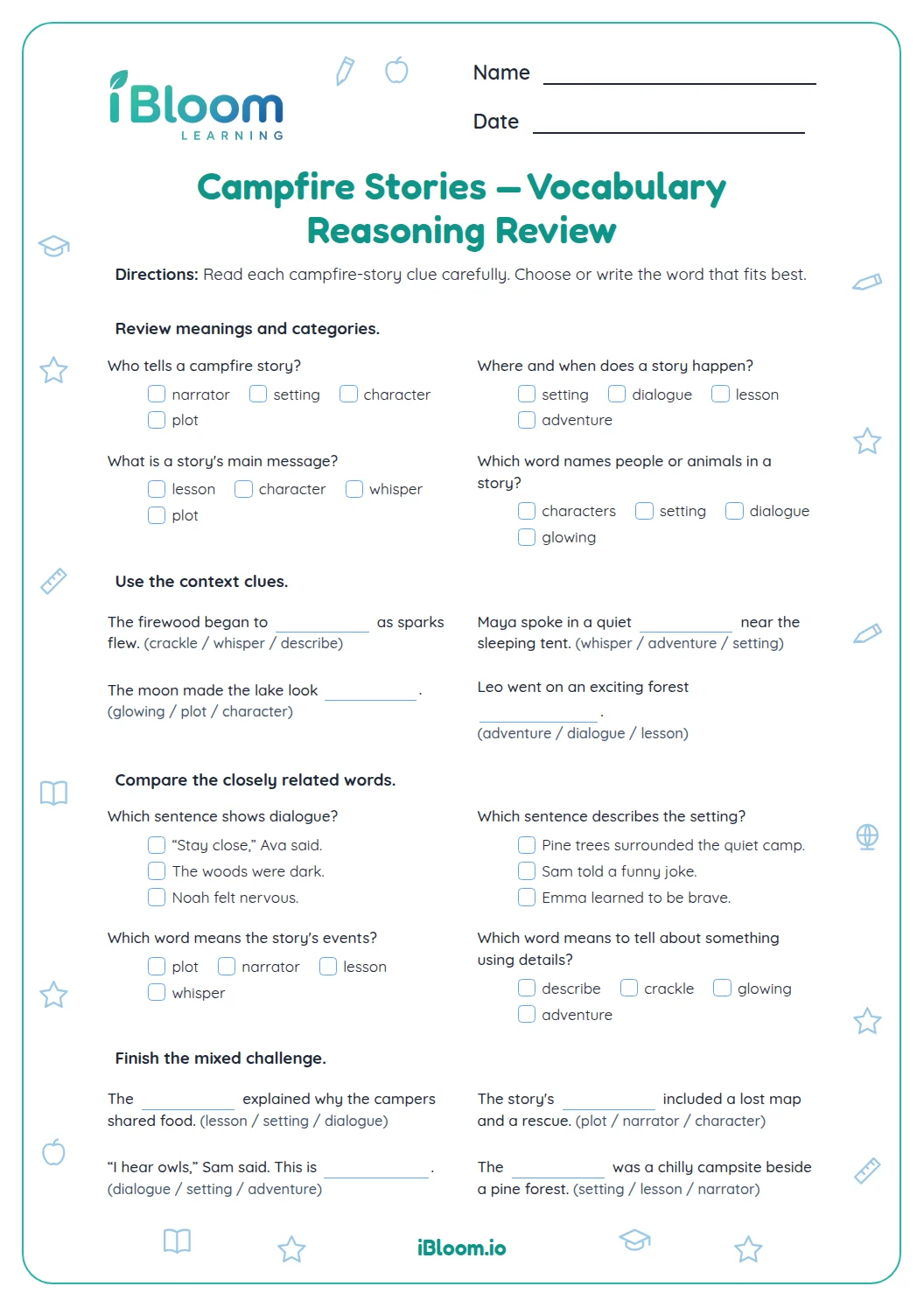
This Grade 3 worksheet helps students sort campfire and story words by meaning, then use those words in short sentences. Students distinguish a tool from a food, a sound from a mood, and a place from a character. The follow-up items show how the vocabulary fits into a camping scene.
Aligned to L.3.4 and L.3.5
What is on this worksheet?
Eight category choices and six sentence completions use the campfire setting to practice meaning and context. The categories include food, tools, sounds, places, characters, camping items, and story moods.
- Part A: classify eight camp and story words
- Part B: complete six sentences with a fitting word
- The key gives the category or missing word
How do students classify vocabulary?
A useful clue points to a word’s meaning or category. Spark, flame, smoke and glow describe different things a learner might notice near a fire. Crackle names a sound; story names something people share. Sorting by meaning helps students remember how each word is used.
How do context clues support word learning?
The sentence prompts place each word in a familiar camping moment. A flashlight helps people see, a campfire crackles, and a spooky story can make listeners feel nervous. Encourage children to reread the whole sentence after choosing a word.
How to use this worksheet
- 1Read each word or sentence all the way through.
- 2For a category choice, ask what the word names or describes.
- 3For a blank, try the word in the sentence and reread it for sense.
- 4Check each response against the key.
Common mistakes and quick fixes
The mistake
Mixing up a word’s category and its setting
The fix
A blanket is a camping item even when it is used near a campfire. Name what the word refers to, rather than where it might appear.
The mistake
Choosing a word that fits the scene but not the sentence
The fix
Read the whole sentence with the word inserted. “A funny story may make listeners laugh” connects the mood to a likely response.
The mistake
Treating a describing word as a thing
The fix
Spooky and funny describe a story’s mood. A flashlight is a tool, while a storyteller is a person.
Common Core alignment
This worksheet gives focused Grade 3 practice with the skill named in its title.
Recognize word relationships and shades of meaning.
On this sheet: The questions ask students to apply this skill in short, checkable steps.
Show the official wordingHide the official wording
Determine or clarify the meaning of unknown and multiple-meaning word and phrases based on grade 3 reading and content, choosing flexibly from a range of strategies.
Recognize word relationships and shades of meaning.
On this sheet: The questions ask students to apply this skill in short, checkable steps.
Show the official wordingHide the official wording
Demonstrate understanding of figurative language, word relationships and nuances in word meanings.
What to practice next
Make more practice
Questions parents and teachers ask
How does this worksheet classify the campfire words?
Students sort words by what they name or describe. Marshmallow is campfire food, flashlight is a tool, crackle is a sound, and spooky or funny describes a story’s mood. Ask the student to explain the clue aloud and point to the detail that supports the answer.
What does it mean to connect vocabulary words?
The sentence prompts show how words work together in a familiar camping scene. A flashlight helps people see, a campfire crackles, and a spooky story can make listeners feel nervous. Ask the student to explain the clue aloud and point to the detail that supports the answer.
Can a word fit more than one category in real life?
Some words may have more than one use, but each clue on this worksheet points to one category. For example, “flashlight” clearly names a tool, while “marshmallow” names a food. Ask the student to explain the clue aloud and point to the detail that supports the answer.
How can an adult help with the word choices?
Ask the child to explain the clue that helped them decide. If a word is unfamiliar, read the sentence aloud and talk about the camping scene before checking the answer key. Ask the student to explain the clue aloud and point to the detail that supports the answer.
Which words appear in the sentence part?
The sentence completions use crackle, flashlight, spooky, laugh, campfire, and storyteller. Each word fits a clue in the sentence, such as the sound wood makes as it burns or the person who shares a tale. The key lists the intended word for each blank.