
About this worksheet
This free Grade 4 vocabulary worksheet uses Independence Day words in sentences that explain or illustrate their meanings. Part A has six multiple-choice questions, Part B has six blanks with a shared word bank, and Part C asks for two short answers. The 14 questions practice Common Core L.4.4.a: using context to determine a word or phrase’s meaning. Children meet twelve target words, from liberty and independence to patriot and fireworks, then return to symbol and liberty to explain their thinking. The separate answer key includes sample wording for the two written responses.
Aligned to L.4.4.a
Which Independence Day words are included?
The twelve target words are parade, liberty, declaration, symbol, freedom, fireworks, independence, colony, patriot, flag, revolution, and celebrate. They connect public celebrations with ideas such as freedom and self-government.
The first six words appear in capital letters in Part A. Part B introduces the remaining six in a word bank. Part C revisits two Part A words and asks children to explain their thinking.
What kinds of clues should children look for?
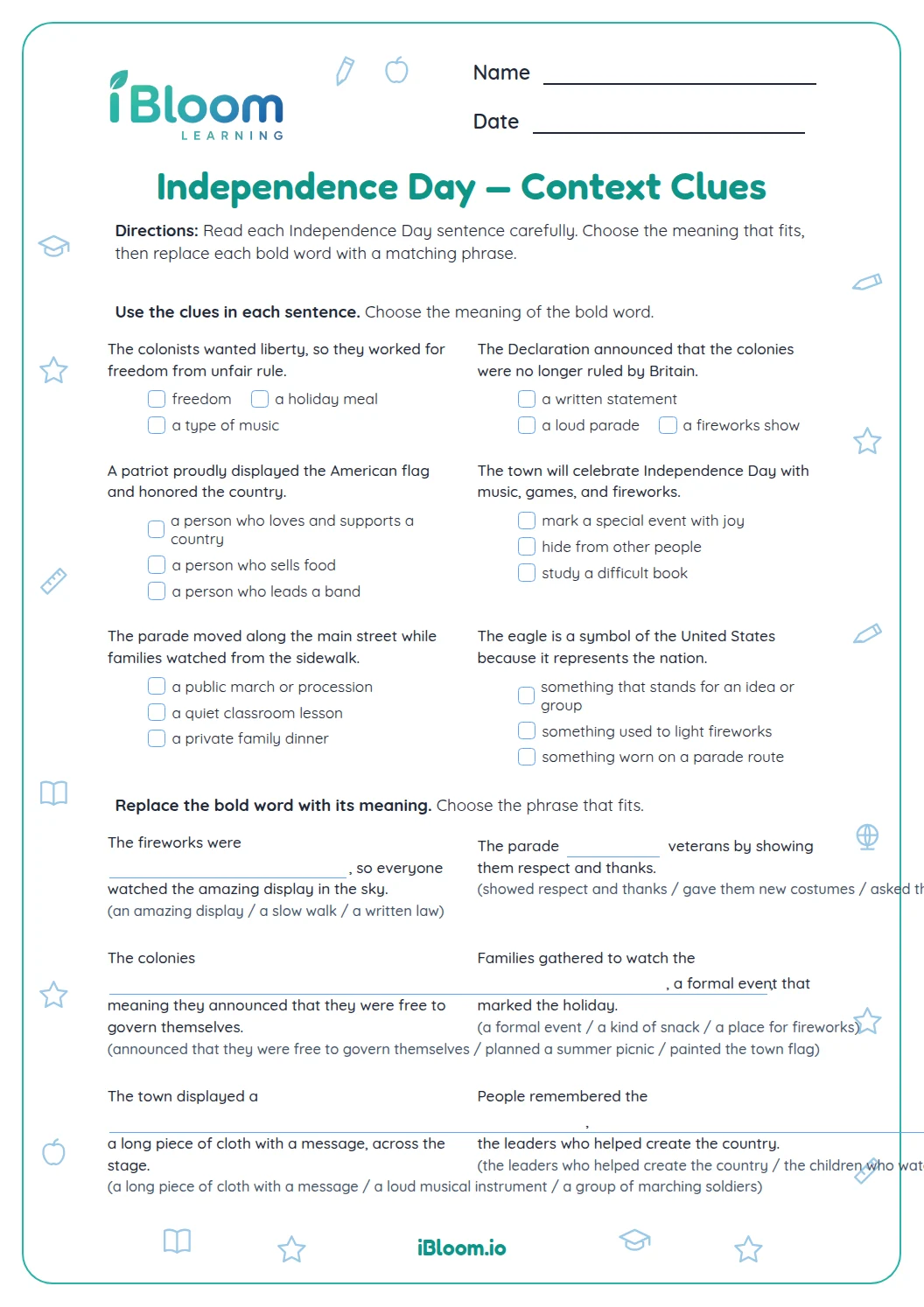
Some sentences define the target directly: the liberty sentence states that it means freedom. Other sentences give examples, such as bands and floats moving along a street to illustrate a parade.
A clue can also restate an idea. In question 3, formal written statement explains declaration. Have children test a chosen meaning in the sentence before selecting it.
- 1Question 1: The town held a PARADE, with bands and floats moving down Main Street.
- 2Clues: bands and floats moving down a street.
- 3A procession is an organized group moving along a route.
- 4Answer: public procession.
What makes a strong answer in Part C?
A strong answer connects the word to the sentence. In question 13, a flag is a sign that stands for the country. In question 14, live freely is the word-pair that explains liberty.
The answer key gives sample responses. Children can use different words if the meaning and supporting clue stay accurate. Discuss the clue before asking for a complete written sentence.
How to use this worksheet
- 1Read the sentence before the choices in Part A, pausing at the capitalized word.
- 2Underline a phrase that defines or illustrates the target word.
- 3Try the chosen meaning in the sentence and select the best fit.
- 4Use each word-bank word once in Part B, then reread all six completed sentences.
- 5For Part C, check each short answer against the meaning and clue in the sentence.
Common mistakes and quick fixes
The mistake
Choosing a parade meaning just because it sounds festive.
The fix
Use the actual clue: bands and floats moving along a street form a procession.
The mistake
Treating a symbol as the thing it represents.
The fix
A flag stands for a country. The cloth flag and the country are different things.
The mistake
Confusing patriot with a country or a holiday.
The fix
The clue someone tells you that patriot names a person. The rest of question 9 explains what that person values.
Common Core alignment
Use definitions and examples in sentences to explain Independence Day words.
On this sheet: Every question provides context; the final two ask children to explain a meaning or its clue.
Show the official wordingHide the official wording
Use context (e.g., definitions, examples, or restatements in text) as a clue to the meaning of a word or phrase.
What to practice next
Make more practice
Further reading
Questions parents and teachers ask
Does my child need to know the holiday’s history first?
No, the sentences provide the clues needed to answer the vocabulary questions. Liberty is defined as freedom, and declaration is explained as a formal written statement. Read the clue phrases aloud if needed, then ask your child to choose the meaning that fits the sentence.
How many different words are practiced?
The worksheet introduces twelve target words across Parts A and B. Part C returns to symbol and liberty for two short-answer questions, bringing the total to fourteen questions. Reusing those words lets children move from choosing a meaning to explaining a word or pointing out a helpful clue.
What does independence mean in the word-bank section?
Independence means that a country governs itself rather than being ruled by another country. That definition is built into question 7. Ask your child to use the whole sentence to distinguish independence from colony, another word in the bank that describes a place governed by a distant country.
How should I mark the two written answers?
Look for answers that preserve the meaning of the sentence. For question 13, a symbol is a sign that stands for something; the flag represents the country. For question 14, freely completes “Liberty lets people live freely.” Children may use their own wording if it keeps those meanings.
How can I help my child distinguish liberty from independence?
Compare the target word with the sentence before looking at the answer key. Symbol stands for something, live freely explains liberty, revolution names a fight to change who rules, and celebrate means to mark a special occasion. Ask your child to point to the clue words and explain one choice.