

About this worksheet
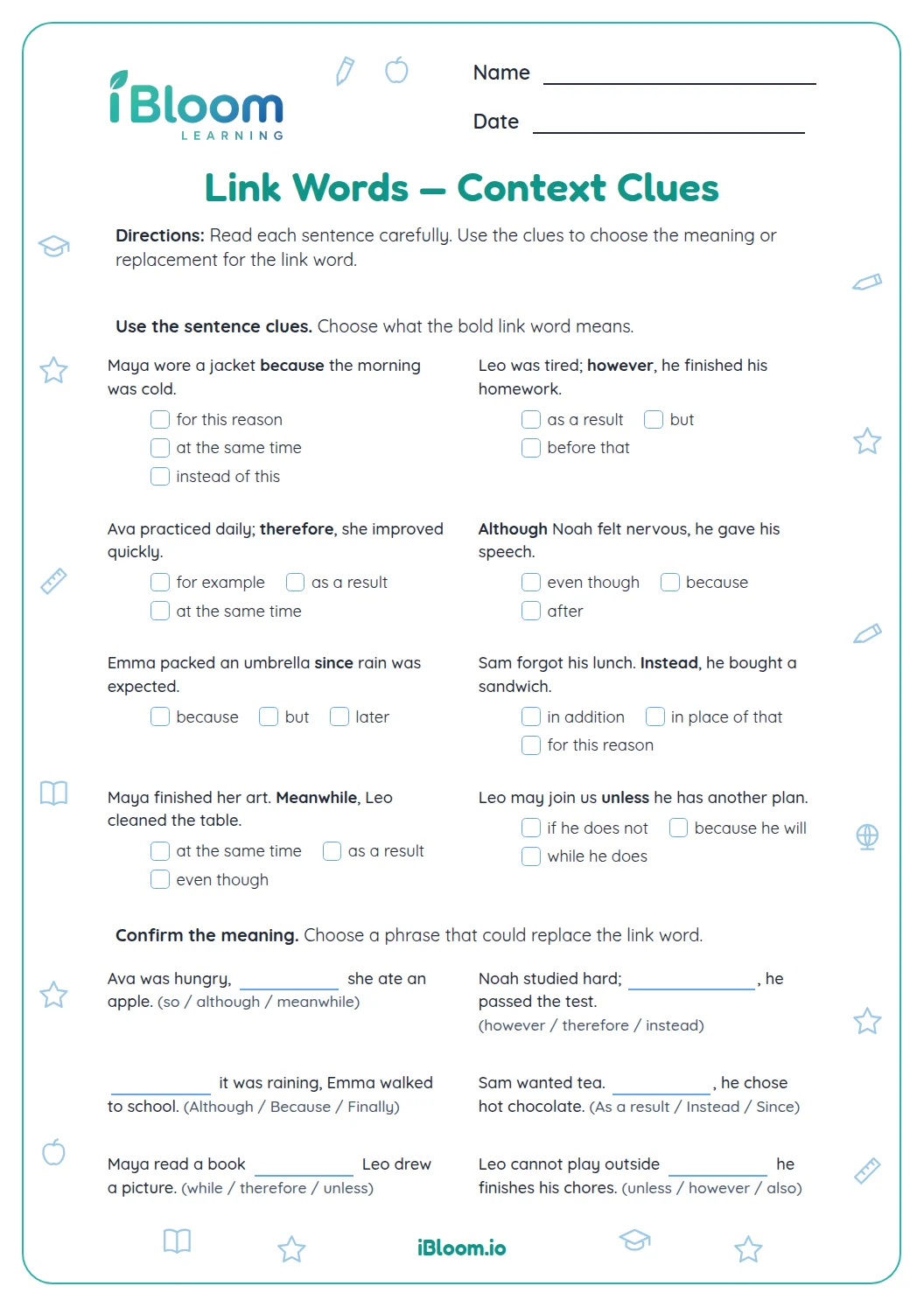
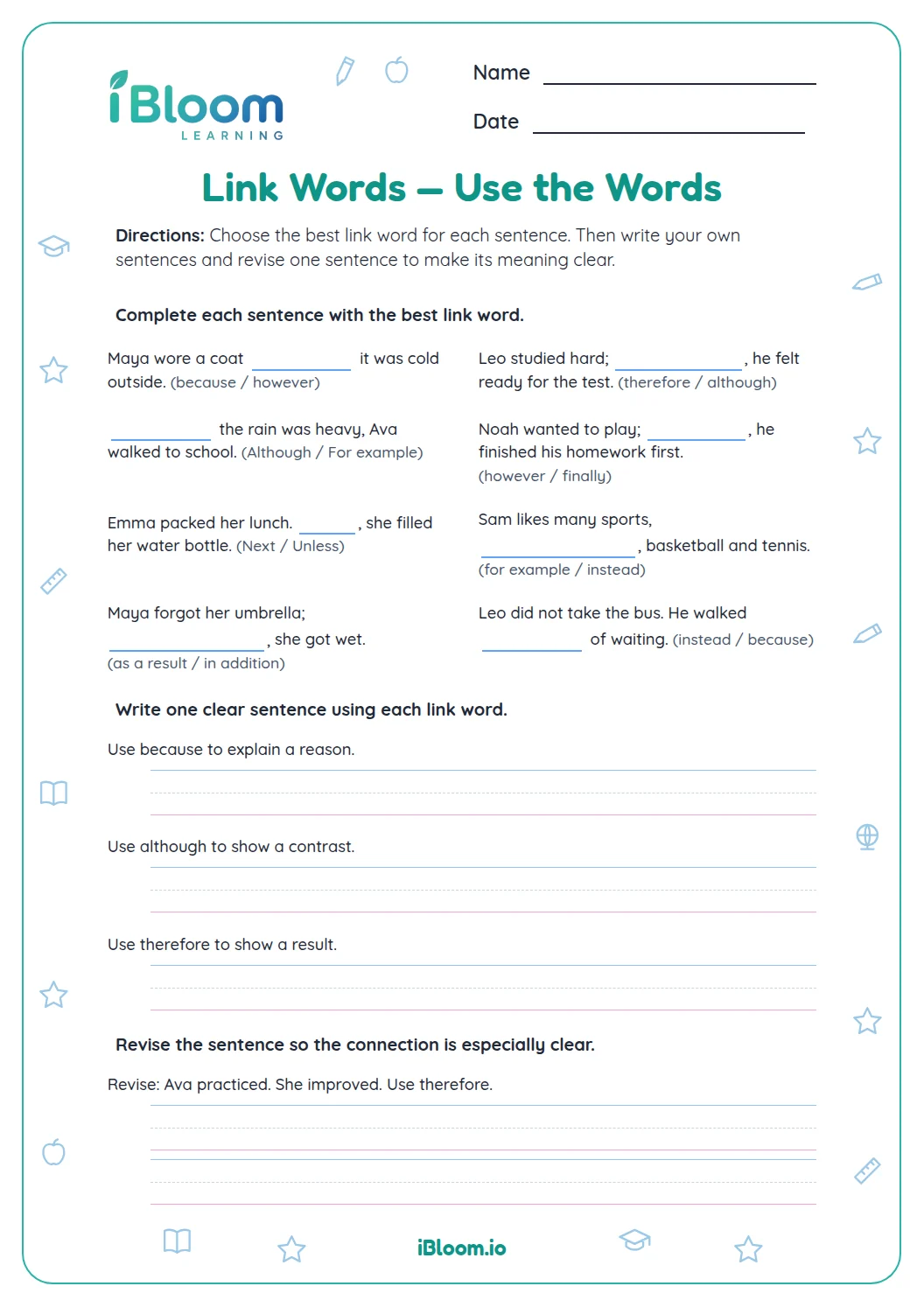
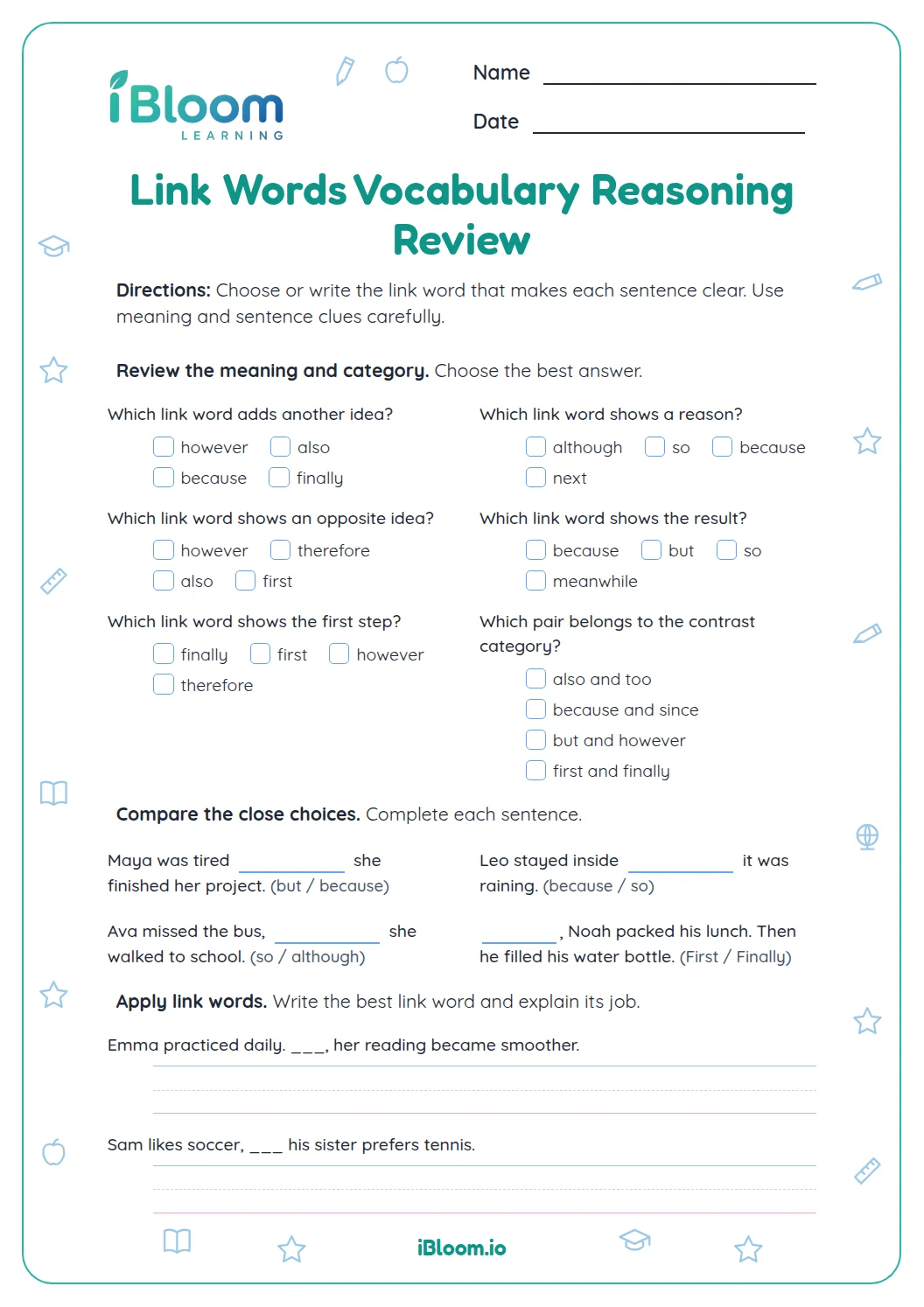
This free printable Grade 5 worksheet gives students focused practice with link words. It includes 18 questions that move from recognition to application, with clear directions and a separate answer key. The page aligns with L.5.1: Use conjunctions and linking words to connect ideas and show relationships.
Aligned to L.5.6
What will learners practice?
The worksheet has 18 questions arranged in increasingly demanding parts. Each part focuses on a distinct way to use link words.
For example, question 1 asks: “{qs[0]["prompt"]}” The answer key gives a concise check for every item.
- Part A builds recognition of link words.
- Later parts ask learners to apply the idea and explain a choice.
How can students work through link words?
Read the complete prompt first, then look for the detail that signals link words. Reread the sentence or model before choosing an answer.
How should families review the answers?
Compare each response with the key, then revisit the words or details that support it. Ask the learner to explain one answer in their own words.
How to use this worksheet
- 1Read the directions and name the skill in your own words.
- 2Complete Part A carefully, checking each prompt before answering.
- 3Move through the later parts in order and use evidence from the item.
- 4Compare answers with the key and correct any missed items.
- 5Choose one response and explain how you reached it.
Common mistakes and quick fixes
The mistake
Answering before rereading the full item.
The fix
Read the whole sentence or model again, then point to the clue that supports the answer.
The mistake
Choosing an answer because it looks familiar.
The fix
Check that the choice fits the exact meaning and wording in the prompt.
The mistake
Skipping a check after finishing.
The fix
Use the key to review every response and explain any correction.
Curriculum alignment
This worksheet practices skills described in L.5.1.
Use linking words to signal contrast, cause, sequence, time, and other logical relationships.
On this sheet: The items use transition words and conjunctions to connect ideas and show their relationships.
Show the official wordingHide the official wording
Acquire and use accurately grade-appropriate general academic and domain-specific words and phrases, including those that signal contrast, addition, and other logical relationships (e.g., however, although, nevertheless, similarly, moreover, in addition).
What to practice next
Make more practice
Questions parents and teachers ask
What are linking words?
Linking words connect ideas and help readers understand how those ideas relate. Words such as because, although, next, and however can signal cause, contrast, sequence, or time. This worksheet asks students to use those relationships in sentences. Have the learner point to the clue in the worksheet and explain the choice.
How can students choose between “because” and “so”?
“Because” introduces a reason, while “so” introduces a result. In “The path was muddy, so we wore boots,” wearing boots is the result of the muddy path. Reread both clauses to check the connection. Have the learner point to the clue in the worksheet and explain the choice.
What does “however” signal?
“However” signals contrast. It helps connect ideas that differ, as in “The room was small; however, it held twenty desks.” The contrast word alerts readers that the second idea differs from what they might expect. Have the learner point to the clue in the worksheet and explain the choice.
How many questions are included?
There are 14 questions in three parts: choosing a connector, completing a sentence, and identifying a connector’s job. The answer key is provided on a separate two-page spread. Have the learner point to the clue in the worksheet and explain the choice.
Can more than one linking word ever work?
Some sentences can accept more than one connector if the wording and punctuation change. On this sheet, students use the sentence as written and choose the word that best fits its relationship. For blanks without choices, accept a sensible connector.