Addition Word Problems for Grade 1
Free story sums for Class 1 with addition and subtraction examples, printable-style and interactive worksheet links, and answer checks.
Free printable worksheet
Free addition word problems worksheet for Grade 1
This two-page printable has 12 Grade 1 addition word problems with totals up to 20. Children write each number sentence, and page 2 is the answer key.
- Free PDF download
- Answer key included
- Ready to print
Free to print and use at home or in class. How to use this worksheet
Addition word problems for Grade 1 help children read a small situation, join two groups, and explain the total.
Free addition word problems worksheet for Grade 1
This two-page printable has 12 Grade 1 addition word problems with totals up to 20. Children write each number sentence, and page 2 is the answer key.
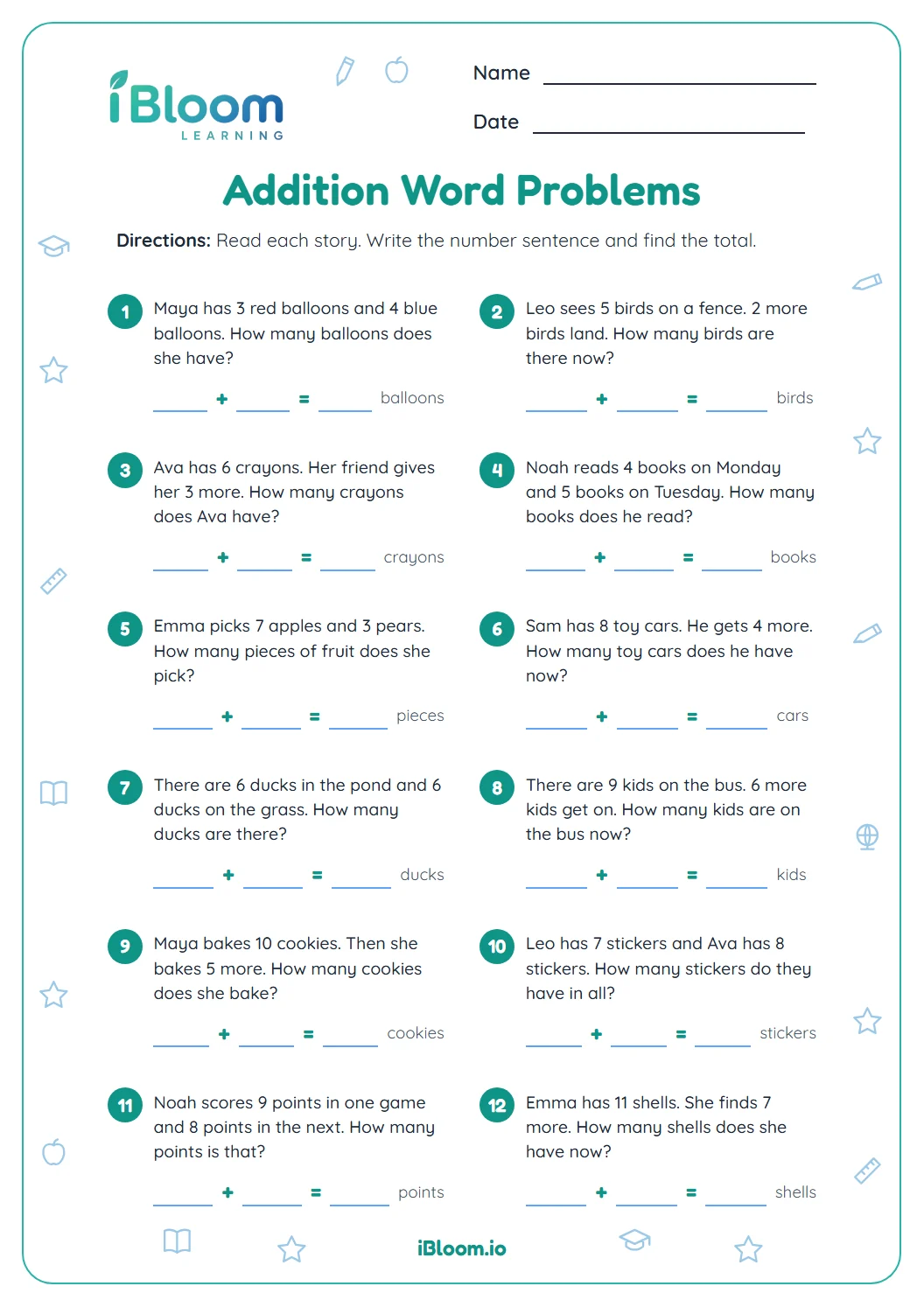
Download the free Grade 1 addition word problems worksheet PDF
Answer key preview
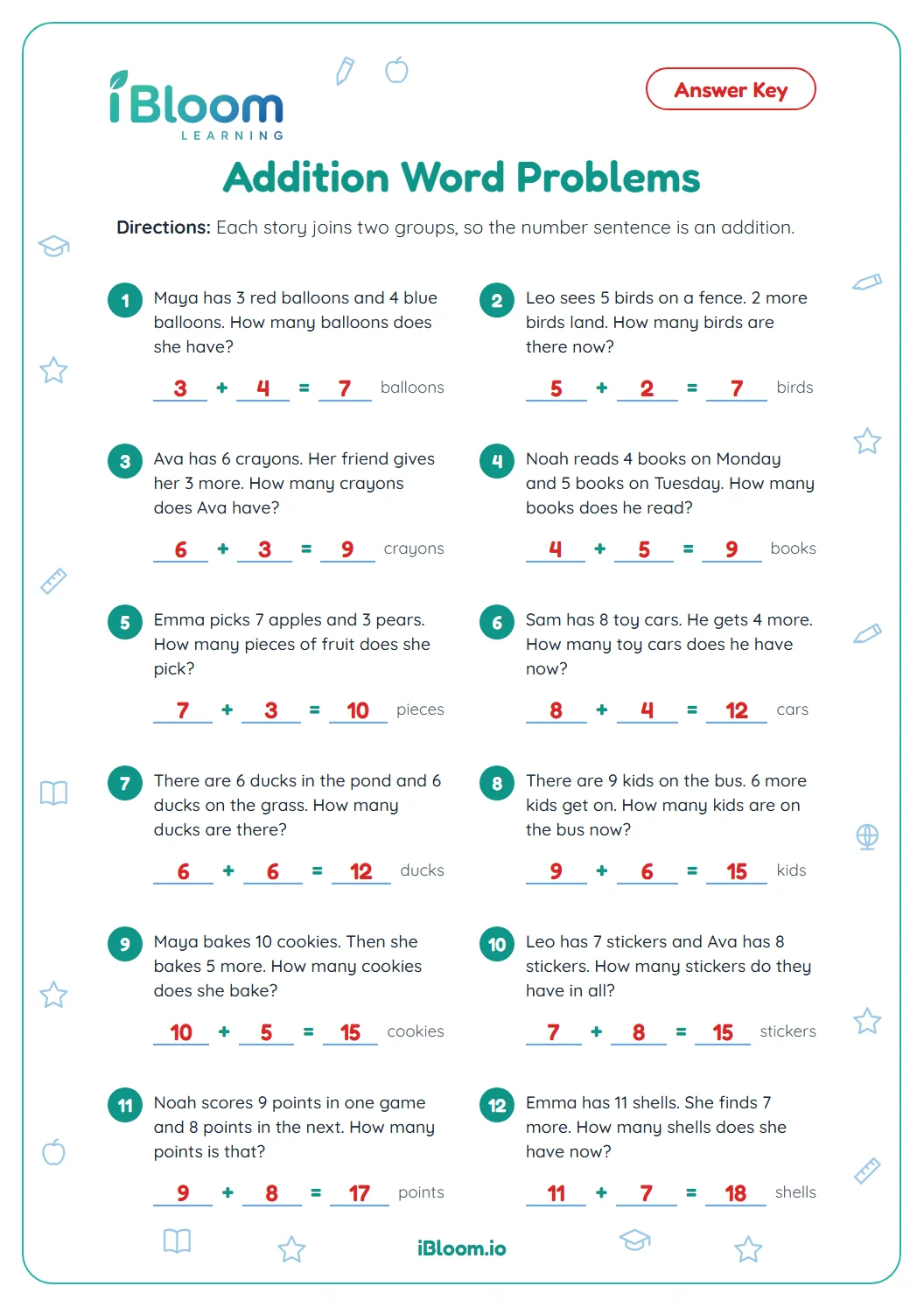
Let your child act out the first story with toys or counters before writing the number sentence.
Start With the Matching Practice
Use the guide with the most relevant iBloom worksheet or lesson so the explanation turns into real child practice.
India Worksheet Search Match
Parents and teachers searching for story sums for class 1 usually want a free worksheet-style page that is quick to understand, printable or usable online, and clear enough for India curriculum practice. This page now names that intent early for CBSE, NCERT-aligned, ICSE, and state-board families so they can see that it covers Class 1 story sums for addition and subtraction using objects, pictures, and number stories.
It is written for India-based school and home practice across Delhi, Mumbai, Bengaluru, Chennai, Hyderabad, Pune, Kolkata, Ahmedabad, Jaipur, Lucknow, Kerala, Tamil Nadu, Karnataka, Maharashtra, Telangana, Gujarat, Rajasthan, West Bengal, and Uttar Pradesh.
Use it this way:
- Start with the worked example or short explanation before the child begins.
- Use the linked iBloom practice page for interactive worksheet practice.
- Ask the child to explain one answer aloud so the activity is more than copying.
- Use India curriculum language naturally: Class, UKG, LKG, CBSE, NCERT, state-board, sums, story sums, worksheet, printable practice, interactive practice, and answer checks.
This update is aimed at better snippet match for the query story sums for class 1 while keeping the visible copy useful for children, parents, and teachers.
Table of Contents
Worksheet And Lesson Previews
Solving Addition Word Problems Using Models Worksheets for Kindergarten Preview
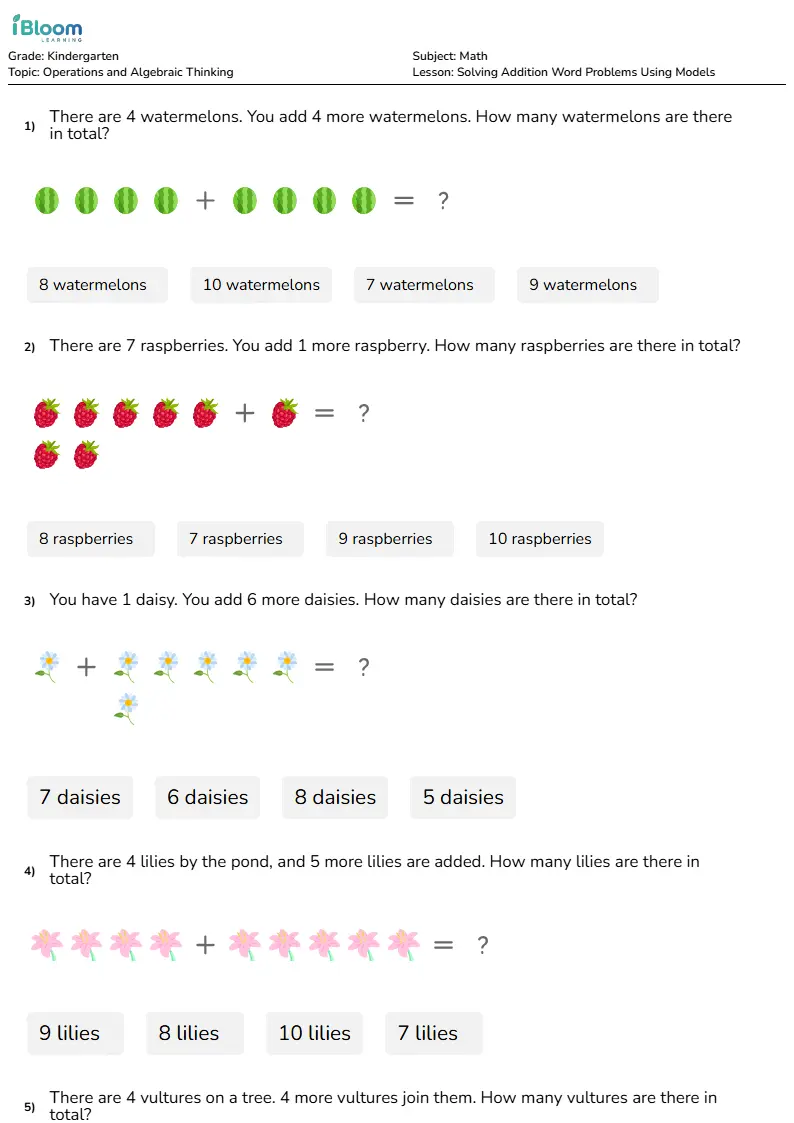
Use this preview to see the kind of practice children will open before you start the routine.
Key Takeaways
- addition word problems grade 1 should connect a real situation, a visible model, an equation, and a spoken explanation.
- Children learn addition more deeply when they use objects and story cards before fast facts.
- Parents can use short daily practice; teachers can reuse one page for warm-ups, centers, small groups, and exit tickets.
- Internal practice should move from the article to the exact worksheet or lesson, then to a related hub when the child is ready.
- India, US, and UAE families may use different grade labels, but the child still needs the same join-and-explain routine.
Why This Addition Skill Matters
A child may know 4 + 3 but still need help seeing why a story calls for addition. Word problems connect reading, real objects, pictures, and equations so the child understands the action before writing an answer.
The IES early math practice guide supports intentional early math teaching with clear examples, models, and practice. The NCTM classroom resources also emphasize representation and mathematical communication. For young learners, that means the worksheet should not be only a page to finish. It should help the child show what is being joined, say the total, and explain the answer.
Use this guide with Addition Worksheets for Grade 1, Addition Worksheets for Grade 2, and Picture Addition Worksheets when adults need a broader path. Then return to the exact practice links above so the child can work on the skill directly.
Step-by-Step Routine
Start with one clear model. Read the problem or direction, ask what is being joined, and let the child build the situation with objects and story cards. Then connect the model to an addition sentence.
- Read the direction or story slowly.
- Name the first group.
- Name the second group.
- Join, count on, fill the frame, or jump forward.
- Say the total and explain how the model shows it.
The explanation can be simple: "I started with 6, added 3 more, and got 9." This sentence matters because it shows the child understands the action, not only the final number.
Examples Children Can Try
- Put 5 counters on the table and add 4 more. Ask what changed and what the total is.
- Draw two groups of dots and write the addition sentence that matches.
- Use a ten-frame to show 7 and 2 more, then explain how many spaces are filled.
- Start at 8 on a number line, jump forward 3, and say where you land.
- Make one new addition story for a parent, teacher, or classmate.
Parent Practice Plan
Parents can keep practice to ten calm minutes. Use objects at home: spoons, crayons, blocks, books, snack pieces, or toy cars. Let the child join two groups physically before writing an answer. If writing slows the child down, do the first round orally and ask for only two written answers.
In India, families may connect this to CBSE, ICSE, NCERT-aligned, state-board, Class 1, Class 2, tuition revision, Delhi, Mumbai, Bengaluru, Chennai, Hyderabad, Pune, Kolkata, Ahmedabad, Jaipur, Kerala, Tamil Nadu, Karnataka, Maharashtra, Telangana, Gujarat, Rajasthan, West Bengal, and Uttar Pradesh.
Teacher Practice Plan
Teachers can use this page four ways:
- Warm-up: one joining problem on the board.
- Small group: children build the model with counters, frames, or number lines.
- Math center: pair the worksheet with a model mat and sentence frame.
- Exit ticket: one equation plus one spoken or written explanation.
For children who finish quickly, ask them to create a new example. For children who need support, reduce the numbers and return to objects or pictures. Connect fluent learners to Subtraction Worksheets for Grade 1 so they begin seeing addition and subtraction as related operations.
Common Mistakes
- The child counts the first group again instead of counting on.
- The child writes an equation without understanding what is being joined.
- The child guesses from the larger number.
- The child fills a ten-frame or jumps on a number line too quickly and loses track.
- The adult gives the answer before the child has tried a model.
When mistakes happen, solve one item slowly and ask the child to show the model again. One careful correction is more useful than a long page finished with the same error.
Keep Practicing on iBloom
Use the guide with the most relevant iBloom worksheet or lesson so the explanation turns into real child practice.
Frequently Asked Questions
What age is this addition practice best for?
It is best for children beginning to join groups, count on, use ten-frames, use number lines, or solve simple addition stories. That often includes kindergarten, Grade 1, Class 1, and early Class 2 learners.
Should children memorize addition facts first?
No. Fast facts are useful later, but young learners should first understand what addition means with objects, pictures, frames, or number lines.
How long should practice take?
Five to fifteen minutes is enough for many children. Stop after one confident explanation.
What should I do if my child guesses?
Ask the child to show the two groups and explain what is being joined. Then solve a smaller example before returning to the worksheet.
Which iBloom page should we use next?
Start with the matching worksheet above, then use the paired lesson when the child needs more modelling.
Related practice
Practice this topic
Continue with a lesson, generator, or printable worksheet.