Free printable practice
Cursive Alphabet Practice Activities
Printable cursive alphabet worksheets help children form individual cursive letters with correct strokes, spacing, slant, and smooth handwriting habits.
Explore Cursive Alphabet
Free printable worksheet PDFs
Preview every available page, then download the free worksheet PDF for home, homeschool, tutoring, or classroom practice.
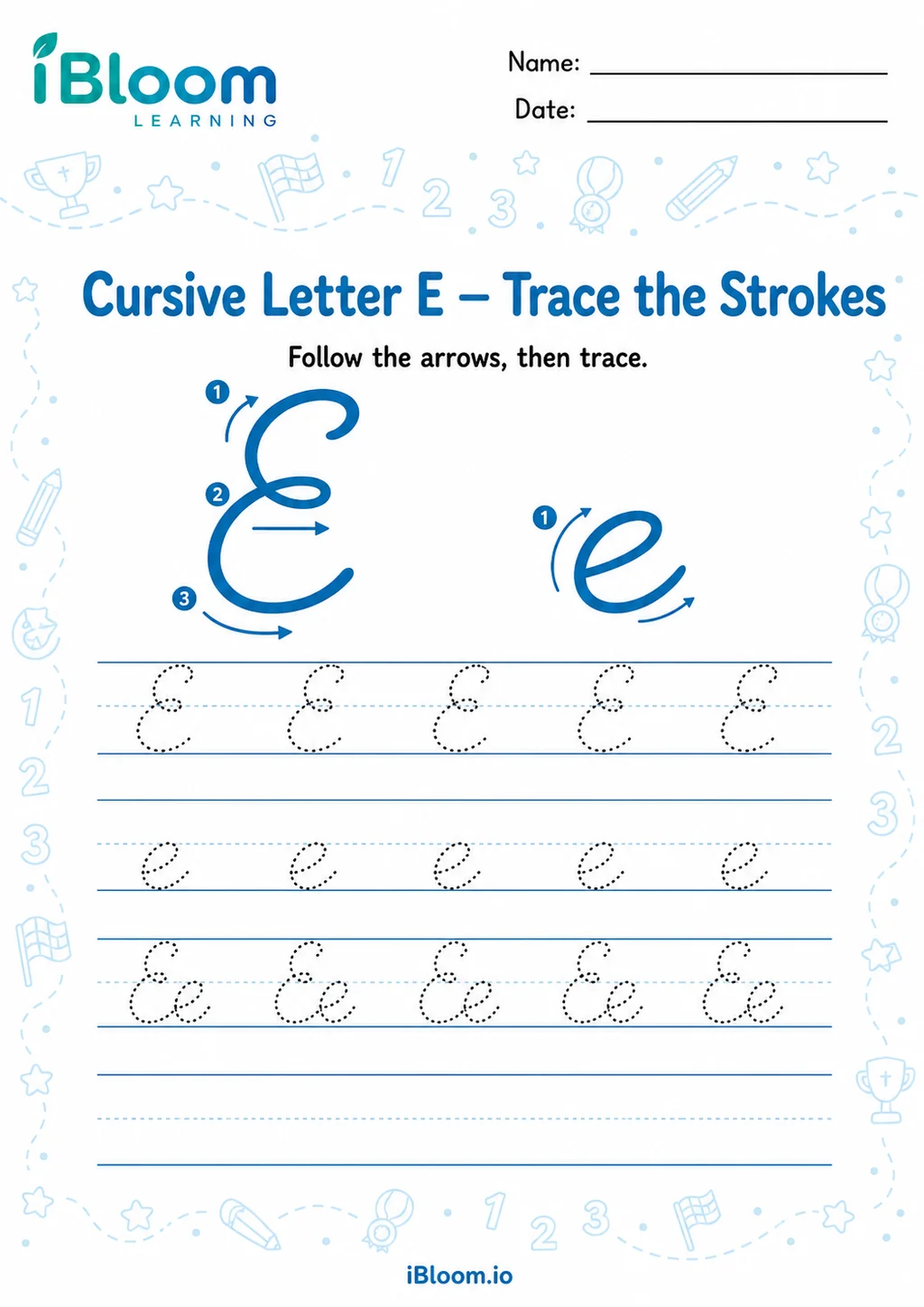
Preview the exact activity before downloading it.
Practice that builds confidence
Building cursive letter formation
These cursive alphabet practice activities help children learn how individual letters are formed, where each stroke begins, and how letters sit on handwriting lines. Students practise looped, curved, tall, short, and descending letters while building steadier pencil control.
The printable collection includes focused pages for letters such as A, B, D, E, F, G, H, I, J, K, L, M, N, O, P, Q, R, S, T, W, X, Y, and Z, plus a cursive letter guide for quick reference. Activities support tracing, copying, and independent writing so children can move from guided formation to fluent cursive.
Cursive writing is not just a different alphabet style; it is a sequence of connected movements. These worksheets guide children to notice entry strokes, loops, humps, curves, tails, and exit strokes. Letters such as T, F, H, K, L, and B strengthen tall-letter control, while G, J, Q, Y, and Z help children practise descenders below the baseline. Rounded letters such as O, A, D, and Q build smooth circular motion.

Progression across the alphabet pages
Children begin by tracing a model letter, then copy the same letter with less support, and finally write it independently. The cursive letter guide can be used before each page to review direction, slant, and line placement. Similar letters can be grouped together: M and N for humps, E and L for loops, P and B for tall stems, and R and S for careful curves.
A simple parent routine
At home, choose one letter page at a time. Ask your child to point to the starting spot, trace the first model slowly with a finger, then write three careful examples in pencil. After that, have them circle their neatest letter and explain why it looks correct. Keep the focus on smooth motion rather than filling every line quickly.

Classroom uses for teachers
Teachers can use these printables for handwriting centers, morning work, small-group practice, or quick review after introducing a new cursive letter. The pages also work well as targeted practice when students confuse letters with similar strokes, such as I and J, O and Q, or M and N. Displaying the guide nearby helps students self-check without waiting for correction.

Common errors to watch for
Watch for letters that start in the wrong place, slant in different directions, float above the baseline, or drop too far below the line. Some students make loops too narrow, close rounded letters too tightly, or forget the exit stroke needed for future joining. A helpful child-friendly strategy is: start, slide, shape, and stop—begin in the right spot, move smoothly, form the letter, then finish ready for the next one.
Free printable PDF download
Use this cursive alphabet practice worksheet page to preview the activity, print it, or download it as a PDF for quick practice. It works well for homework, homeschool lessons, tutoring, morning work, revision, and classroom centers.
Answers and answer key support
After the child completes the worksheet independently, parents and teachers can use the answer support or answer key information to check the work, review mistakes, and choose the next practice step.
Why iBloom worksheets help
The iBloom cursive alphabet pages give children repeated, letter-specific practice without overwhelming them. Clear models, consistent line spacing, and focused letter pages make it easier to see progress, correct habits early, and build confidence before moving into words and sentences.
Helpful answers
Frequently asked questions
Which cursive letters are included in this collection?
The collection includes focused practice pages for many individual cursive letters, including A, B, D, E, F, G, H, I, J, K, L, M, N, O, P, Q, R, S, T, W, X, Y, and Z, along with a cursive letter guide.
How should a child use the cursive letter guide?
Use the guide before starting a worksheet to check the starting point, stroke direction, slant, and line placement. Children can also keep it nearby while copying letters independently.
Should children trace or write independently first?
Most children benefit from tracing first, then copying with a model, and finally writing the letter on their own. This progression helps them learn the movement before trying to write from memory.
What cursive mistakes are most common with alphabet practice?
Common mistakes include starting in the wrong place, making loops too small, ignoring the baseline, changing slant from letter to letter, and forgetting the exit stroke.
Can these worksheets be used before cursive word practice?
Yes. These pages are useful before word practice because children need secure individual letter formation before they can join letters smoothly in words.
Is this cursive alphabet practice worksheet free?
Yes. You can preview it for free and use the printable worksheet for home or classroom practice.
Can I download this cursive alphabet practice worksheet as a PDF?
Yes. Use the worksheet download option to save a printable PDF, or print the worksheet directly from the page.
Does this cursive alphabet practice worksheet include answers or an answer key?
When the activity has fixed answers, iBloom includes answer support so parents and teachers can check the completed worksheet.