
About this worksheet
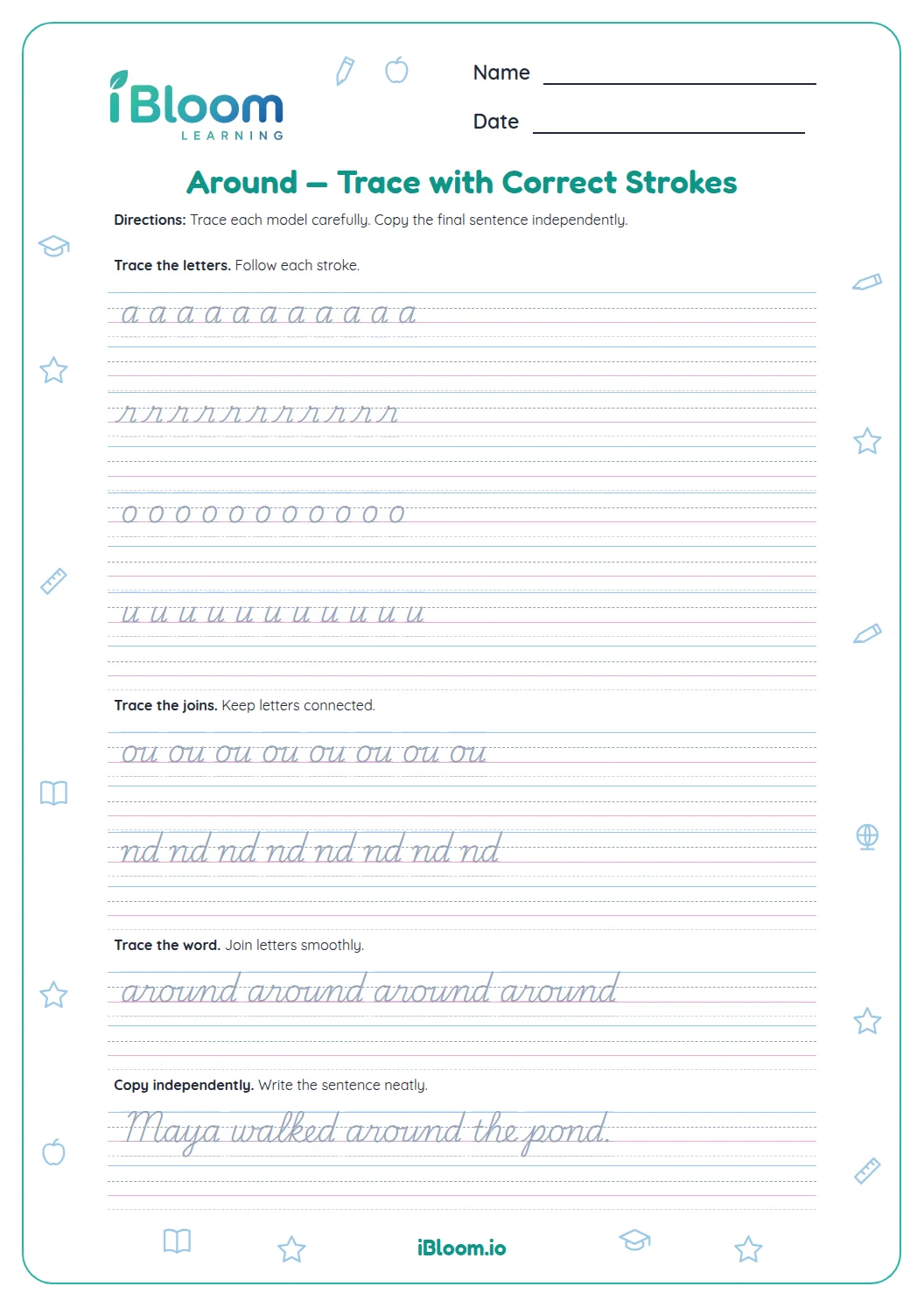
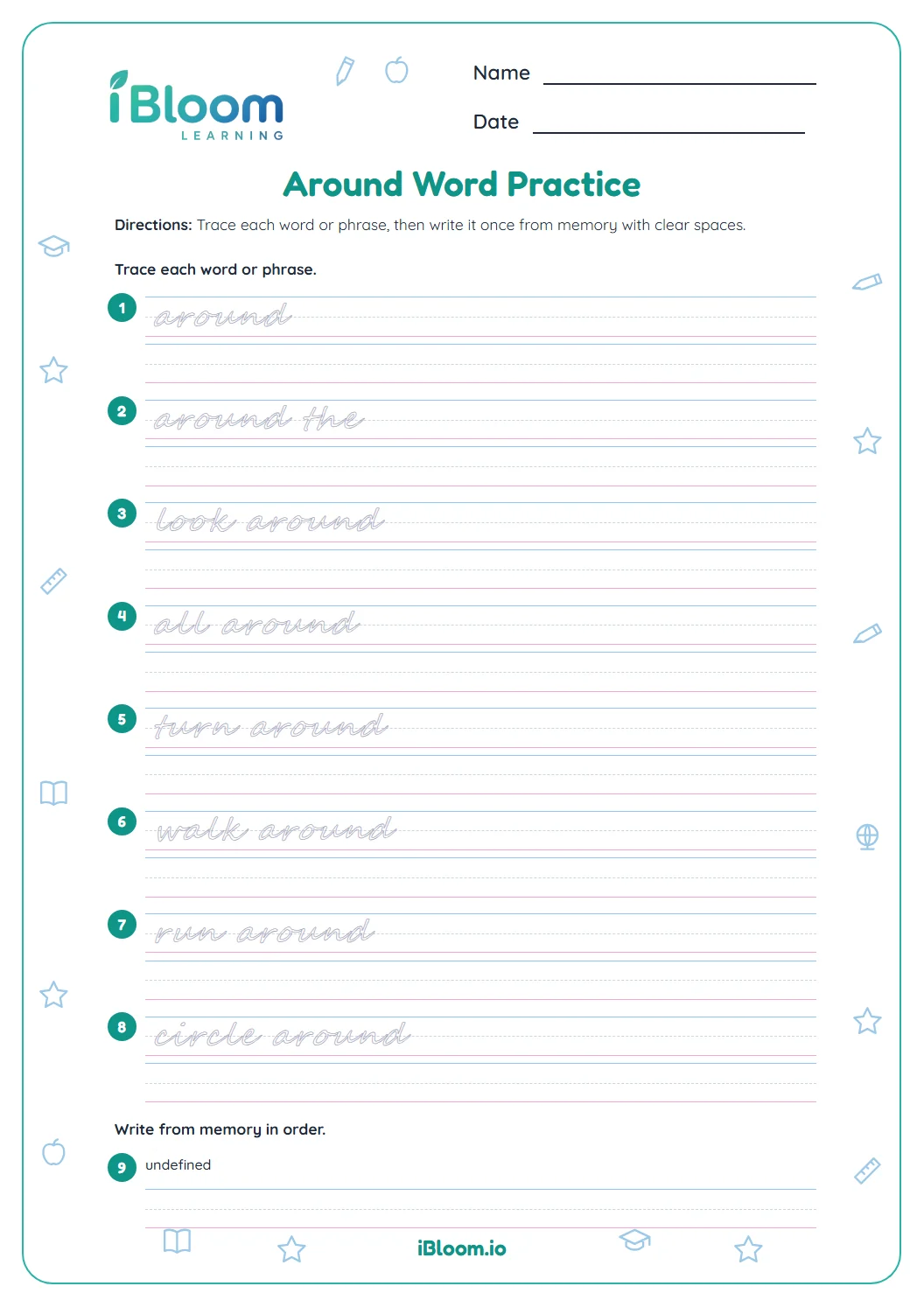
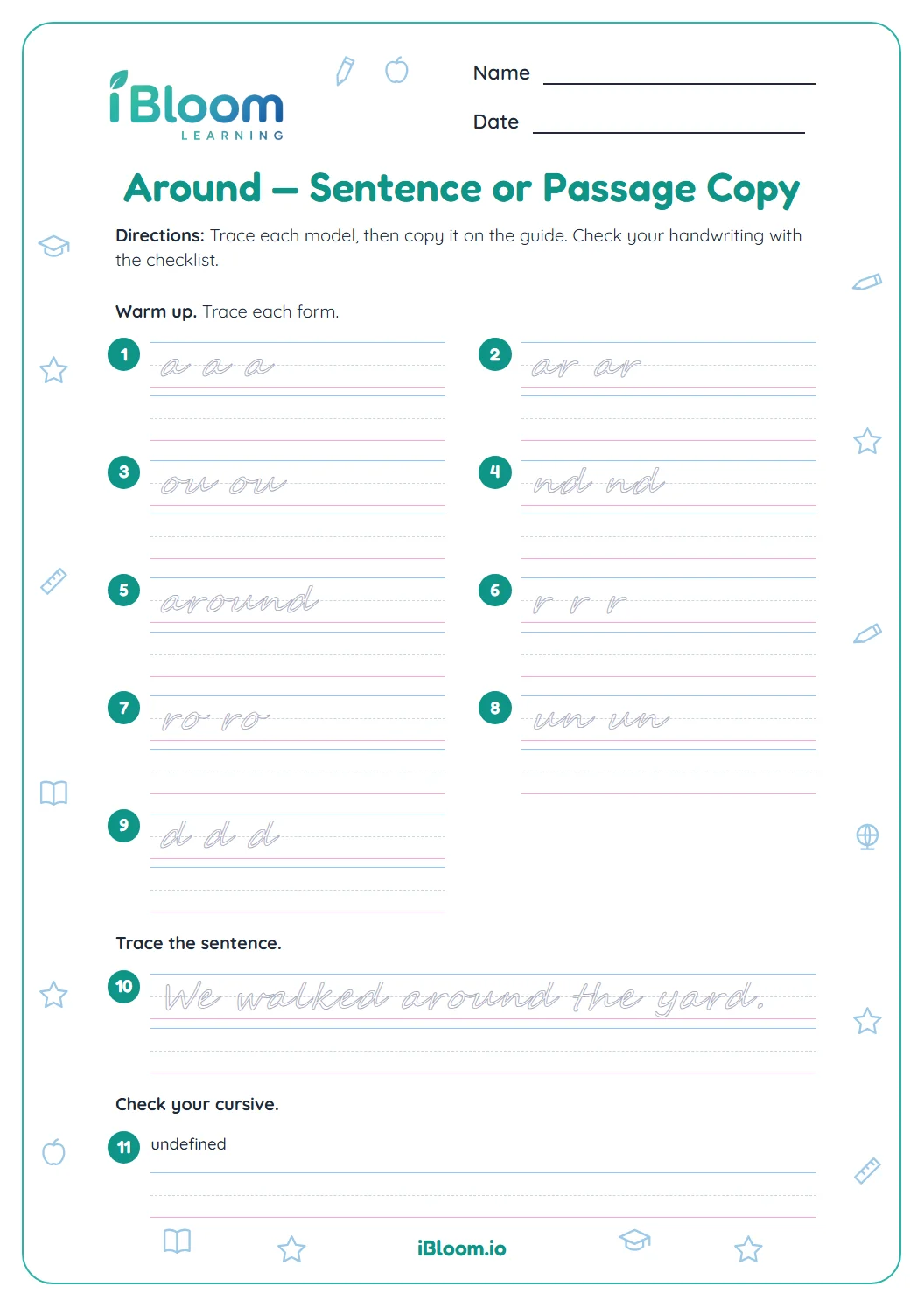
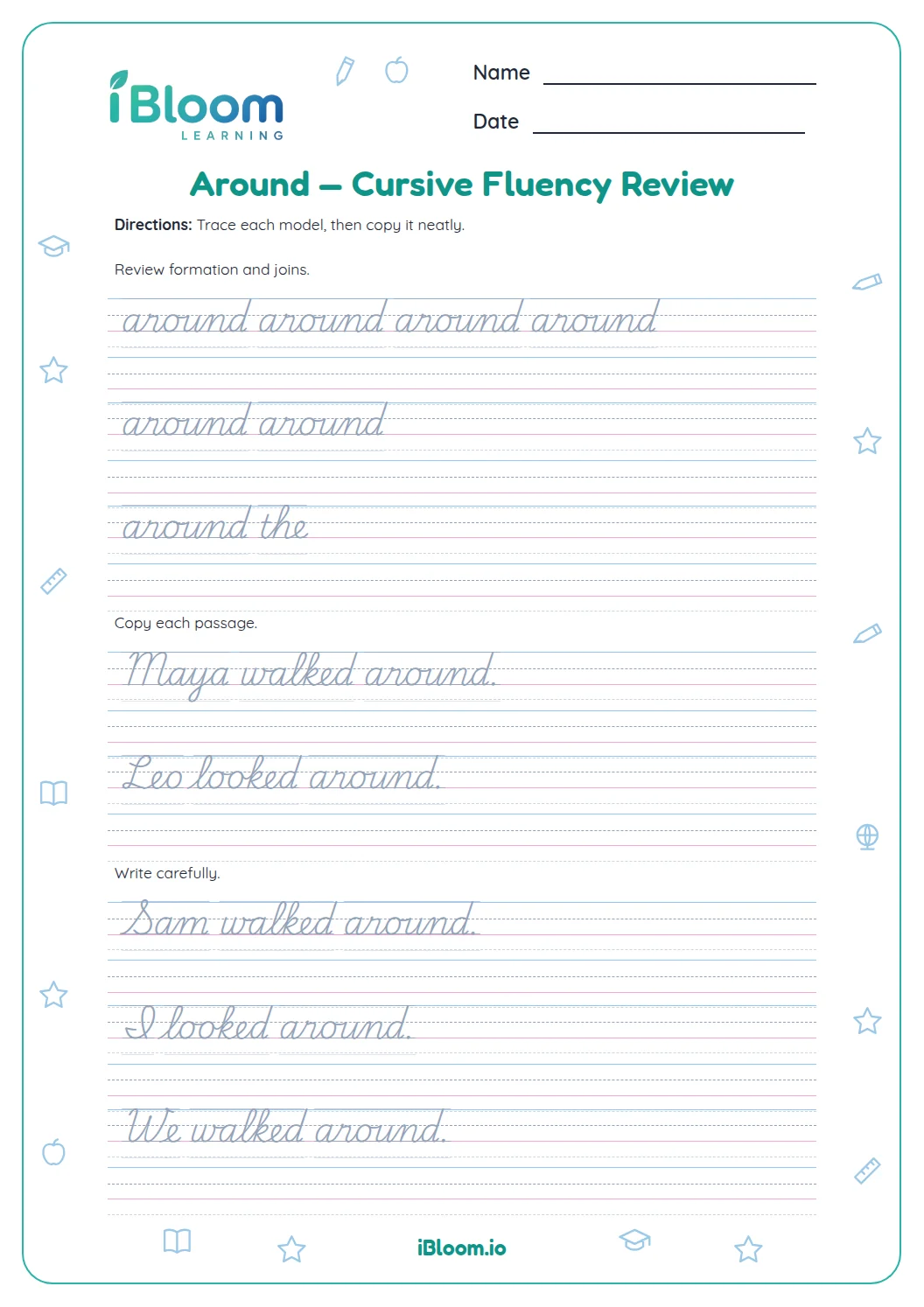
This free cursive worksheet for Grades 2–5 begins with five join groups: ar, no, ou, un, and nd. Students combine the joins in around and round, then copy six short sentences and one phrase that reuse around and keep the practice focused on connected writing. Each of the 14 rows provides a cursive model to trace and a handwriting row to copy. The separate model key repeats the text for comparison. Watch for clear joins and a visible space between words.
What text will my child copy?
Part A practices ar, no, ou, un, and nd three times each, then brings the pairs together in around and round. These short groups let students focus on how letters connect.
Part B copies seven short phrases and sentences about walking around a garden. The wording repeats around and round so children can attend to joins, word spacing, and sentence punctuation.
How do the joins build the word around?
The sheet first isolates five pairs, then asks students to copy around and round as connected words. In around, keep the letters together from a to d; in round, join r-o-u-n-d without inserting spaces.
- 1Read the model: around around.
- 2Trace a-r-o-u-n-d as one word, then leave a space.
- 3Copy both words on the empty row and compare the joins.
What should I check in the sentences?
Read the copied lines in order and check that each word remains readable. Look for connected letters within a word, a visible gap between words, and the period at the end of each sentence.
The model key repeats the expected cursive text for comparison. Choose one feature, such as a smooth join or clear word space, to review at a time.
How to use the worksheet
- 1Read the six garden sentences and the short phrase aloud before copying.
- 2Trace each of the five join rows slowly, following the gray model.
- 3Copy around and round, then check the connections between the letter pairs.
- 4Trace and copy the six sentences and one phrase in order.
- 5Compare one copied word with its model, then improve one unclear join.
What to watch for
The mistake
Leaving gaps between ar, ou, and nd when writing around.
The fix
Use the whole-word model to join across r–o and u–n as well as within each pair.
The mistake
Joining the last letter of one word to the next word.
The fix
Finish the word, lift the pencil, and leave a visible space before starting the next word.
The mistake
Making every letter the same height.
The fix
Compare small letters with taller letters in the model and use the handwriting guides to keep the differences clear.
What to practice next
Make more practice
Questions parents and teachers ask
Is there a whole passage on this worksheet?
The sheet has six short sentences about a garden walk and the phrase “around us.” Children trace and copy the lines in order, from “We walk around” to “We walk around again.” Each line gets its own practice row for joins and word spacing.
Why practice ar, no, ou, un, and nd first?
The worksheet isolates these five letter pairs before students copy around and round as connected words. The groups let children attend to a small part of the cursive movement before tracing whole words. The later lines reuse around and round in context.
Should children lift the pencil between words?
Yes. Leave a clear space between words, even when the letters within each word connect. The garden sentences and “around us” give repeated chances to practice that difference. Read one copied line aloud while pointing to its word spaces, then compare those spaces with the gray model.
How should the model answer key be used?
Use the key to compare the copied text, letter forms, and word spaces. It repeats the expected cursive text rather than assigning one score to handwriting. Choose one word to examine together and identify a readable join before asking the child to improve a single unclear connection.
Can we split the practice into shorter sessions?
Yes. Complete the five join groups and two word rows first, then return for the seven phrases and sentences. Before starting the sentence practice, trace around once with a finger to recall its connections. A short pause between lines can help the child return attention to the model.