

About this worksheet
This free cursive handwriting worksheet helps students in Grades 2–5 connect lowercase a to other letters, then use those joins in words and a sentence. Part A has three groups of four joins, including ab, ar, and aw. Part B has nine A words and ends with “Ava has an apple.” Each of the seven numbered items has a gray cursive row to trace and an empty row to copy. A separate model key supports checking letter formation, spacing, and joins.
Which joins does this worksheet introduce?
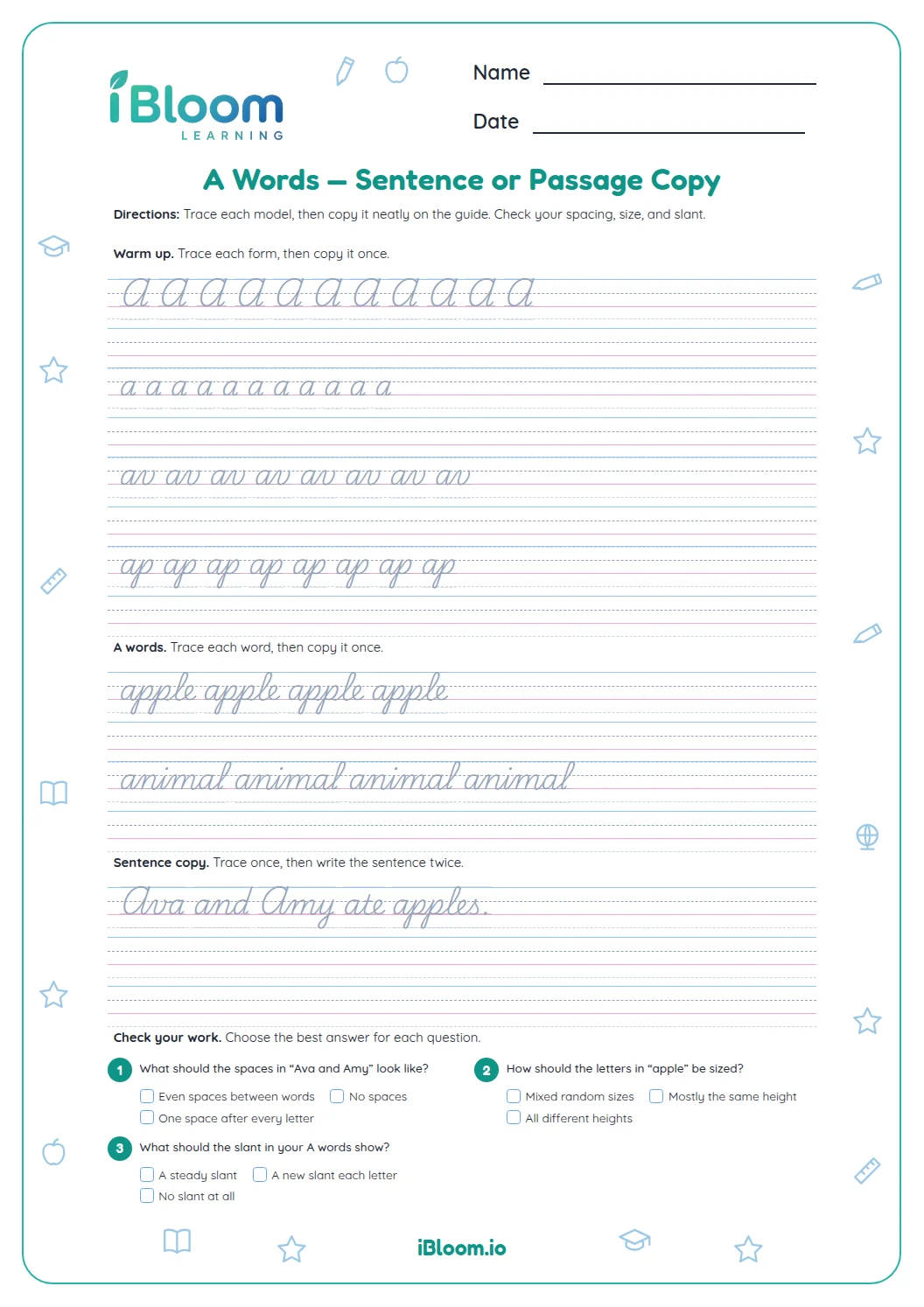
Part A gives twelve combinations in three groups: ab, ac, ad, al; am, an, ap, ar; and as, at, av, aw. Each begins with lowercase a and connects to a different next letter. Notice where the exit stroke leaves a and how the next letter begins.
Trace each gray model, then copy the entire group on the empty row. Leave a space between combinations. If room remains, repeat the group for extra practice, keeping the letters readable and the spaces clear.
How do the joins lead into whole words?
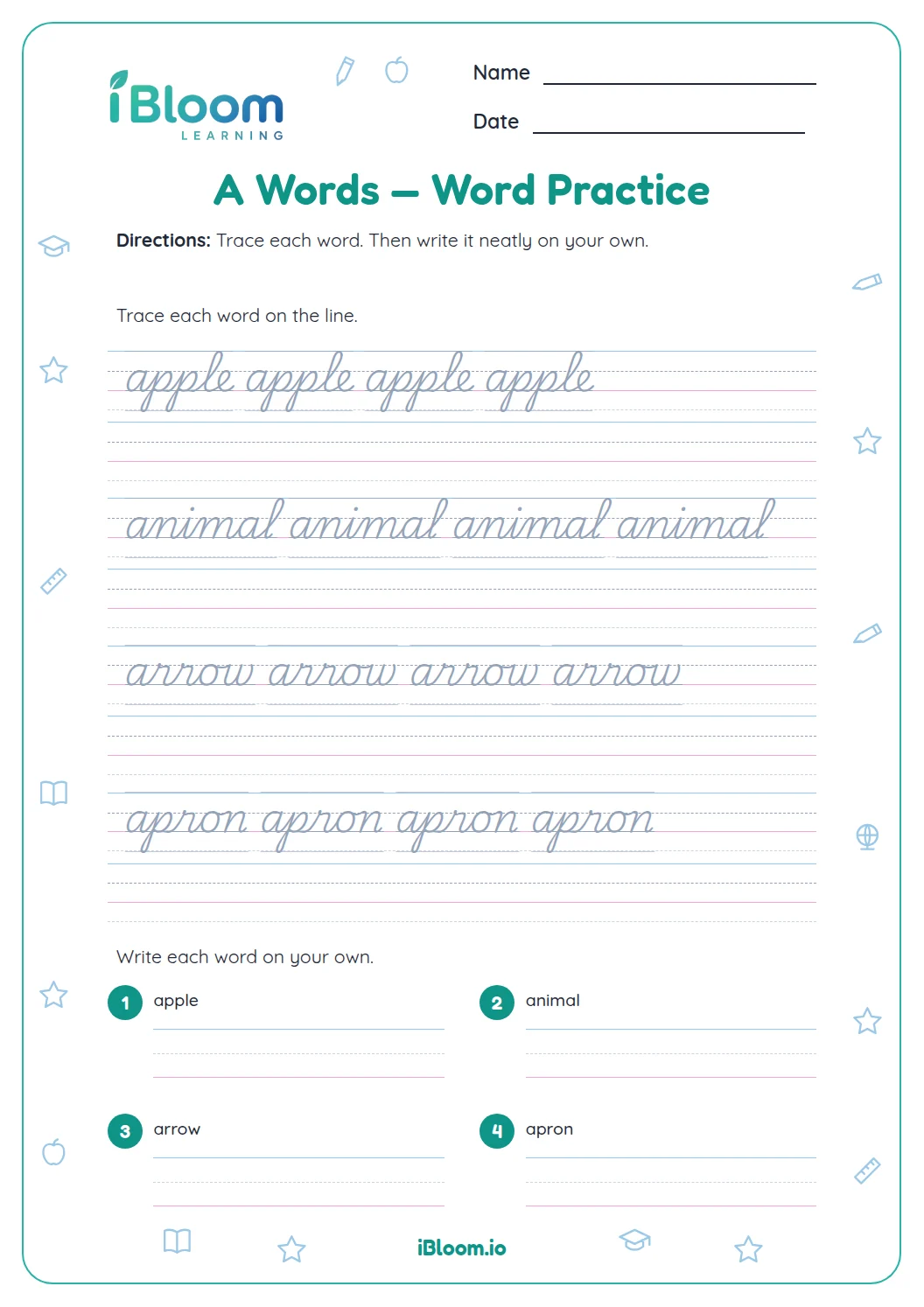
Part B uses nine words in three groups: ant, arm, art; ask, apple, after; and away, animal, around. These words carry the short joins into longer strings of letters. Trace and copy every word, leaving spaces between them.
The final item applies the same spacing habit to “Ava has an apple.” Follow the capital A model, connect the letters within each word, and leave a clear gap before starting the next word. Include the period when copying the sentence.
- 1Part A: Trace am, an, ap, and ar, then copy the group.
- 2Question 4: Trace ant, arm, and art.
- 3Copy all three words on the empty row, leaving spaces between them.
- 4In arm and art, keep the a-to-r connection clear.
What should students look for in their copies?
Check that the a closes, the letters sit on the writing line, and tall letters reach the height shown by the model. Look at the narrow joining strokes between letters as well as the letter shapes. A connection should leave enough room to recognize both letters.
Use the key as a model reference. Ask the student to choose one readable copy and name what worked. If a join is crowded, try that short combination again before rewriting the whole word.
A slow trace-and-copy routine
- 1Point to the start of lowercase a and follow the model with a finger.
- 2Trace all four joins in each Part A item, then copy the whole group.
- 3In Part B, find a familiar starting join before tracing and copying all three words.
- 4Copy the final sentence, including its capital letter, spaces, and period.
- 5Compare one copy with the model for closed a shapes, letter height, and clear joins.
Mistakes to notice and fix
The mistake
Leaving the top of a open so it resembles u.
The fix
Slow down around the oval and close it before following the exit stroke.
The mistake
Crowding the next letter against a until the join is hard to see.
The fix
Follow the model’s connecting stroke and leave room for the next letter’s shape.
The mistake
Making every letter the same height in al or after.
The fix
Use the handwriting guides and compare the tall letters with the shorter a.
What to practice next
Make more practice
Questions parents and teachers ask
Which A words are included?
Part B includes ant, arm, art, ask, apple, after, away, animal, and around. Before those nine words, students practice twelve short joins in three groups. The final item is the sentence “Ava has an apple.” Altogether, there are seven numbered items to trace and copy.
What should students do on the empty row?
Students should copy the entire model from the gray row: four joins, three words, or the final sentence. They can look back whenever needed. Leave spaces between separate items and words, then compare letter height and connections. If there is room, repeat a group for extra practice.
Is the answer key useful for handwriting practice?
Yes. The key provides the target text and cursive models for comparison. Use it to check that the student copied the right letters in order and kept the joins readable. Letter formation may vary slightly, so focus on clear shapes and consistent use of the writing guides.
Can a beginner complete the joins before trying the words?
Yes. A beginner can work through the three groups in Part A first and return to the words in a later session. Those groups contain twelve short joins. Once the movements feel manageable, ant, arm, and art reuse familiar beginnings before the child tries longer words and the sentence.
Should students try to write the words quickly?
No. Start slowly enough to follow the model and keep each letter recognizable. Ask the student to compare one copy with the gray row and choose a single feature to improve, such as closing a or spacing the join. Speed can increase as the movements become more comfortable.