

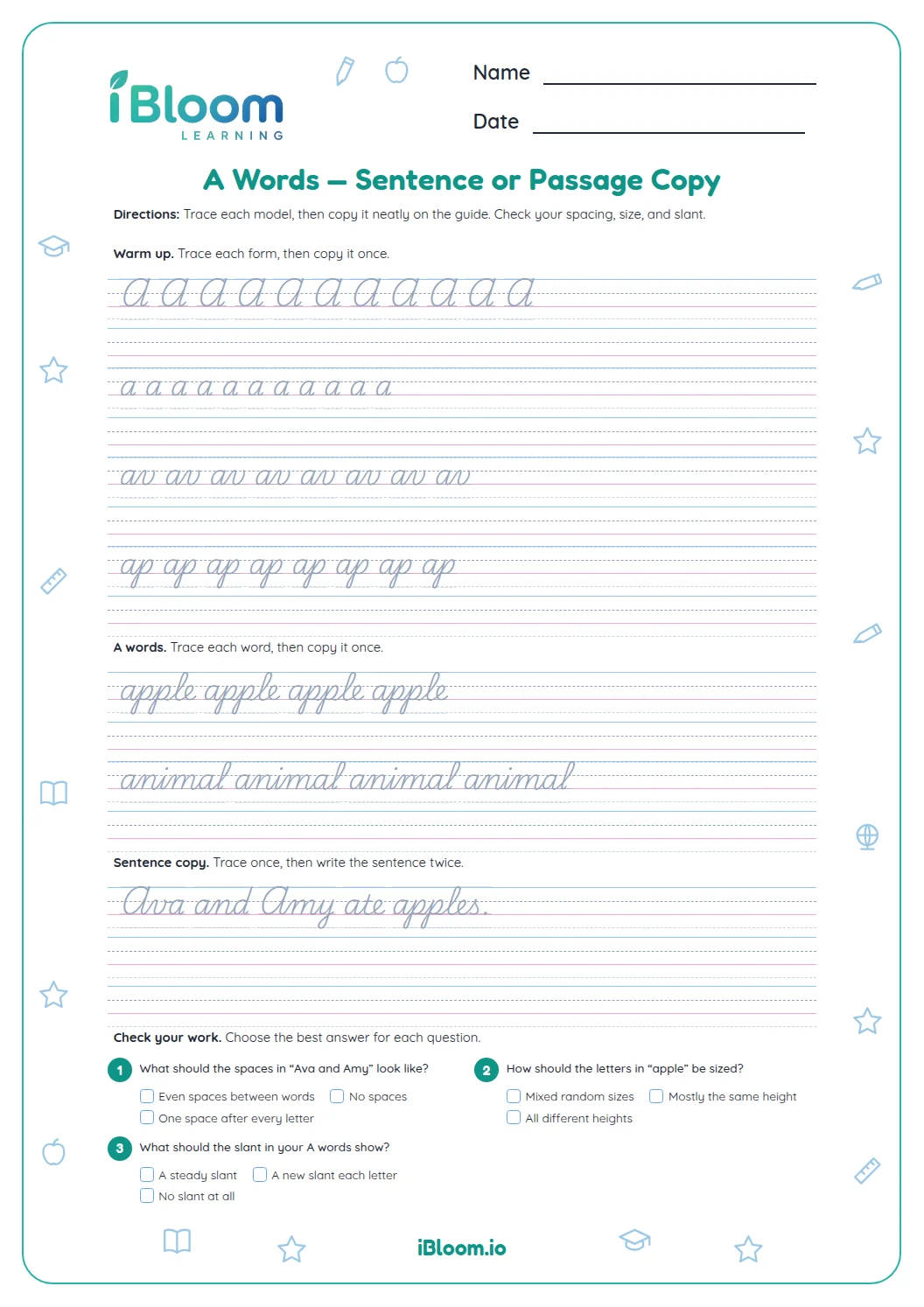
About this worksheet
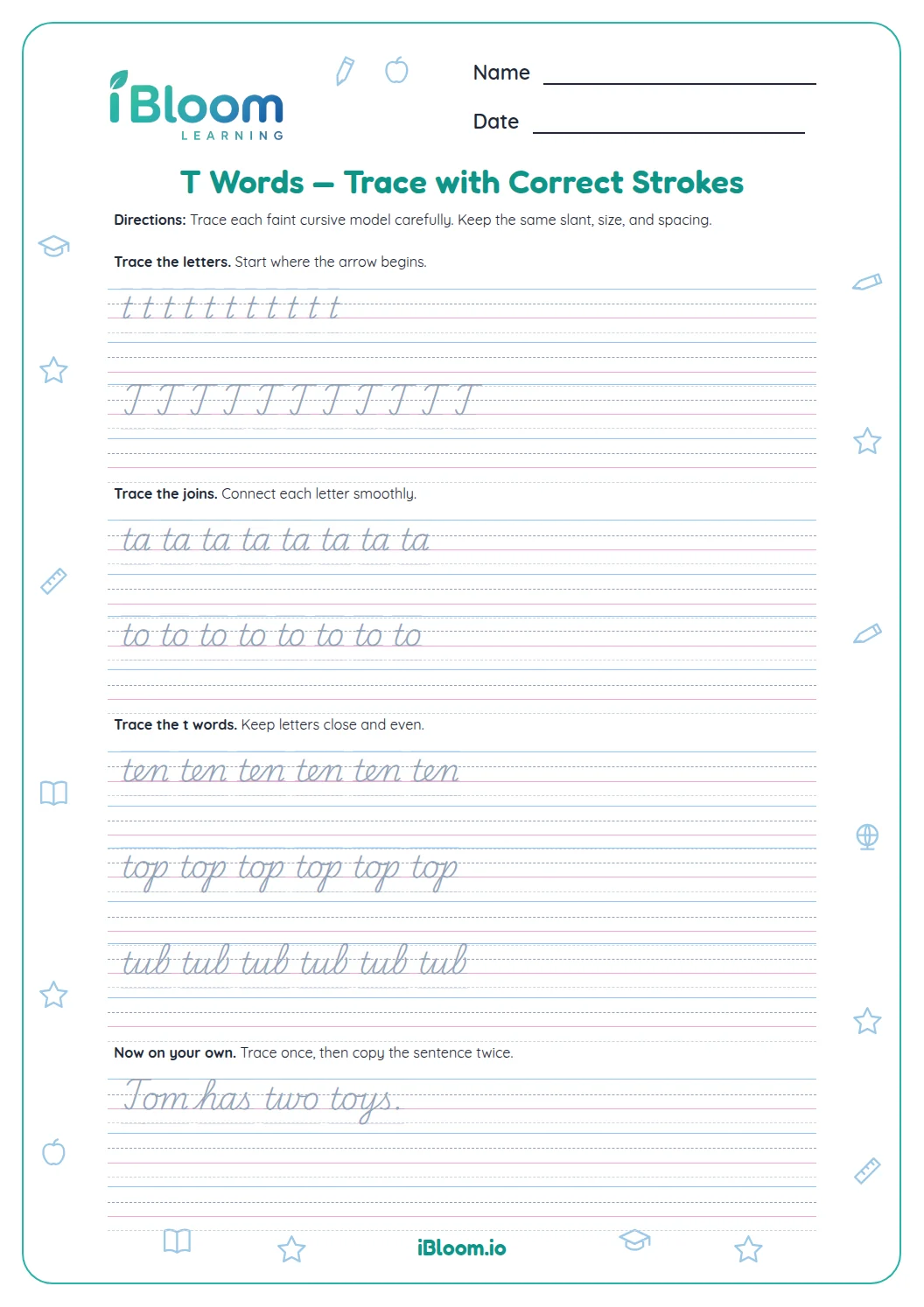
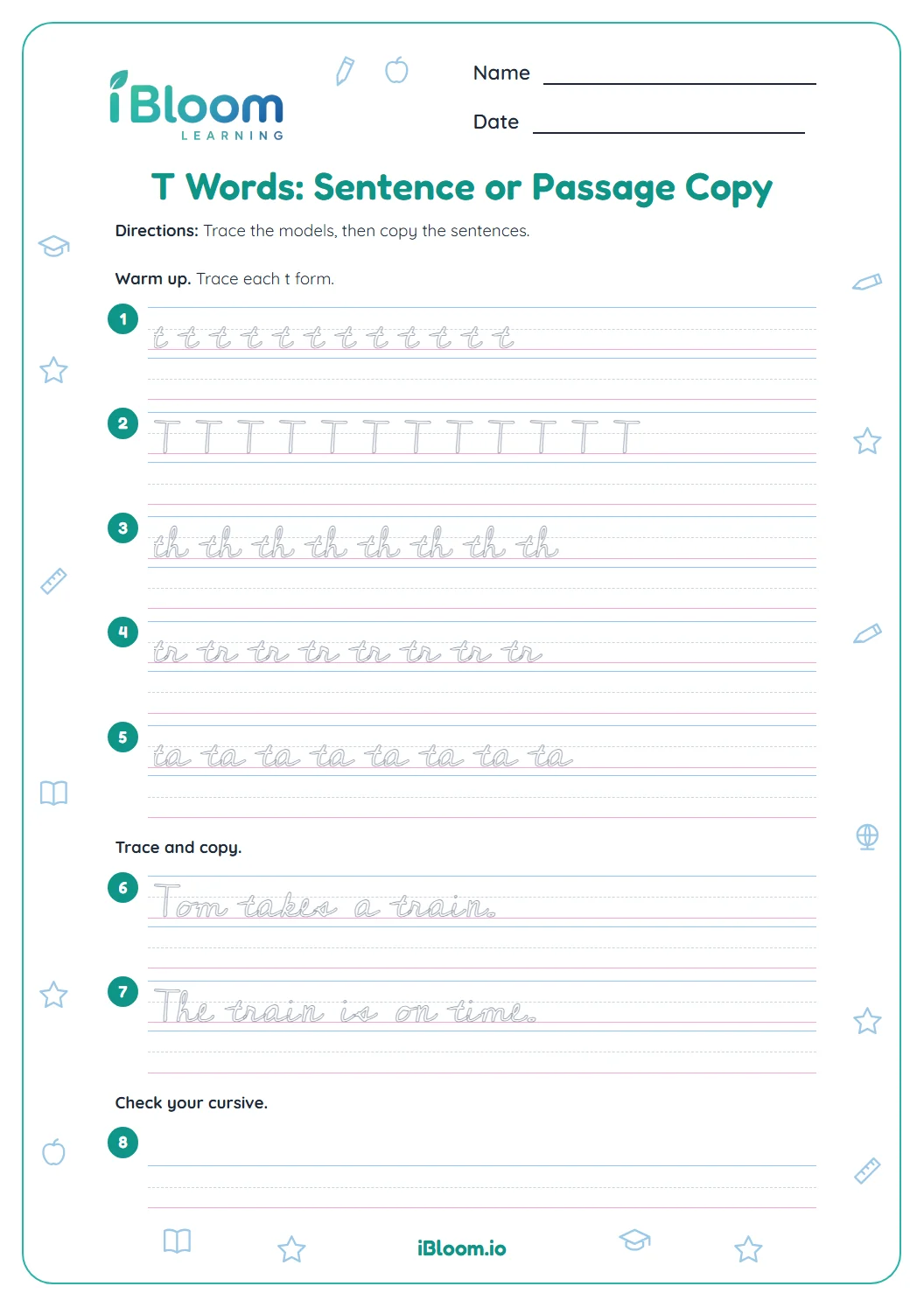
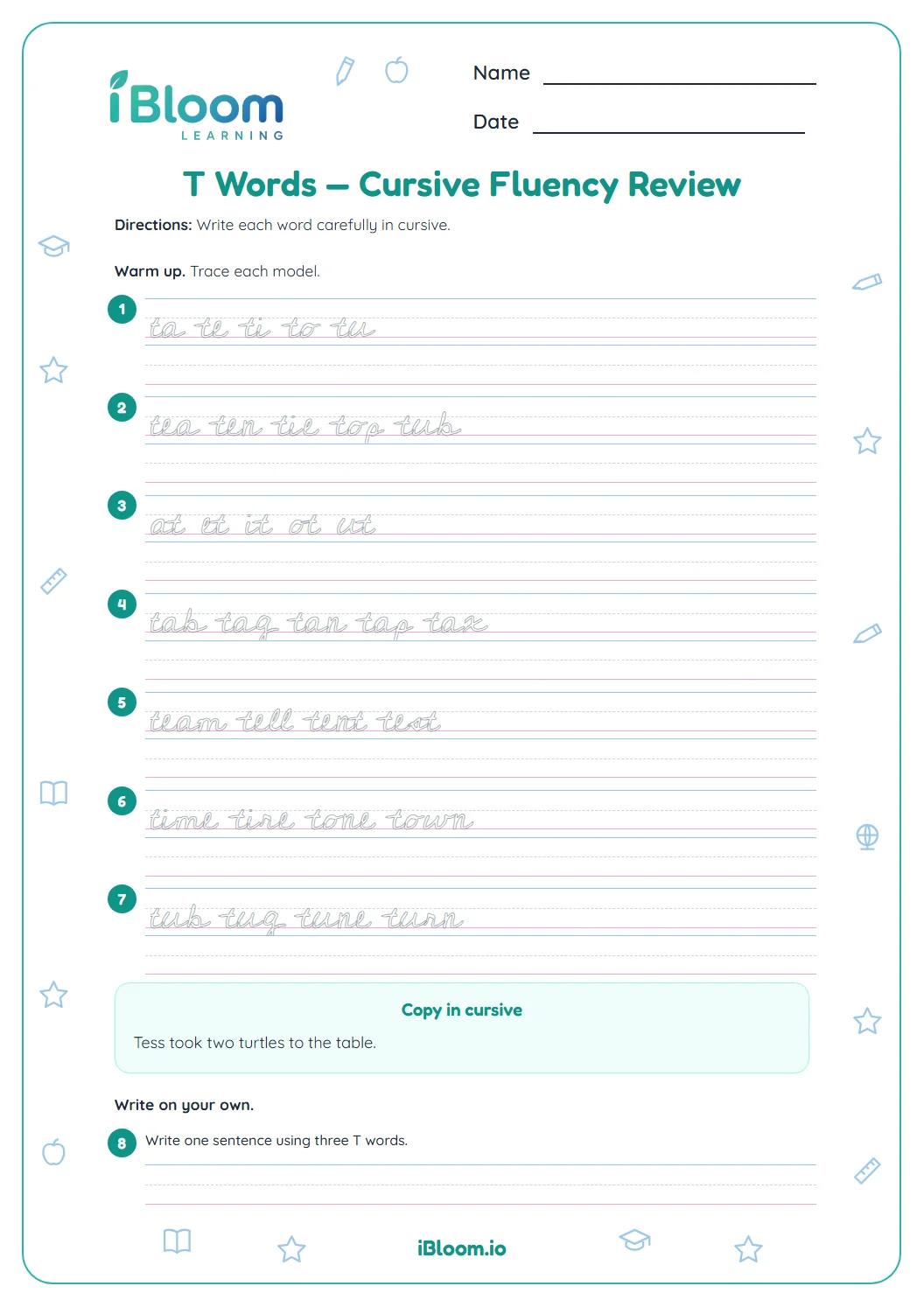
This cursive worksheet gives focused practice with words that begin with T. Learners trace familiar short words, move to longer words, and finish with two brief phrases to practice connected letter shapes, spacing, and steady pencil control.
What does this T-word page practice?
Learners trace and copy short words that begin with t, then move to longer words and two brief phrases. The repeated T start gives the hand practice with a capital or lowercase t as it appears in ordinary words.
The gray model and open copy row make the sequence visible: look closely, trace the connected letters, then write the same text again.
How the practice builds
Part A starts with familiar short words such as tree and train. Part B adds longer words with different joins. Part C asks learners to keep cursive flowing across a short phrase.
The page focuses on legible, connected handwriting rather than a spelling test. The answer key repeats each target so a learner can compare letter shapes and spacing.
How to use this worksheet
- 1Trace the gray model from left to right, following each connected letter.
- 2Copy the same word or phrase on the open ruled row beneath it.
- 3Compare the copy with the model for letter shape, spacing, and a steady baseline.
- 4Use the answer key to confirm the target text, then choose one word to practice again.
Cursive details to check
The mistake
Lifting the pencil between letters that should connect.
The fix
Follow the gray model’s joins and keep the letters flowing within each word.
The mistake
Leaving too little space between two words in a phrase.
The fix
Leave a clear word space while keeping letters inside each word connected.
The mistake
Letting letters drift above or below the writing line.
The fix
Use the ruled baseline as a guide and compare letter height with the model.
What to practice next
Make more practice
Questions parents and teachers ask
What does each cursive item ask the learner to do?
For each item, trace the gray cursive model and copy the same word or phrase on the ruled row. The model stays visible while the learner practices. This makes it possible to compare letter shape, joins, spacing, and size without turning the activity into a spelling test.
Are the words all T words?
Yes. Every word begins with t, and each phrase also starts with a T word. The list moves from short familiar words such as tree and train to longer choices such as thunder and teacher. That progression gives practice with both a capital T and lowercase t in connected writing.
How can an adult help without writing for the child?
Ask the learner to name the word, point to the gray model, and follow its joins with a finger before tracing. After the copy, compare the child’s spacing and letter shapes with the model. Praise one clear feature, such as a steady baseline or a smooth join.
Is this a spelling test?
No. The word stays printed as a model, so learners can focus on connected letter shapes and how each word sits on the lines. The answer key repeats the target text for checking; it does not score handwriting style.