



About this worksheet
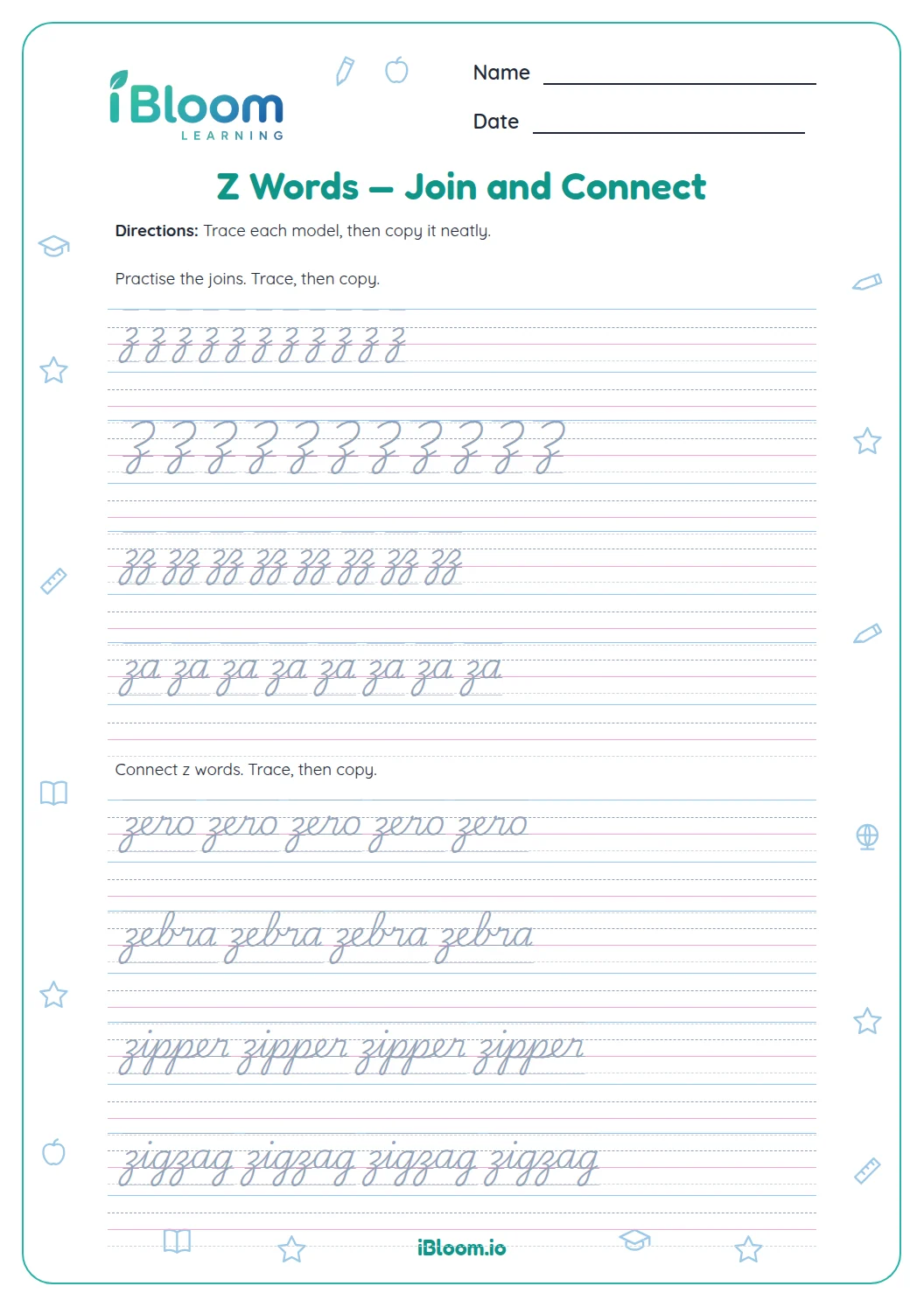
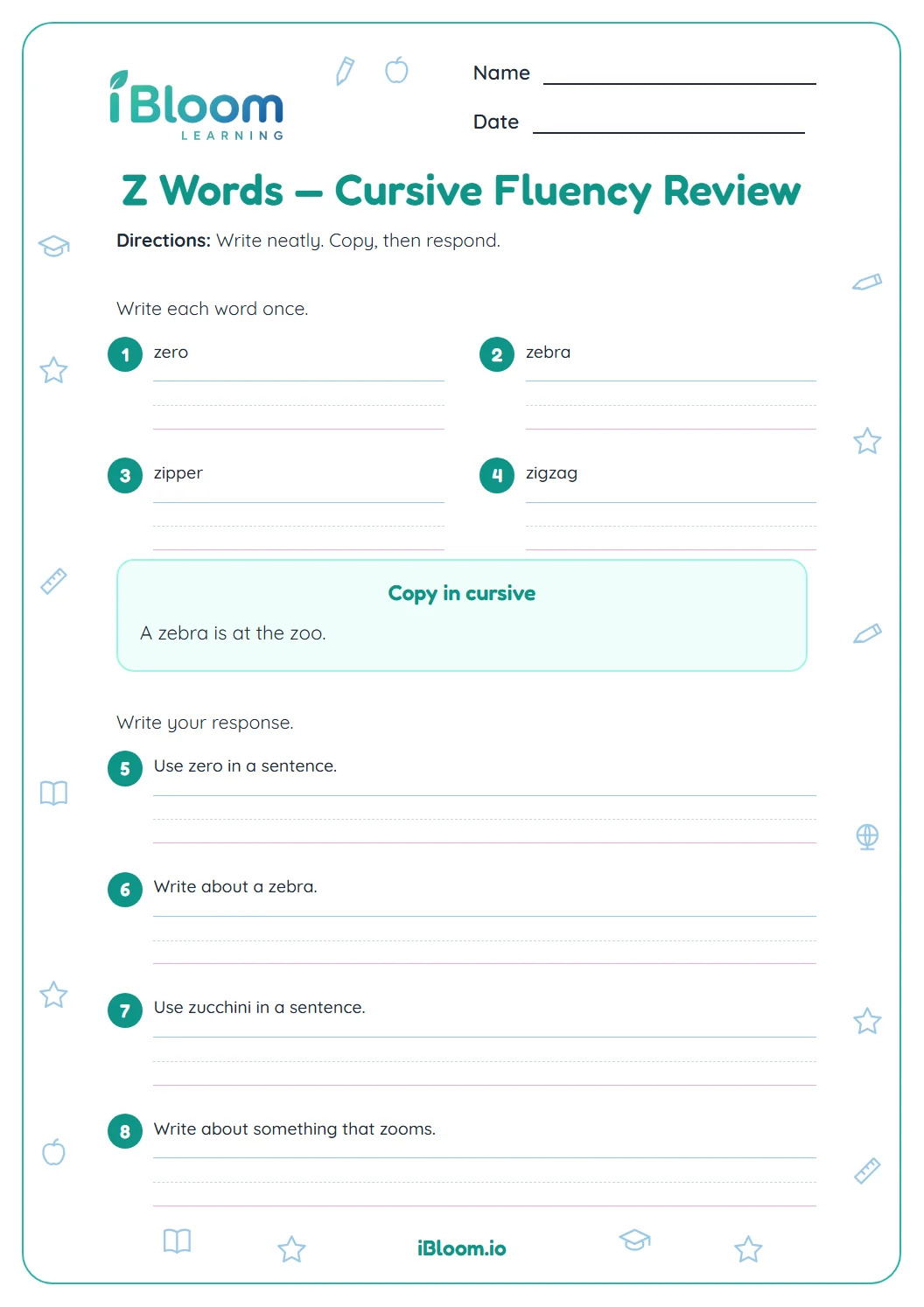
This free printable cursive worksheet gives children in Grades 2–5 five models to trace and copy on handwriting lines. Part A begins with lowercase z, capital Z and the joins za, ze, zi, zo and zu. Two word models then practice zero, zebra, zipper and zigzag, with repeats. Part B repeats “Zoe saw a zebra.” twice, bringing the letter shapes and joins into a sentence. An adult can demonstrate stroke direction before tracing begins. Each gray model has an empty copying row beneath it, and a separate model key helps children compare their letter shapes, connections and spacing.
Which letters and words will children trace?
The first model repeats z and Z twice each, then adds za, ze, zi, zo and zu. The next two models practice zero, zebra and zigzag twice each and zipper once. These words practice different joins and the second z in zigzag.
Part B prints “Zoe saw a zebra.” twice. Each numbered model has one gray tracing row and one empty copying row. The repeated sentence gives children a second attempt after checking their first copy.
How should an adult model the strokes?
Point to the beginning of lowercase z and demonstrate its path slowly, including the stroke below the baseline and the return into the next letter. Model capital Z separately before beginning the sentence.
Have the child trace the gray path before copying onto the empty row. For zipper, form the connected letters first and add the dot over i afterward.
- 1Trace zipper, following z into i.
- 2Trace zigzag twice, leaving spaces between words.
- 3Notice both z letters in zigzag.
- 4Copy all three words on the empty handwriting row.
What should children check in the sentence?
Check the capital Z in Zoe, the lowercase z in zebra and the spaces between all four words. Each sentence ends with a period. Compare one feature with the model before writing the sentence again.
Keep small letters at a consistent height and let descending strokes reach below the baseline. If a join is difficult, retrace that part of the gray model before copying the whole word again.
How to use this worksheet
- 1Read the four practice words and the sentence aloud.
- 2Demonstrate lowercase z and capital Z, then trace and copy the first model.
- 3Trace and copy each repeated word model, leaving spaces between words.
- 4Trace and copy the first sentence, checking capital Z and the final period.
- 5Use the second sentence model for another attempt, then compare both copies with the key.
Mistakes to check and how to fix them
The mistake
Using a print z with straight strokes in the copied words.
The fix
Trace the curved cursive model again, following its descending stroke into the next letter.
The mistake
Leaving a gap between z and the next letter in zero.
The fix
Follow the exit stroke into e while tracing, then repeat that connection in the copy.
The mistake
Starting Zoe with lowercase z or omitting the second z in zigzag.
The fix
Compare each word letter by letter with its model before tracing it again.
What to practice next
Make more practice
Questions parents and teachers ask
Which words and sentence are on the worksheet?
The word models are zero, zebra, zipper and zigzag, with repeated practice in two models. Before them, children practice z, Z and five joins: za, ze, zi, zo and zu. Part B repeats “Zoe saw a zebra.” twice, with a tracing row and an empty copying row for each model.
Are stroke arrows printed on the letters?
No, the sheet uses gray cursive models on handwriting lines. An adult should demonstrate the starting point and movement before the child traces. Begin with lowercase z and capital Z in the first model, then show how the exit stroke connects z to a following vowel.
Why practice both lowercase z and capital Z?
Both forms appear in the sentence “Zoe saw a zebra.” Capital Z starts the name Zoe, while lowercase z starts zebra. The first model gives a separate example of each form so children can compare their size and shape before using them in connected words.
Why is the same sentence printed twice?
The second sentence gives children another attempt after checking the first copy. Compare the capital Z, the join in zebra and the spaces between words. Choose one feature to improve, trace the second gray sentence, then copy it on the empty row and compare the two attempts.
How should we use the model answer key?
Use the key to compare letter order, cursive shapes, joins and word spacing. Handwriting will vary, so look for a recognizable Z or z and connected letters within each word. Check the four words in the sentence and its final period, then choose one feature to practice again.